IN BRIEF
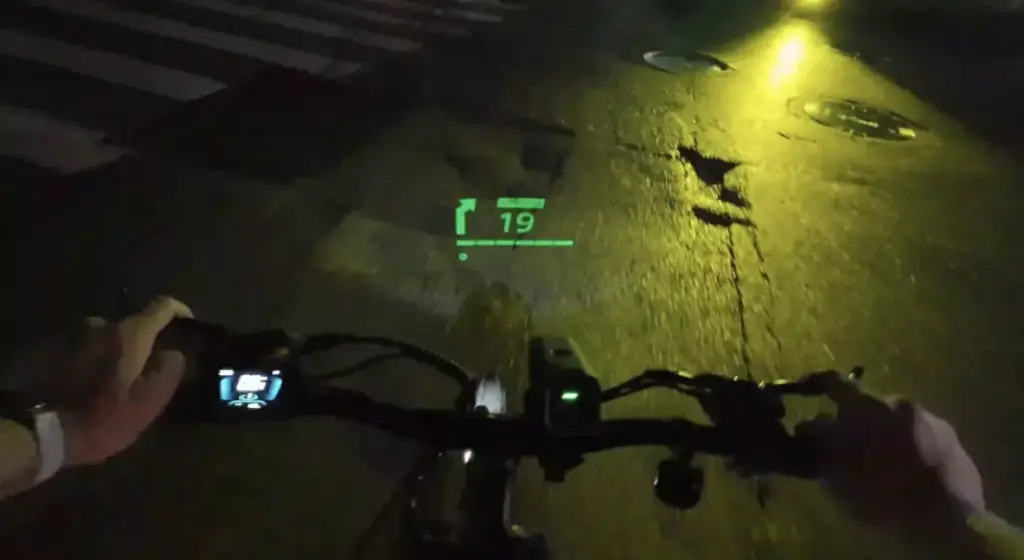
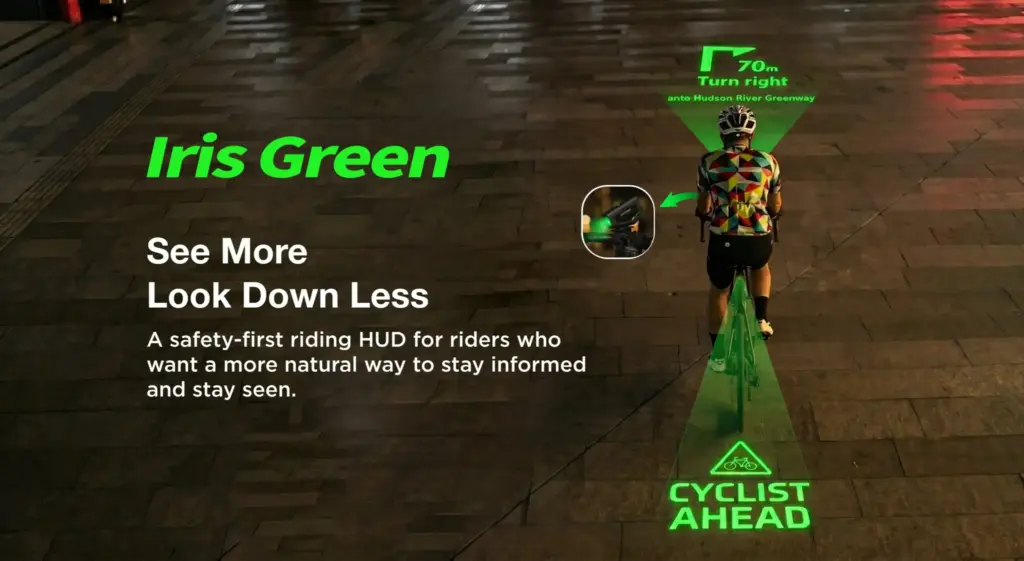
Startup Irisarworld is crowdfunding on Kickstarter: Iris Green, a tiny head-up display (HUD) that projects navigation and ride data into the cyclist’s field of vision using a MEMS laser. The campaign has already raised more than €126,868 (as of 2 June) against a €1,096 target, with 579 backers and a deadline set for 19 June 2026. Aerospace aluminium housing, IP67, OTA updates. Early bird price: $99 (approx. €91) — shipping costs calculated separately after the campaign.
| Technology | MEMS laser projection (LBS) |
| Protection rating | IP67 |
| Housing | Aerospace aluminium |
| Software updates | OTA (Over-The-Air) |
| Compatibility | City bikes, commuter, road, e-bikes |
| Early bird price | $99 (approx. €91) |
| Kickstarter target | 1 096 € |
| Amount raised | 126 868 € (x115) |
| Campaign ends | 19 June 2026 |
Glancing down at the handlebar to check speed, distance or the next turn — every cyclist does it dozens of times an hour. Iris Green starts from a different idea: projecting that information straight ahead, in the line of sight, rather than 80 centimetres below it.
A laser engine rather than another screen
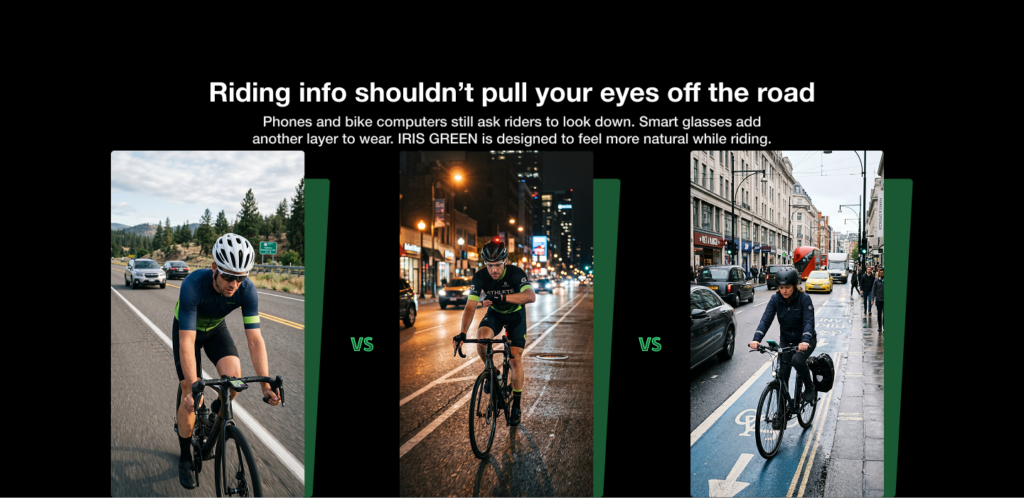
The device relies on LBS technology — laser beam scanning. A MEMS module (microelectromechanical system) steers a tiny laser beam to form an image without a conventional lens or manual focusing. The claimed result: a sharp, compact projection suited to reading on the move. The brand explicitly positions Iris Green as an alternative to handlebar computers, not as an accessory to stack on top of one.
Navigation, pace, night — a deliberately short selection
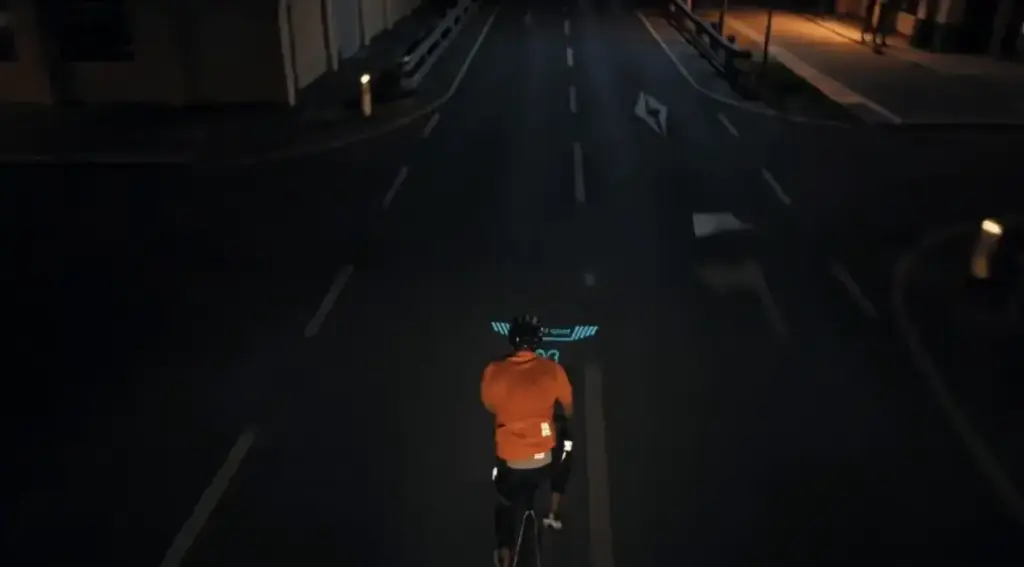
Iris Green displays navigation, speed and ride data. The brand stands by a short list: the best display is not the one that shows everything, it is the one that shows what matters at the right moment. An animations mode — triggered automatically by on-board algorithms — is also built in for certain riding situations.
The housing is made of aerospace aluminium, certified IP67 (immersion up to one metre). It is compatible with city bikes, road bikes and e-bikes — the brand is clearly targeting the commuter and everyday segment, not sport cycling alone. The companion app handles synchronisation and remote firmware updates (OTA), with no hardware to swap out.
When the campaign overshoots its target
The Kickstarter campaign opened with a deliberately low target (€1,096), a sign that the brand was looking to validate interest rather than fund production. At the time of writing, Iris Green shows €126,868 raised and 579 backers, with 17 days still to go. Funding overshot by that much reflects real market interest — but it does not guarantee delivery on schedule: on Kickstarter, hardware projects can run late. The early bird price is $99 (around €91); shipping will be calculated separately after the campaign depending on destination.
What the brand itself acknowledges as uncertain
Irisarworld sets out its own risks in the campaign. Regulations on laser projection vary from country to country: some road traffic rules in Germany and the United Kingdom specifically govern projection onto the road surface — local certifications are under way. Visibility in bright sunlight is still being optimised: the automatic brightness management algorithm is not yet finalised. Finally, MEMS optical components are specialised parts whose supply can be affected by disruptions to the global chain — the brand says it holds buffer stock and has stable relationships with its suppliers.