IN BRIEF
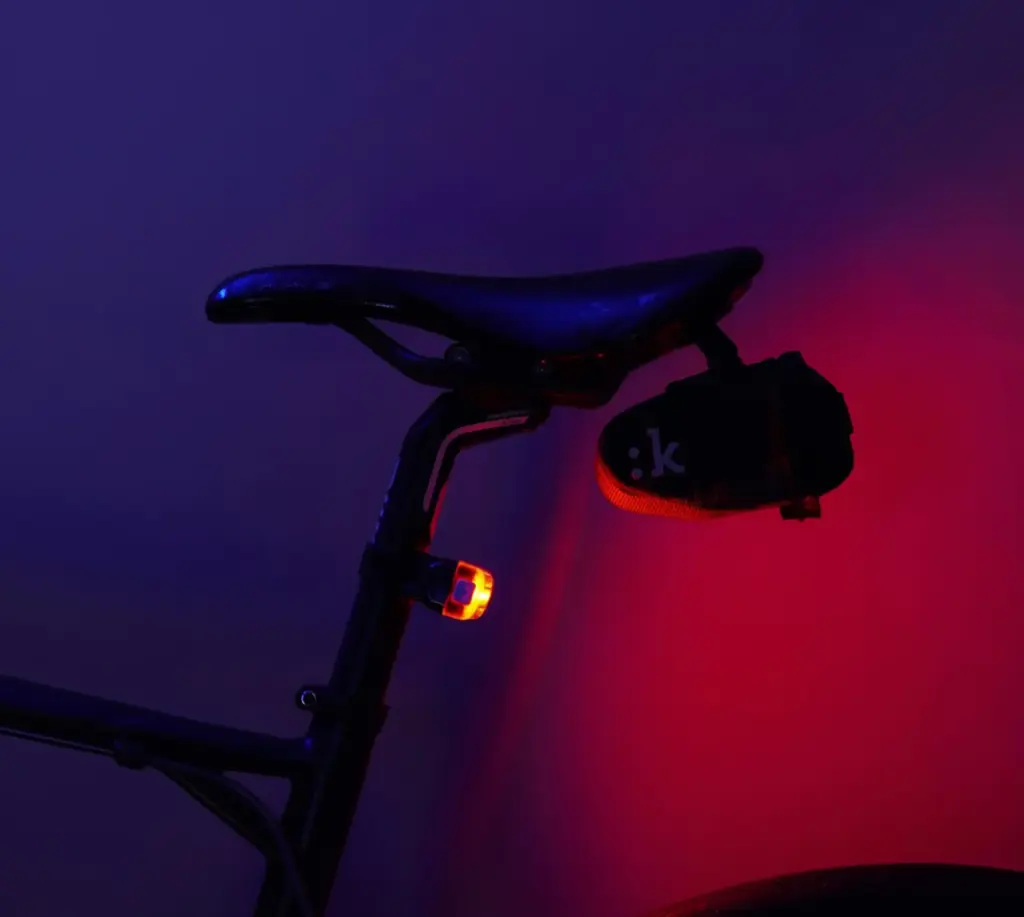
In case you missed it, decree no. 2024-1074 of 29 November 2024 bans flashing rear position lights on bicycles in France. Since then, only a steady light is allowed at the rear — the fine is 11 euros. The text was adopted without consulting cycling associations, triggering a petition calling for its repeal. Meanwhile, Germany has gone the other way: since June 2024, direction indicators (to signal a lane change) have been allowed on German bicycles for the first time.
France’s Barnier government signed decree no. 2024-1074 on 29 November 2024. A text that went almost unnoticed, yet one that changes a widespread habit among many cyclists: using a red rear light in flashing mode to be seen more easily. That is now banned.
What the law says
Paragraph V of article R313-5 of France’s Highway Code (code de la route) is now unambiguous.
“At night, or during the day when visibility is insufficient, every motorised personal mobility device or cycle must be fitted with a rear position light. This light must not be flashing and must be clearly visible from the rear when the vehicle is being ridden.”
Article R313-5 of the French Highway Code, as amended by decree no. 2024-1074 of 29 November 2024
The decree does bring one welcome clarification: it is now permitted to carry an additional light on your person — on a helmet, for example — to improve visibility. But that option remains conditional on a steady light being fitted to the bike. Wearing one on its own is not enough.
The situation for front lights is murkier. Article R313-25 of the Highway Code states that lights “may not be of variable intensity, except those of direction indicators”. A wording that appears to target flashing at the front as well — but without the same clarity as for rear lights. This legal grey area deserves to be settled.

A measure adopted without consultation
According to industry stakeholders, the decree was reportedly issued without consulting everyday cycling associations or the governing bodies of competitive cycling. That criticism — not officially confirmed — went down all the worse because the cyclists concerned have a solid safety argument to make.
Outside built-up areas, on secondary roads, in poor visibility, the flashing rear light was popular for its ability to catch drivers’ attention from a greater distance. Research confirms that apparent brightness is more pronounced with an intermittent signal than with a steady light — particularly at low flashing frequencies, according to the work of Christophe Martinsons, a specialist in the effects of temporal modulation of light. Martinsons does add a caveat: these results would need further investigation in the specific case of red lights for bicycles.
Supporters of the decree put forward other arguments: red flashing can be confused with other road signals, it makes distances harder to judge and it can dazzle drivers in the dark. Points that are open to debate — but which lawmakers evidently did not put to those most directly concerned.
A petition, and silent federations
On 27 December 2024, Samuel Barone, a member of the Grand Est Cyclisme community, launched a petition on the official platform of the French National Assembly, entitled: “Flashing bike lights banned: cyclists in danger, let’s repeal this decree!”
“Depriving cyclists of this life-saving piece of equipment amounts to sacrificing their safety on the altar of regulation disconnected from realities on the ground.”
Samuel Barone, author of the petition
In early January 2025, when the first articles on the subject appeared, the petition had gathered 6,300 signatures — far short of the 100,000 needed for it to be examined by the National Assembly. But its potential remained intact, provided the major cycling federations got behind it. That has not happened yet: the sport’s representative bodies have remained silent, taking no public position for or against the decree.
Some cyclists openly say they will carry on using their lights in flashing mode outside built-up areas, even at the risk of the 11-euro fine. A symbolic amount — enough for many to put the rule into perspective.
Germany goes the other way
The contrast with neighbouring Germany is striking. On 19 June 2024 — five months before the French decree — Germany amended its highway code to allow direction indicators on bicycles for the first time. These amber devices, modelled on those used on cars and motorbikes, make it possible to signal a lane change without taking a hand off the handlebars.
The distinction matters: direction indicators and flashing position lights are two different things. The former signal an intention to manoeuvre; the latter seek to make the cyclist visible in traffic. Germany allows the one, France bans the other. Both countries are responding to safety concerns — but they rank them differently.
In France, the question of direction indicators on bicycles remains a legal vacuum. The November 2024 decree does not mention them. Their status has not been settled.
What it changes in practice
Most lights sold in France today come with both a steady mode and a flashing mode. Compliance therefore poses no hardware problem: simply changing the setting is enough. The market has not yet moved to drop flashing modes — commercially promoted as a visibility selling point, they remain present on almost every model on the shelves.
Lionel Simonot, a lighting expert and specialist writer, suggests an alternative: rather than banning flashing, lawmakers could have set minimum photometric performance requirements for lights — pushing cyclists towards more effective devices, rather than towards more restrictive practices. The debate remains open. The petition, meanwhile, is still online.