IN BRIEF
A year after its inauguration, the J&G production site in Tianjin — the product of a joint venture between Joykie and Golden Wheel — is running at full capacity. The 100,000 m² factory builds bikes in every category, from children’s models to UCI-certified carbon frames. It handles carbon fabric manufacturing, painting and quality control on site, in a production flow modelled on the Toyota Production System.
The J&G (Tianjin) Technology Co. factory opened its doors on 9 May 2025, in the Ninghe district of Tianjin. A year later, Cycling Industry News toured the whole site. What can be seen there says a great deal about the state of global bicycle manufacturing.
From Toray fibre to boxed bike, everything under one roof
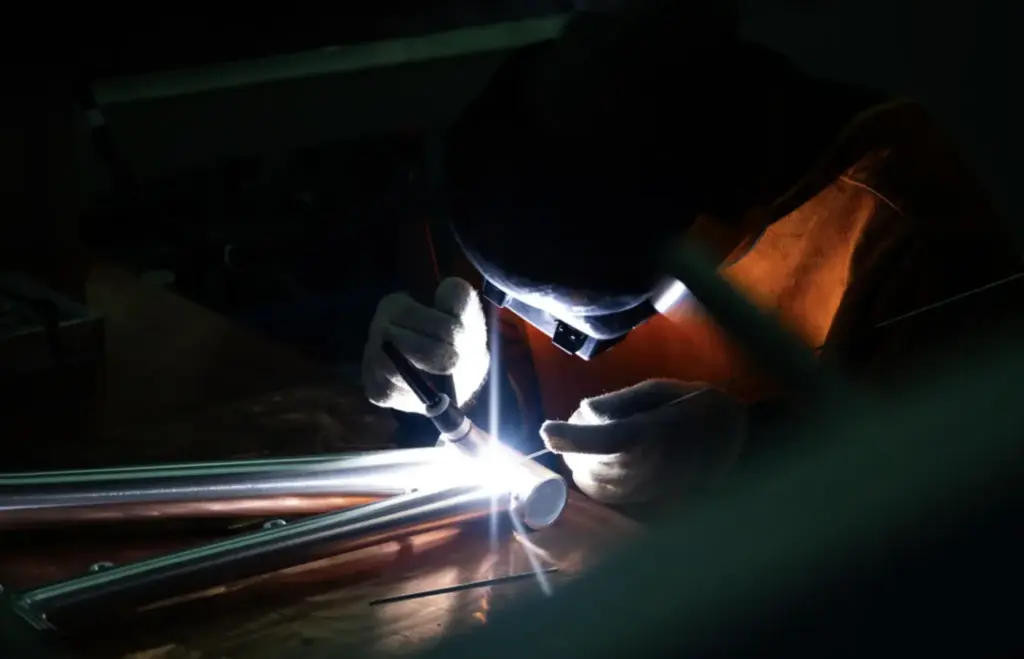
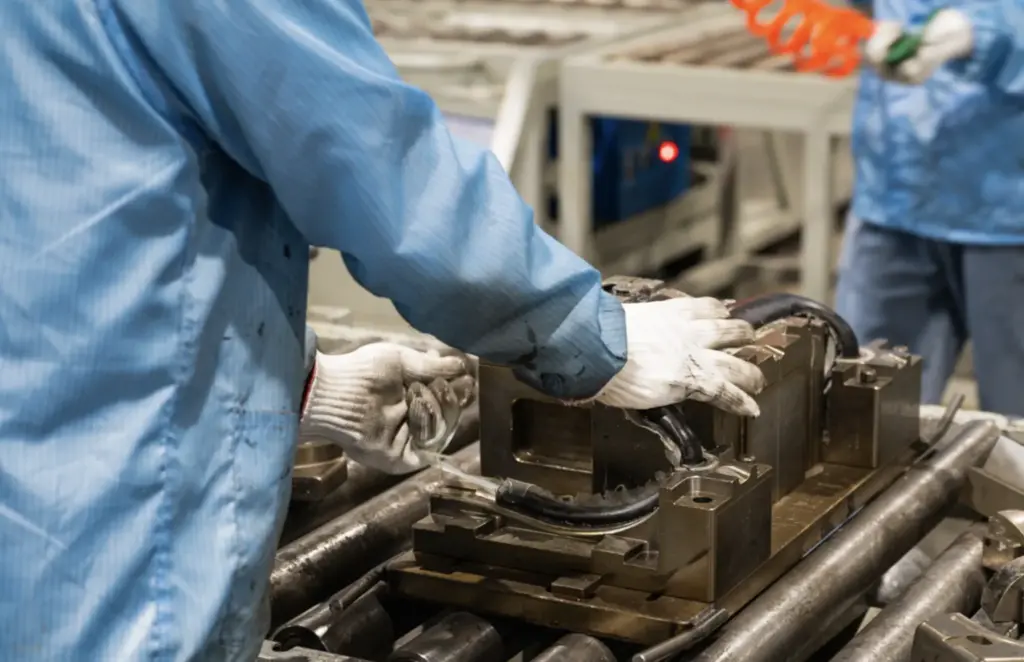
The most striking feature of the J&G factory is not its size — 100,000 m² is substantial, but not unique in the industry — it is its degree of vertical integration. Reels of raw Toray carbon come in at one end. At the other, UCI-certified carbon frames come out, ready to be built up. In between: automated looms weaving the carbon fabric on site, robotic welding stations, a water-based paint booth (solvent-free), and an in-house moulding shop for tooling.
That degree of integration cuts transport times between subcontractors, reduces the risk of supply breaks and makes it possible to control quality at every stage. It is what the car industry has been doing for decades — the high-end bike industry is getting there gradually, and this site is one of its most complete examples.
Toyota Production System and RFID traceability
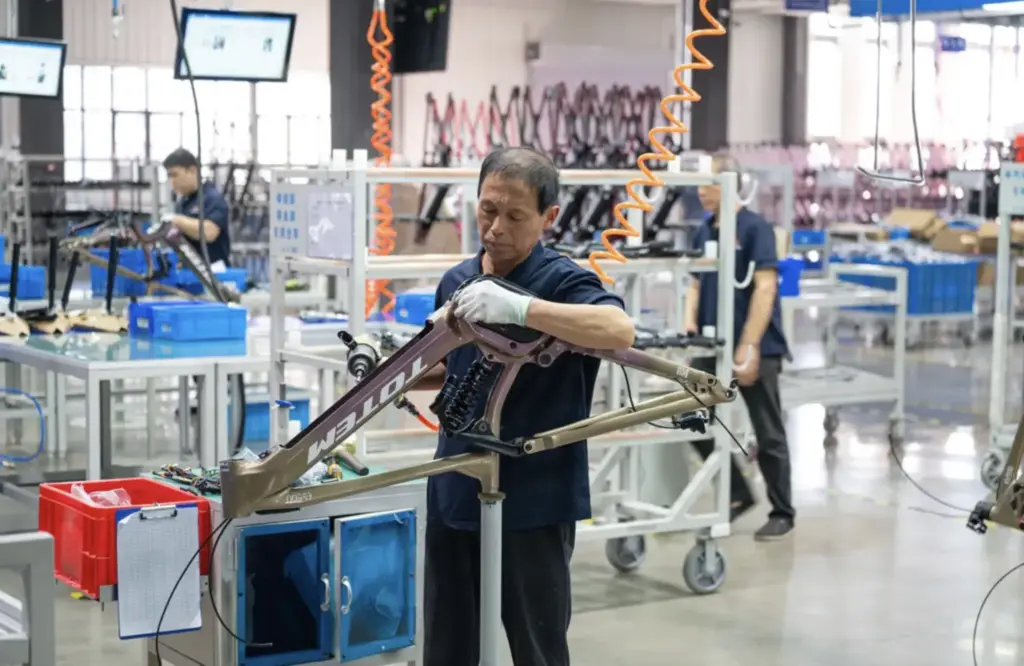
Production is organised along the lines of the Toyota Production System: just-in-time flow, mixed workstations (robots and human operators alternating), reduced intermediate stock. Every bike or component is tracked by an RFID chip throughout its manufacture, interfaced with in-house ERP software. The aim is to reduce assembly errors and shorten the time between order and shipping.
The factory produces under several brands — Joykie, Totem, Uplands, Amslod, sold under the “Bike Work” banner — and for worldwide export, with Europe as the priority market according to Joykie.
The question left hanging
The Cycling Industry News report does not mention production volumes — either deliberately or because the factory does not disclose them. In the bike industry, large Chinese factories regularly build for European and American brands without the end buyers knowing it. If J&G supplies unnamed OEM brands, the real production figures would be far higher than those of its house brands alone.
A factory of this kind shifts the competitiveness question: it is no longer only a matter of labour costs, but of technological integration and logistics. China continues to consolidate its position in high-end bike manufacturing, well beyond entry-level segments.