IN BRIEF
Researchers from Queen Mary University of London and Homerton University Hospital reviewed three years of emergency department visits at a hospital in north-east London. Of 5,529 cycling-related attendances, 564 involved an electric bike. Compared with riders of conventional bikes, e-bike riders faced a 41% higher risk of head or neck injury, and a 33% higher risk of lower-limb injury; their risk of upper-limb injury, however, was 36% lower. The authors point to alcohol and lower helmet use. Adam Tranter, former walking and cycling commissioner for the West Midlands, cautions nonetheless that hospitals file illegally derestricted machines under the “e-bike” label.
The study is titled “Trauma Visits Relating to E-Bikes and Non-E-Bikes at a London University Hospital Emergency Department Between 2022 and 2025: A Retrospective Cohort Study” and appears in the Journal of Emergency Medicine. It covers cycling-related emergency department visits between September 2022 and August 2025, and compares the injuries of e-bike riders with those of riders on conventional bikes.
What the study measures about e-bike injuries
“Conducted by researchers from Queen Mary University of London and Homerton University Hospital, the study examined cycling-related visits to the emergency department of a hospital in northeast London between September 2022 and August 2025” road.cc reports. Of the 5,529 attendances recorded, 564 — close to 10% — were classed as involving an electric bike.
The comparison between the two groups yields three gaps. “Compared to “conventional” bike injuries, ‘e-bike’ riders were 41 per cent more likely to suffer a head or neck injury and 33 per cent more likely to sustain a lower limb injury. However, they were 36 per cent less likely to experience damage to their upper limbs.” road.cc details. These are relative risk gaps recorded in a single emergency department: the study describes an association, it does not establish that electric assistance is in itself the cause of the injuries.
Alcohol and helmets, the two factors highlighted
The authors link these crashes to two behaviours. According to the study abstract, alcohol was involved in 8.0% of e-bike cases, against 3.0% of non-e-bike cases. And “Where documented, 81 per cent of ‘e-bike’ riders were also reported to not be wearing helmets at the time of their crash”. Three percent of those injured on an electric bike — seventeen people — required surgery.
“These accidents were frequently associated with alcohol use and a lower reported use of helmets than in non-e-bike accidents and potentially resulted in more significant injuries,” the researchers write, as quoted by road.cc. Adam Stoneham, a trauma surgeon at Homerton University Hospital, puts the finding in context: “E-bikes have been a total gamechanger; they make cycling much more accessible to people of all health and ages and they greatly increase the distance you can commute. But of course this comes at a cost.” He added: “London infrastructure is not set up to deal with the volume of bikes we are currently seeing”
The caveat: what the word “e-bike” covers
This is the main limitation raised since publication. Adam Tranter, former walking and cycling commissioner for the West Midlands, warns: “The bigger issue is that hospitals and emergency services often use ‘e-bike’ as a catch-all term, including illegally modified machines that are electric motorbikes in law.” In other words, some of the casualties counted in the “electric bike” column were not riding a compliant pedal-assist bicycle.
The work also documents the growing share of electric bikes in London emergency departments: according to the abstract published by the publisher, the proportion of e-bike-related visits rose “from 3.8% in year 1 to 16.0% in year 3”. Adam Tranter puts that increase in perspective: “It is unremarkable that e-bike injuries appear to have risen as a share of cycling injuries, given how e-bike use has grown in the capital,” he tells road.cc.
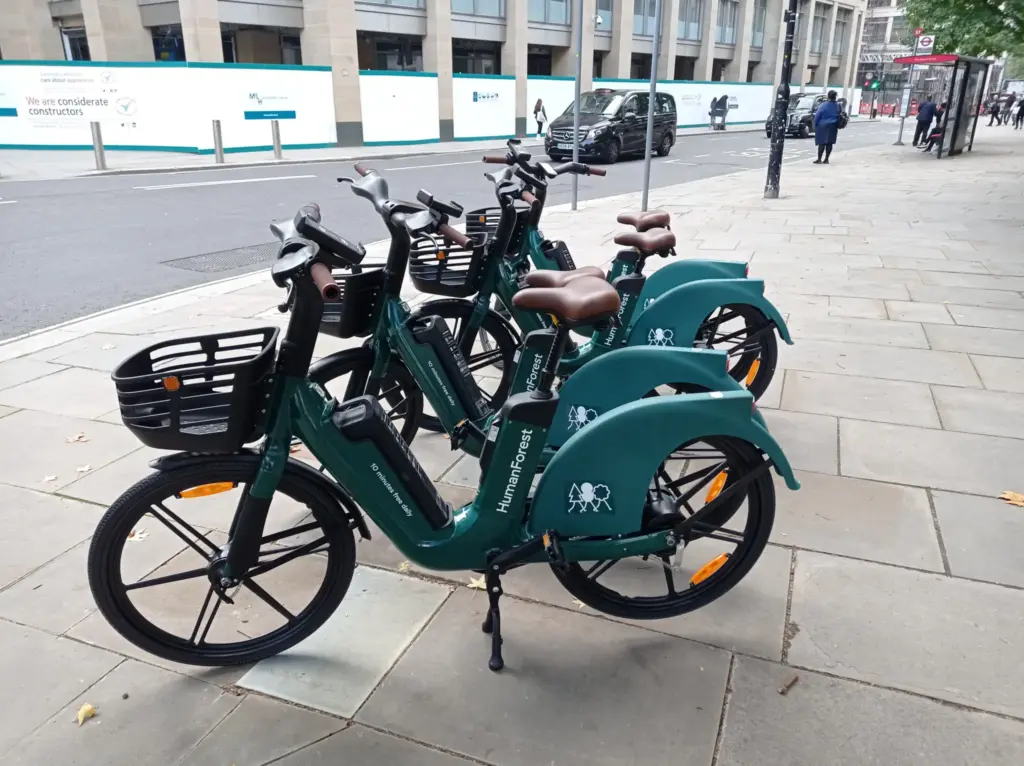
Lead photo: Human Forest bikes in London — Philafrenzy / Wikimedia Commons (CC BY-SA 4.0).