IN BRIEF
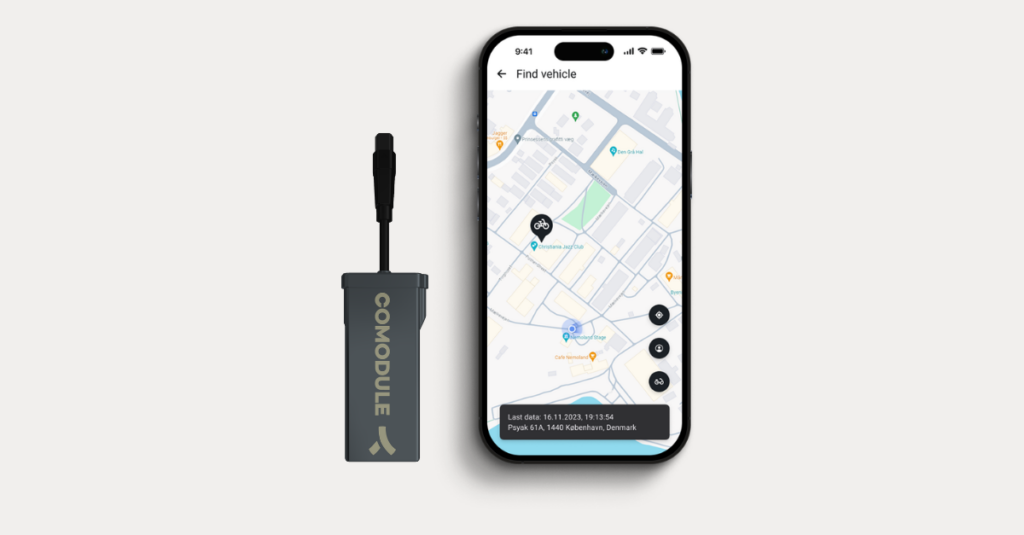
Comodule, the Estonian company that lists Riese & Müller, Gazelle and Urban Arrow on its site among the brands « connected by Comodule », unveiled a new unit called Astra on 1 September. The brand describes it as a next-generation connectivity solution and highlights two figures: up to twelve months of standby battery life, and location tracking claimed to be accurate to within 2.5 m thanks to Wifi-Locate positioning, meant to take over where standard GNSS struggles — in dense cities and indoors. The module runs on Cat-1bis and is intended to work with most drive systems. Pre-orders are open, and production is due to ramp up in 2027. No price is given in the announcement.
| Product | Comodule Astra, IoT module for electric bikes |
| Claimed battery life | Up to 12 months in standby |
| Claimed location accuracy | Up to 2.5 m, via Wifi-Locate positioning |
| Network | Cat-1bis cellular |
| Claimed compatibility | Most drive systems, from basic tracking to full drive-system integration |
| Software | Comodule’s ready-made app, or the customer’s own branded app |
| Availability | Pre-orders open, production ramping up in 2027 |
Theft remains the black spot of the electric bike, and for a few years now the industry has answered with the same reflex: slip a connected unit into the frame, then sell the subscription that goes with it. Those units have one flaw: they drain the very battery they are supposed to protect. That is one of the two arguments in the Astra announcement, published by Comodule on 1 September.
The Comodule Astra IoT module banks on long standby
The first argument fits in one line on the official page: « Up to 12 months of battery life in idle », that is, up to twelve months of battery life at rest. Comodule adds that its low power draw makes it possible to « keep an e-bike running up to 6 times longer than the current market average ». The brand draws a specific use case from it: a bike can spend the winter in the garage, or sit between two rentals, with anti-theft protection still active.
That factor of 6 is a manufacturer’s claim, resting on a « market average » that the announcement does not detail. As it stands, it therefore cannot be verified.

Location by Wi-Fi rather than GPS
The other argument, the one the announcement puts first, is more technical. According to the announcement, Astra « locates a vehicle with up to 2.5 m accuracy thanks to Wifi-Locate positioning ». The reasoning is spelled out: « You’ll get reliable location data even in dense urban areas and indoors, exactly where standard GNSS can struggle. »
This is the classic problem with bike GPS trackers: they work well in open countryside, and far less so in an underground car park or a narrow street lined with buildings — that is, at the exact spot where bikes disappear. Relying on the mapping of surrounding Wi-Fi networks rather than on satellites is a familiar answer in mobile phones; Comodule is claiming it here for the bike.
On the network side, the module « runs on Cat-1bis cellular technology », which the brand presents as « a future-proof standard delivering faster response times and more reliable connectivity across all environments ».
A unit aimed at manufacturers, not at consumers
Astra is not sold to the cyclist: it is aimed at manufacturers and fleet operators. The announcement claims compatibility « with most drive systems », from basic tracking through to full drive-system integration, the argument being that it lets a whole range standardise on a single IoT solution. On the software side, the manufacturer can « opt for Comodule’s ready-made app or connect their own branded app ».
On its commercial positioning, the company sums up its intent this way: « With Astra, we’re making advanced connectivity accessible to more e-bike brands without compromising on quality. Pre-orders are now open, with production ramping up in 2027. » The announcement includes no price.