IN BRIEF
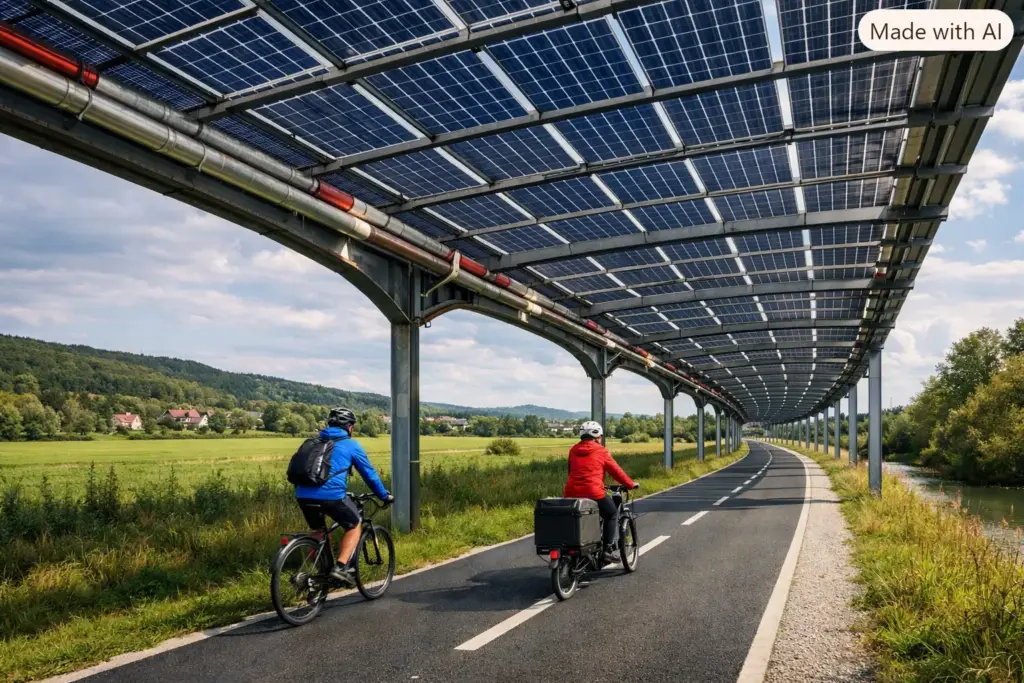
A concept for a cycle path roofed with solar panels was presented on 24 August in Erfurt, at the second Thuringian mobility conference. Per kilometre, the costing sets out around 9,000 m² of productive surface and a peak output of 1.71 MWp, for an investment estimated at €4.76 million — and more than €20 million in revenue over forty years of operation, electricity and heat combined. A 400-metre test section is proposed at Bad Blankenburg, monitored independently as a real-world laboratory. The canopy is also meant to provide shelter from rain, cut winter snow clearing and carry the lighting.
| Presented | 24 August 2026, 2nd Thuringian mobility conference, Erfurt |
| Active surface | around 9,000 m² per kilometre |
| Peak output | around 1.71 MWp per kilometre |
| Investment | around €4.76 million per kilometre |
| Projected revenue | more than €20 million per kilometre over 40 years (electricity and heat) |
| Pilot section | 400 metres at Bad Blankenburg (Thuringia) |
| Authors of the costing | Manfred Josef Hampel (Institut für Nachhaltigkeit) and Hannes Neupert (ADFC Thuringia) |
| Framework | Interreg CleanMobilEnergy project, first presented in December 2023 |
What if a cycle path, instead of costing money, brought some in? The question was put on 24 August in Erfurt, figures in hand, to the second Thuringian mobility conference. The answer lies in a roof of solar panels above the cycle lane.
A solar cycle path that produces both electricity and heat
German trade magazine RadMarkt reports that “at the 2nd Thuringian mobility conference, on 24 August 2026 in Erfurt, a concept for cycle paths roofed with solar panels was presented”. The principle the magazine describes is contained in the word it uses, “solarüberdachte”: cycle paths roofed with solar, with a photovoltaic canopy built above the path.
The sizing is precise. “For one kilometre of solar cycle path, the concept provides for around 9,000 m² of energy-active surface, a peak electrical output of around 1.71 MWp, as well as the additional use of the heat produced”, RadMarkt writes. It is that last point which sets the project apart: according to the concept, the heat produced can be fed directly into a nearby network.
€4.76 million per kilometre, €20 million in revenue over forty years
The economic costing is the heart of the presentation. “The investment costs per kilometre of solar cycle path amount to around €4.76 million. Over 40 years of operation, the revenue from the sale of electricity and heat can reach more than €20 million per kilometre”, RadMarkt reports. On paper, that is a ratio of more than four to one.
These calculations, the magazine specifies, were drawn up by Manfred Josef Hampel, of the Institut für Nachhaltigkeit, and Hannes Neupert, of ADFC Thuringia — the German cyclists’ federation —, as part of the European Interreg CleanMobilEnergy project, and presented for the first time in December 2023, then reworked within the Thuringian mobility network, the magazine specifies.
A roof that also serves the rider
The benefit claimed is also the user’s, and that is what makes the project interesting from handlebar height. According to RadMarkt, “the canopy fitted with solar modules protects from sun and precipitation, can ensure that no snow clearing has to be carried out in winter, and allows integrated lighting adapted to needs”. Three arguments that count for a lot on a winter commute.
Ernst Brust, a sworn micromobility expert quoted by the magazine, sums up what is at stake this way — our translation from the German: “The solar cycle path is more than a cycle path with photovoltaics. Here, mobility, energy production and weather protection can be combined into a new infrastructure for bikes, pedelecs and cargo bikes. But the essential thing is that road safety and profitability are demonstrated in practice.”
400 metres to find out
It remains to be shown that the picture holds outside the spreadsheet. RadMarkt and the ADFC Thuringia press release point to the same unknowns to be measured on site: energy yield, profitability, winter operation and road safety. That is the purpose of the pilot section: “A 400-metre-long section at Bad Blankenburg serves as a first test route, as an independently monitored real-world laboratory”, writes Hannes Neupert, chair of ADFC Thuringia’s technical group and co-author of the costing, in a press release circulated by the German site VeloTOTAL. The choice of site is no accident — “the route of the cycle path is already concretely planned and a heat network is in the immediate vicinity”, the same release states, which makes it possible to test heat recovery without building a network specially.
RadMarkt’s report and the ADFC Thuringia press release are both silent on the works schedule and on the funding of this section. At this stage, Thuringia’s solar cycle path remains a costed concept coupled with a pilot project.