IN BRIEF
London’s cycle network has just passed the 450 km mark, Transport for London has announced. That is five times more than in 2016, when it stood at just 90. According to TfL’s press release, the network is now longer than the entire London Underground and exceeds the distance between London and Paris. The threshold was reached thanks to a series of sections delivered in recent months: around 4 km in Islington, 2.5 km in Camden between Camden Town and King’s Cross, 1.6 km in Wandsworth, a 500 m extension in Kingston and the completion of Cycleway 62 on Lambeth Bridge. Two more routes are under construction and due to be finished by the end of the year: according to TfL, one of them will be the borough of Harrow’s first Cycleway.
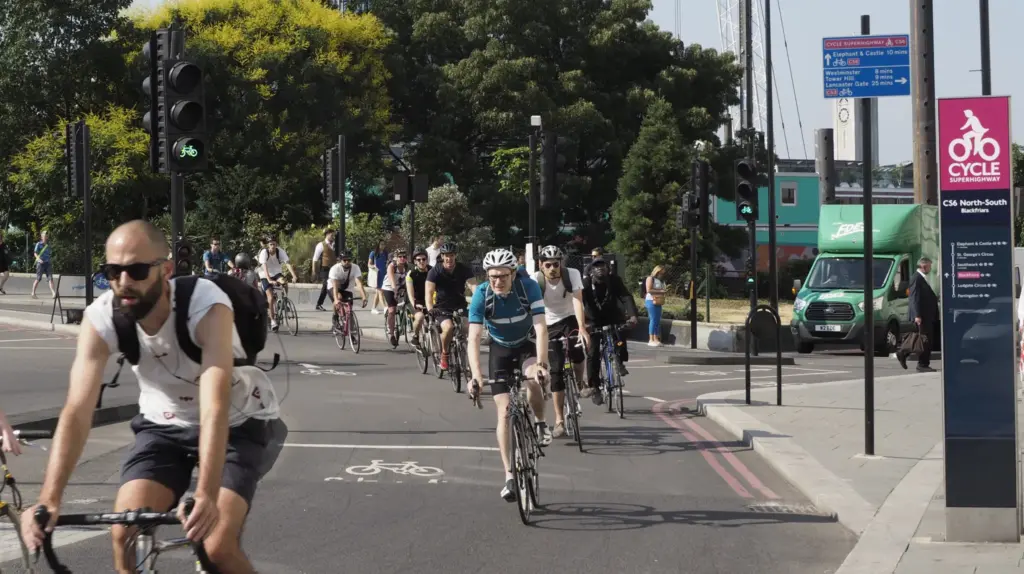
Four hundred and fifty kilometres. The figure, announced on 12 August by Transport for London, says less than the comparison it invites: the British capital’s cycle network is now longer than the whole of the London Underground, and it exceeds the distance between London and Paris. Ten years ago, it ran to 90.
London’s cycle network has grown fivefold in ten years
That is 400% growth over the decade: 90 km in 2016, 450 today. In other words, most of today’s London network has been built in the past ten years — on the scale of a capital city, the Cycleways are still young infrastructure.
TfL points out that cycling itself has followed. Data published last year reported an estimated 43% rise in cycle journeys since 2016, and 1.5 million daily journeys over the year 2025. Those are the figures the authority is putting forward, not 2026 data.
“A quality cycle network benefits everyone, whether or not you choose to cycle, by helping to reduce traffic, improve the local environment and support healthier neighbourhoods,” sums up Helen Cansick, Head of Healthy Streets and Investment at TfL.
The kilometres that tipped the counter over
The 450 km threshold was passed thanks to a series of sections delivered in several boroughs and, on Lambeth Bridge, by TfL itself. Around 4 km of new Cycleway have been delivered in Islington, extending the C23 and C20 routes across the borough. In Camden, 2.5 km better connect Camden Town to King’s Cross. In Wandsworth, 1.6 km link Wandsworth Common to Clapham Common.
Add a 0.5 km extension of Cycleway 29 in Kingston, with segregated lanes on a key south-west London corridor between Tolworth and Surbiton, and you have most of the metres gained. Two more visible projects complete the list. According to TfL, the completion of Cycleway 62 on Lambeth Bridge improves the link between north and south London and creates a new “Safer Junction” in the capital, a junction made safer under TfL’s programme of the same name; the press release also notes the opening of the first section of Cycleway 43, between Hyde Park and Edgware Road, in Westminster.
Harrow and Paddington before the end of the year
Two schemes are under way and due to be completed by the end of the year. According to the press release, the first will be the borough of Harrow’s first Cycleway: 4.5 km between Harrow and Pinner, combining quietened side streets with short stretches of segregated lanes on the main roads. The second is a 0.7 km extension of Cycleway 3, along Westbourne Terrace, near Paddington station, in Westminster.
That mix — a few hundred metres here, four kilometres there — is the hallmark of a network built borough by borough, in partnership with local authorities. “450 km of cycleways is an important milestone in our mission to create an integrated cycle network that connects people to the places they want to go,” says Helen Cansick. “This milestone reflects years of strong partnership with London’s boroughs to deliver safer and more accessible cycling infrastructure.”
London’s mayor, Sadiq Khan, for his part draws a political conclusion from it: “I’m proud to have overseen a dramatic expansion of London’s cycle network, making it easier and safer for Londoners to choose cycling for their everyday journeys. I said I would make London synonymous with cycling — promise made, promise delivered.”
Cover photo: Tilia44 / Wikimedia Commons, CC BY-SA 4.0.