IN BRIEF
The 2026 Tour de France sets off from Barcelona on Saturday 4 July and finishes in Paris on 26 July, after 3,333 km and 54,450 m of climbing. The race opens with a team time trial — the first since 1971 — with a brand-new rule: every rider is given his own time. The route strings together five mountain ranges, eight mountain stages and five summit finishes, two of them at Alpe d’Huez on consecutive days, something never done before. On the final day the peloton returns to Paris over the Montmartre hill, climbed three times. Tadej Pogačar, the defending champion, and Jonas Vingegaard are the men to beat.
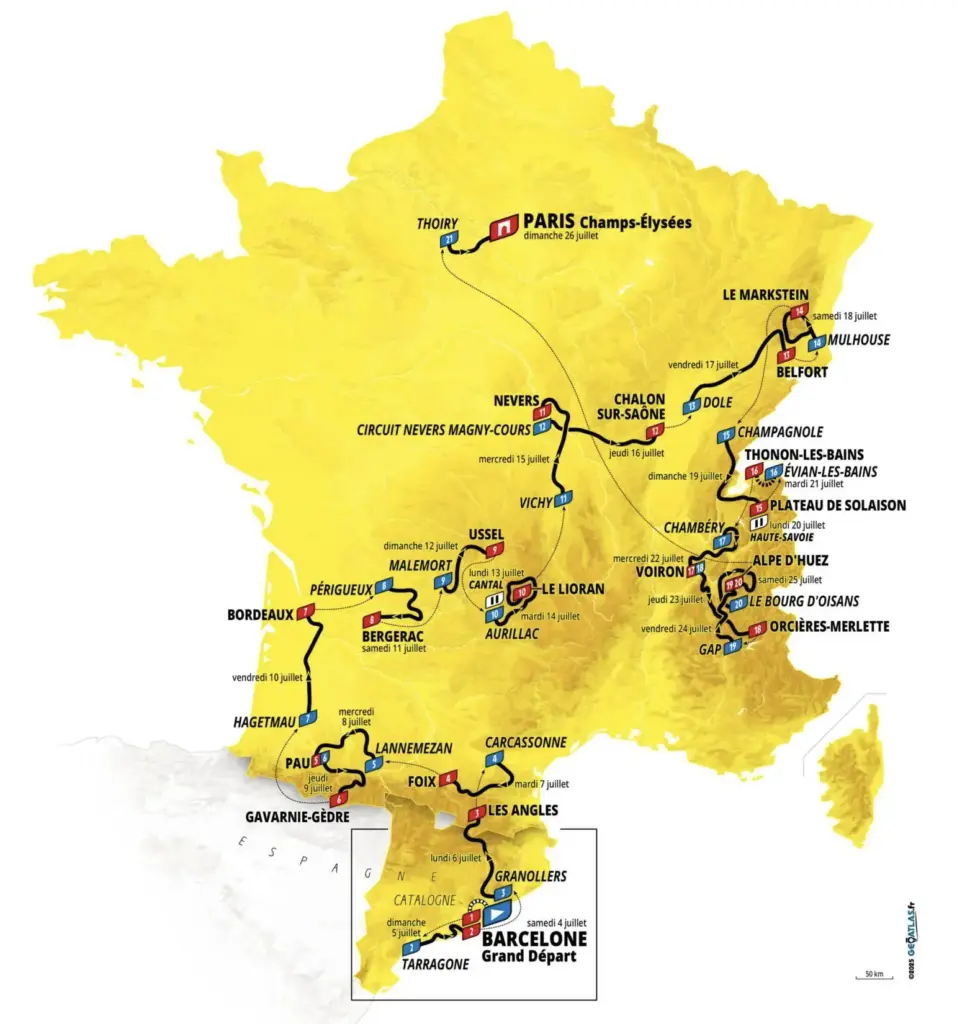
The 2026 Tour de France starts from Barcelona this Saturday 4 July, further south than any Grand Départ in the race’s history. Twenty-one stages later, on 26 July, the finish will be settled in Paris. In between, the organisers have drawn a route that upsets the usual pattern: a team time trial to open, a single individual time trial placed very late, and two back-to-back finishes on Alpe d’Huez.
A Catalan Grand Départ and a reinvented team time trial
This is the third time the Tour has started from Spain, and the first from Barcelona. The city becomes the southernmost starting point in the event’s history. The opening three stages are raced in Catalonia before the race crosses into France: the third goes over the Pyrénées-Orientales to reach Les Angles.
The opening itself breaks with habit. Stage one is a 19.6 km team time trial through the streets of Barcelona, finishing on the slopes of Montjuïc. It is the first team time trial on the Tour programme since 1971. More to the point, it changes in nature: instead of giving the whole team the same time, the 2026 rules give each rider his actual time. That turns an exercise in collective coordination into a long lead-out in which every rider is racing for his own place on general classification.
The hardest opening week in recent memory
Once past Catalonia, the peloton works its way north in stages, crossing the Pyrenees, the Massif Central, the Vosges, the Jura and the Alps in turn. That step-by-step progression avoids settling everything at once and lets fatigue build over three weeks.
The mountains come early. As soon as stage six, the finish is at altitude in Gavarnie-Gèdre, in the heart of the Pyrenees. Next come the Plateau de Solaison — new to the Tour — on stage fifteen, then Orcières-Merlette on stage eighteen, ahead of the Alpine centrepiece.
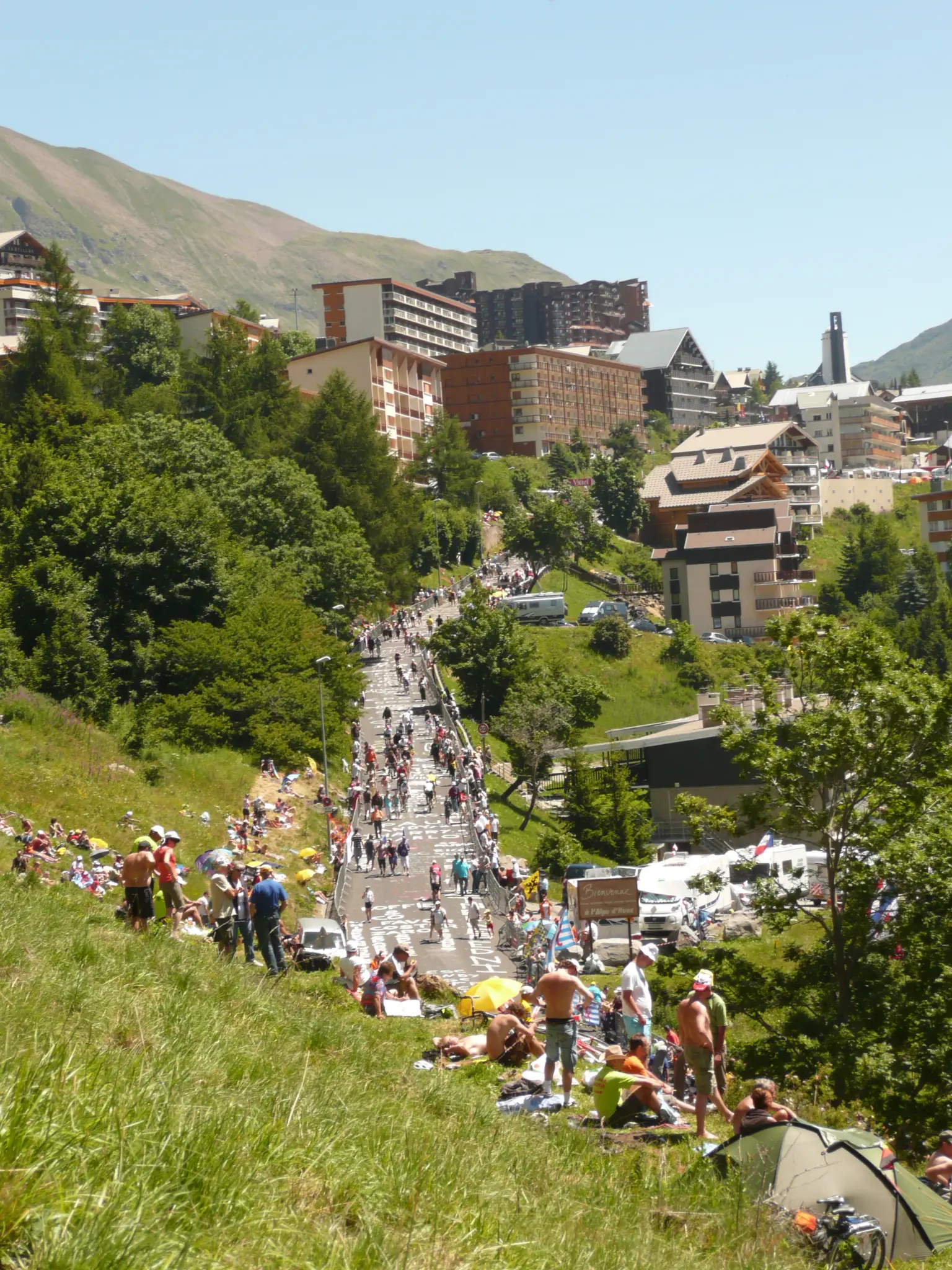
Alpe d’Huez twice over, never seen in 113 editions
The Tour has already finished at Alpe d’Huez around thirty times, but never on two consecutive days. In 2026, stages nineteen and twenty both end there.
The first, a short one (127.9 km), attacks the Alpe after the Col Bayard, the Col du Noyer and the Col d’Ornon; the final climb is 13.8 km at an average of 8.1%. The second is the queen stage, with around 5,600 m of climbing: Col de la Croix de Fer, Col du Télégraphe, Col du Galibier, then the Col de Sarenne before one last haul up to the 21 hairpins. Two ascents of the same giant within twenty-four hours: the idea had never been tried in 113 editions.
A single individual time trial, and sprints that matter again
Unusually, the 2026 Tour has only one individual time trial, and it comes late: 26.1 km between Évian and Thonon-les-Bains on stage sixteen, in the middle of the third week. Enough to keep the general classification open until the Alps.
Another change, a quieter one: several intermediate sprints per stage are back, for the first time since 2010. Points will no longer be settled in a single bunch finish, which should liven up the flat stages and reopen the fight for the green jersey.
Paris over the Montmartre hill, closer to the finish
The final stage leaves Thoiry for 133 km to the Champs-Élysées. As in 2025, it takes in the Côte de la Butte Montmartre, a 1.1 km cobbled ramp averaging 5.9%, climbed three times.
The difference is where it sits: the last time over the top comes 10.3 km from the line, closer to the finish than last year. Last year it was on those cobbles that Wout van Aert dropped Tadej Pogačar to take the win. Reason enough to hope for a less predictable ending than a straight sprint on the Champs.
All 21 stages, day by day
| Stage | Date | Route | Distance | Type |
|---|---|---|---|---|
| 1 | Sat 4 July | Barcelona to Barcelona | 19.6 km | Team time trial |
| 2 | Sun 5 July | Tarragona to Barcelona | 168.5 km | Hilly |
| 3 | Mon 6 July | Granollers to Les Angles | 195.9 km | Mountain |
| 4 | Tue 7 July | Carcassonne to Foix | 181.9 km | Hilly |
| 5 | Wed 8 July | Lannemezan to Pau | 158.3 km | Flat |
| 6 | Thu 9 July | Pau to Gavarnie-Gèdre | 186.2 km | Mountain |
| 7 | Fri 10 July | Hagetmau to Bordeaux | 175.1 km | Flat |
| 8 | Sat 11 July | Périgueux to Bergerac | 180.4 km | Flat |
| 9 | Sun 12 July | Malemort to Ussel | 185.5 km | Hilly |
| — | Mon 13 July | Rest day (Cantal) | — | Rest |
| 10 | Tue 14 July | Aurillac to Le Lioran | 166.6 km | Mountain |
| 11 | Wed 15 July | Vichy to Nevers | 161.3 km | Flat |
| 12 | Thu 16 July | Nevers Magny-Cours to Chalon-sur-Saône | 179.1 km | Flat |
| 13 | Fri 17 July | Dole to Belfort | 205.8 km | Hilly |
| 14 | Sat 18 July | Mulhouse to Le Markstein | 155.3 km | Mountain |
| 15 | Sun 19 July | Champagnole to Plateau de Solaison | 183.9 km | Mountain |
| — | Mon 20 July | Rest day (Haute-Savoie) | — | Rest |
| 16 | Tue 21 July | Évian to Thonon-les-Bains | 26.1 km | Individual time trial |
| 17 | Wed 22 July | Chambéry to Voiron | 174.7 km | Flat |
| 18 | Thu 23 July | Voiron to Orcières-Merlette | 185.2 km | Mountain |
| 19 | Fri 24 July | Gap to Alpe d’Huez | 127.9 km | Mountain |
| 20 | Sat 25 July | Bourg-d’Oisans to Alpe d’Huez | 170.9 km | Mountain (queen stage) |
| 21 | Sun 26 July | Thoiry to Paris (Champs-Élysées) | 133 km | Flat |
Pogačar and Vingegaard, the duel everyone expects
As in previous years, the fight for overall victory narrows down to two men. Tadej Pogačar, the defending champion and already a four-time winner, is chasing a fifth Tour. Jonas Vingegaard remains his main rival. It remains to be seen whether the hilliest route in recent years reshuffles the pack or confirms the pecking order.