IN BRIEF
Two companies are working in parallel to bring the airbag into professional cycling. Van Rysel (Decathlon) has unveiled Project AIRBAG, a racing skinsuit with a fully integrated airbag developed with specialist In&motion: deployment in 60 ms, AI trained on 450 million kilometres of data, total weight around 700 g. Meanwhile, Belgian startup Aerobag has just raised funds from Fundracer — the fund founded by Gérard Vroomen (co-founder of Cervélo) — with deliveries to pro teams announced from Q2 of 2026. Both approaches start from the same observation: according to Van Rysel, around 20% of WorldTour riders suffer a fracture each season.
Van Rysel puts forward a figure of 1,300 fractures in professional competition over the past six years, with injury rates climbing year after year as speeds increase. Jocelyn Bar, product manager at Van Rysel, refuses to accept that figure as inevitable: “Behind every race number, there is a human being. What helmets represented 20 years ago, we believe AIRBAG can represent today.”
Within a few months, two very different companies have staked out the same bet: adapting airbag technology to cycling. One is a major brand, the other a startup. Their approaches look nothing alike, but their diagnosis is identical.
Van Rysel: a skinsuit designed with the airbag, not around it
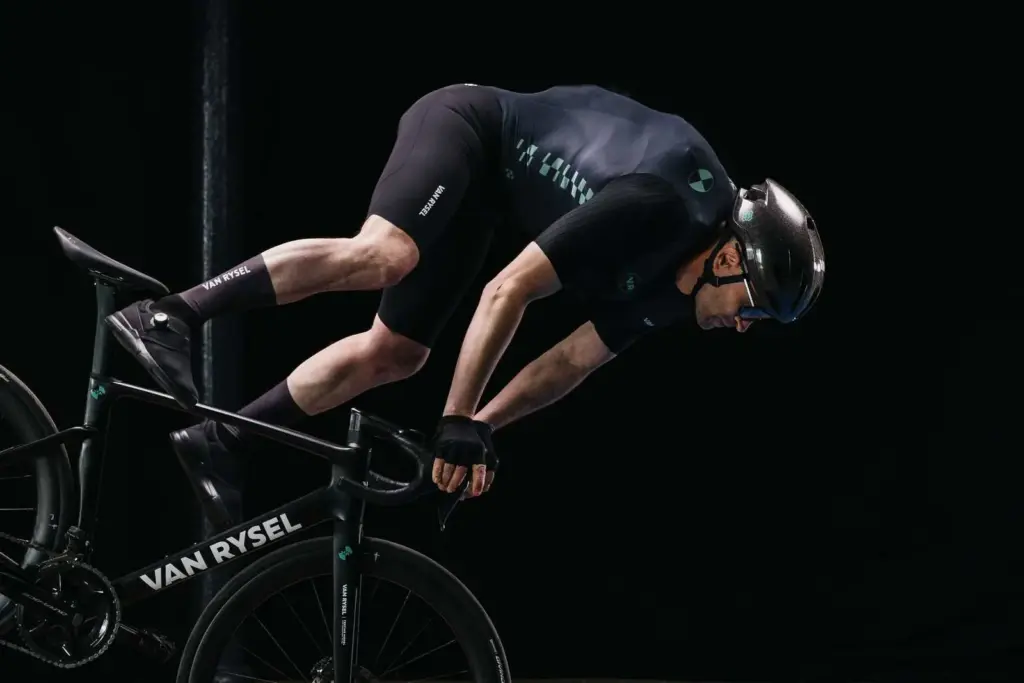
Van Rysel’s Project AIRBAG is not a protective vest you pull on over your kit. It is a complete racing suit — a skinsuit — whose airbag has been an integral part of it since the very first seam. Decathlon’s bike brand has teamed up with In&motion, whose technology has equipped MotoGP riders since 2016, and with the aerodynamicists at Swiss Side to co-develop the whole package.
With or without the airbag, the rider has to feel exactly the same thing. That guided every single decision — aerodynamics, thermoregulation, weight, absolutely everything.
Maxime Dezoomer, engineer at Decathlon
The stated weight is around 700 grams in total, of which 500 grams for the airbag component alone. By way of comparison, equivalent MotoGP systems reach around one kilogram for the airbag alone. The suit also builds abrasion-resistant materials into the typical impact zones, to limit road rash and skin injuries as a complement.
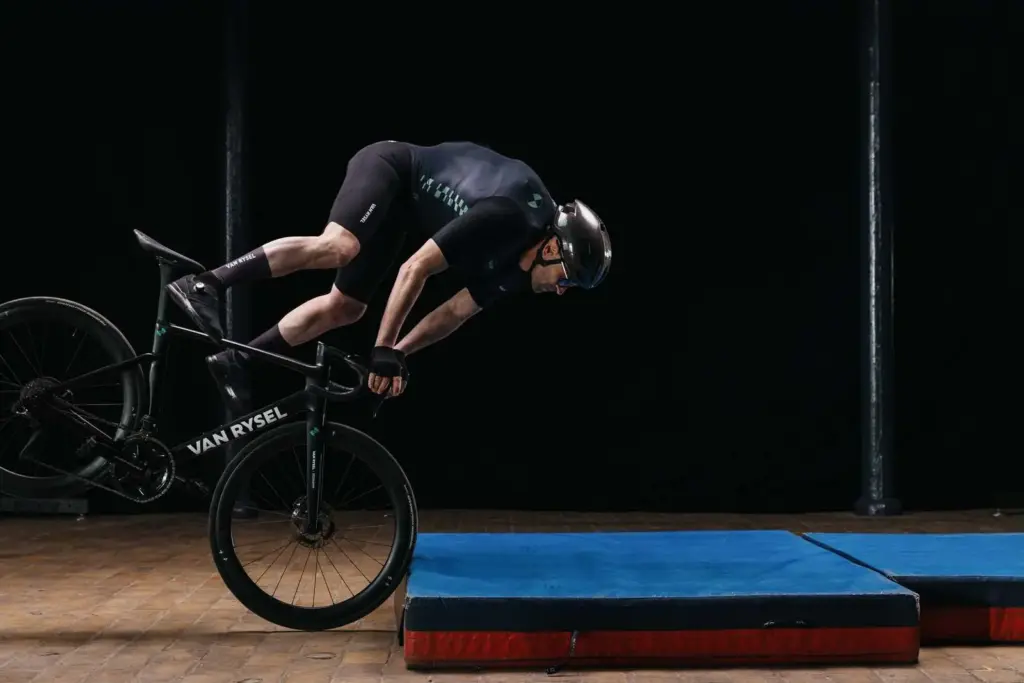
60 milliseconds, 450 million kilometres of data
The challenge common to both approaches is detection: emergency braking or dropping off the edge of the road must not trigger the airbag; a genuine crash must trigger it before impact. The In&motion system built into the Van Rysel skinsuit analyses the rider’s dynamics 1,000 times per second, drawing on algorithms trained on 450 million kilometres of data from MotoGP and skiing. Deployment in 60 milliseconds.
With AIRBAG, we are bringing that intelligence to cycling for the first time, enabling ultra-fast and highly reliable detection, tailored to the unique dynamics of road racing.
Rémi Thomas, CEO of In&motion
The three protected zones were defined from biomechanical analyses and epidemiological studies of cycling accidents: the thorax and rib cage, the cervical area to prevent hyperextension of the neck, and the entire spine. The suit is currently in final validation with professional riders from the Decathlon CMA CGM and Van Rysel Roubaix teams.
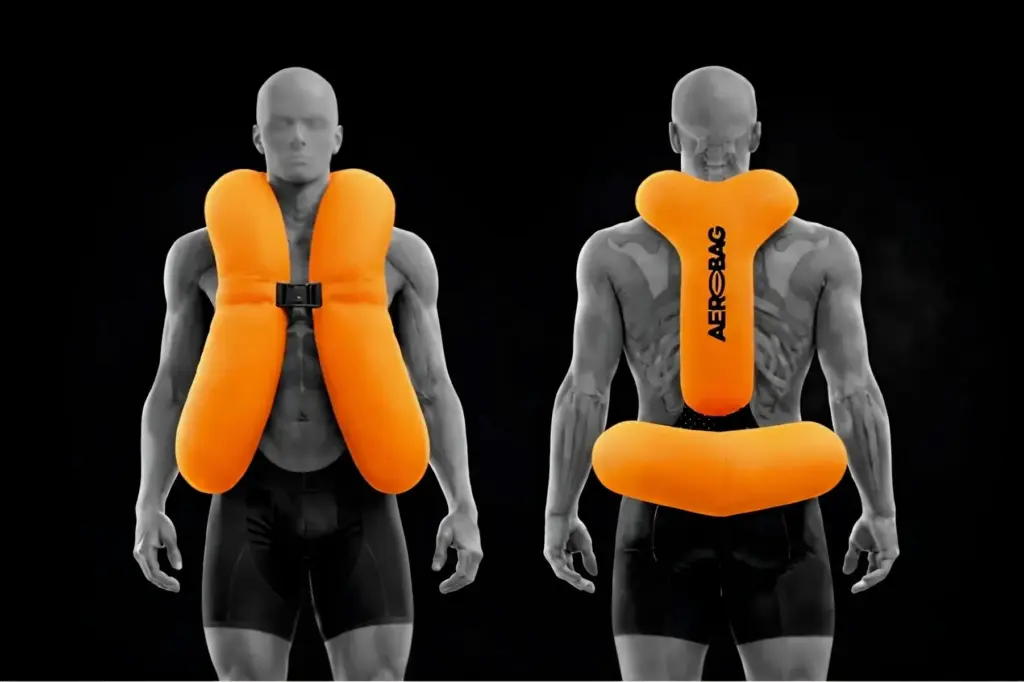
Aerobag: a Belgian startup with heavyweight investors
At the same time, Belgian startup Aerobag has convinced Fundracer to take a stake in the company. Fundracer is an investment fund specialising in micro-mobility founded by René Wiertz, Gérard Vroomen and Andy Ording — Vroomen being the co-founder of Cervélo and of the Cervélo TestTeam. The stake is a minority one; the exact amount remains confidential.
Safety is one of Fundracer’s priority areas, and Aerobag represents a major step forward for the cycling industry. I worked for many years with professional teams and I know how critical better protection is — too many races are ruined by crashes and the injuries that follow.
Gérard Vroomen, co-founder of Cervélo and founding partner of Fundracer
Aerobag’s approach also relies on artificial intelligence to recognise crash scenarios in real time. Bert Celis, the startup’s founder and CEO, sums up the ambition: “It’s crazy that we send pro riders down descents and everyday cyclists into traffic with almost no protection.” The system’s technical details — deployment speed, zones covered, weight — have not yet been made public.
Timelines on a collision course
On the Aerobag side, René Wiertz is announcing deliveries to professional teams as early as Q2 of 2026, followed by access for private buyers in Q3. On the Van Rysel side, the suit is still in “final validation” with partner teams before any possible race debut. No confirmed date, no price announced.
Both companies share the same long-term ambition: start with the pro peloton, then move down to amateurs and urban cyclists. The same path helmets took — they needed decades to become universal, and nobody questions them any more.