IN BRIEF
Until the late 1970s, cyclists rode in wool whatever the weather. Elastane, invented at DuPont in 1958 and adopted by the peloton from 1976, changed everything: the modern bib short was born. Polyester then learned to wick sweat away, Gore-Tex-type membranes made rain bearable, and merino gave wool a second career. Today the work is on aerodynamics and PFAS-free chemistry.
A 1970s racing jersey was knitted. In wool, like grandma’s socks: warm at the start, soaked at the finish, and able to absorb up to a third of its weight in water. Shorts came with a real chamois leather pad stitched into the crotch, which had to be softened with cream before every ride. In fifty years, polymer chemistry has replaced almost every fibre of that outfit. A look back at the materials that changed cyclists’ lives, from the professional peloton to the daily commute.
Four years to drive wool out of the peloton
It all starts in a DuPont laboratory in 1958. American chemist Joseph Shivers developed a synthetic fibre able to stretch up to five times its length without losing shape: elastane, sold from 1962 under the name Lycra. The fibre first dressed girdles and swimsuits. Cycling had to wait until 1976.
That year, Switzerland’s Toni Maier, founder of ASSOS, tested a prototype aerodynamic carbon frame in a wind tunnel. Unexpected verdict: the real brake was the rider and their flapping clothing. Inspired by the Swiss ski team’s suits, Maier turned to DuPont, which held the patent, and produced the first Lycra bib shorts. Comfort did the rest: by around 1980, no professional was racing in wool shorts any more. Maier would also replace the real chamois leather with a synthetic insert — the ancestor of today’s multi-layer pads, more hygienic and machine washable.


Polyester learned to wick sweat away
Lycra settled the question of fit, not that of perspiration. Polyester takes care of that. Unlike wool or cotton, this fibre absorbs almost no water: less than 1% of its weight. Spinners made the most of it by designing grooved-section yarns and double-faced knits that draw sweat by capillary action to the outside of the fabric, where it evaporates. The principle of wicking was set, popularised in the 1980s by fibres such as DuPont’s Coolmax.
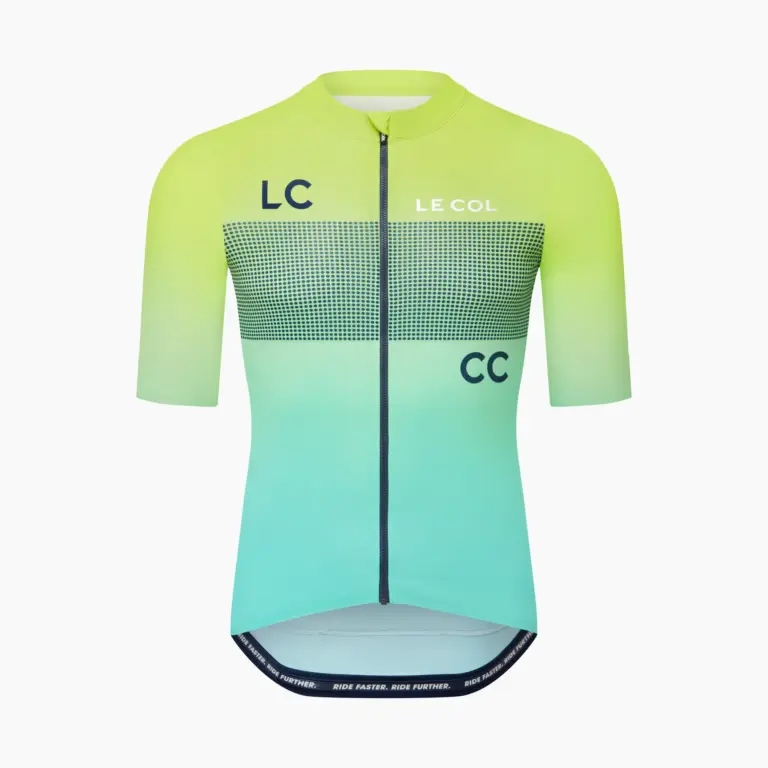
In practice, a modern summer jersey weighs less than 150 grams, dries in a few minutes and stays light even when soaked. Its wool ancestor weighed three times that to start with — and far more in a downpour.
A membrane pierced with billions of holes
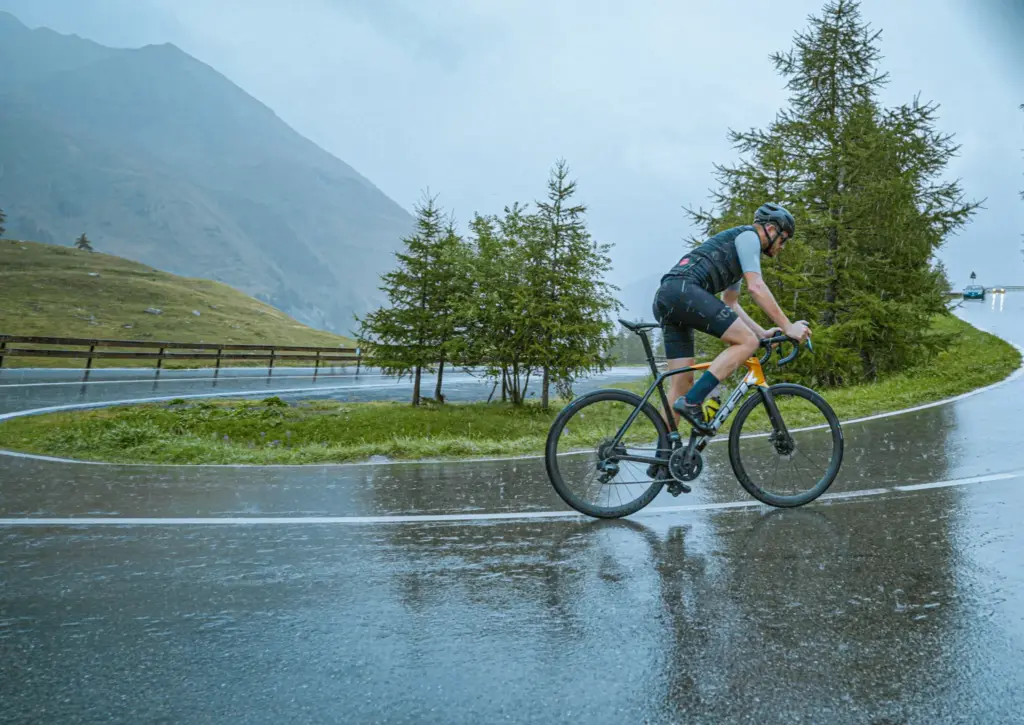
That left the rain. Before the 1980s, cyclists could choose between getting drenched or cooking inside a waterproof cape. The solution came, once again, from a laboratory accident: in 1969, the American Bob Gore abruptly stretched a heated PTFE rod — the polymer behind Teflon — and obtained a microporous material, expanded PTFE. The resulting membrane has around 1.4 billion pores per square centimetre: too small to let a raindrop through, large enough to let body vapour escape.
The first Gore-Tex products arrived in 1976, and the waterproof-breathable membrane principle took hold everywhere: rain jackets, but also softshell windproofs, gloves and overshoes. For cyclists, who produce a lot of heat and hate dead weight, it was the end of the dry-outside-soaked-inside dilemma.

Wool has not had the last word
The irony of history: the fibre driven out by Lycra has come back through the front door. Merino wool, with its very fine fibres — around 17 to 19 microns, against more than 30 for the scratchy rustic sort — is soft on the skin, regulates temperature both ways and naturally neutralises odours. Enough to string together several rides, or even a bikepacking weekend, without a trip through the washing machine.
Brands rarely use it pure: blended with nylon for strength and a touch of elastane for hold, it goes into base layers, socks and four-season jerseys. The best of both worlds, at the very real price of a fibre that is dearer and more fragile than polyester.
Aerodynamics and clean chemistry, the current battlegrounds
On the road, at 40 km/h, most of a cyclist’s energy goes into cutting through the air — and their body accounts for the largest share of it. Textiles have therefore become a hunting ground for watts: textured surfaces that organise airflow like the dimples of a golf ball, seams moved out of the wind, skinsuits developed in wind tunnels. What was once reserved for Olympic time trials is now found on off-the-peg jerseys.
The other job is less visible: the water-repellent treatments that make rain bead on jackets relied on perfluorinated compounds, the notorious PFAS, which persist in the environment. Under pressure from regulators — the European Union is examining a broad restriction on these “forever chemicals” — the industry is switching: Gore has developed an ePE membrane with no intentionally added PFAS, and most brands are reformulating their repellents while rolling out recycled polyester made from plastic bottles. Having dressed cyclists lighter, drier and faster, modern materials are tackling one last specification: leaving no trace behind the wheel.