IN BRIEF
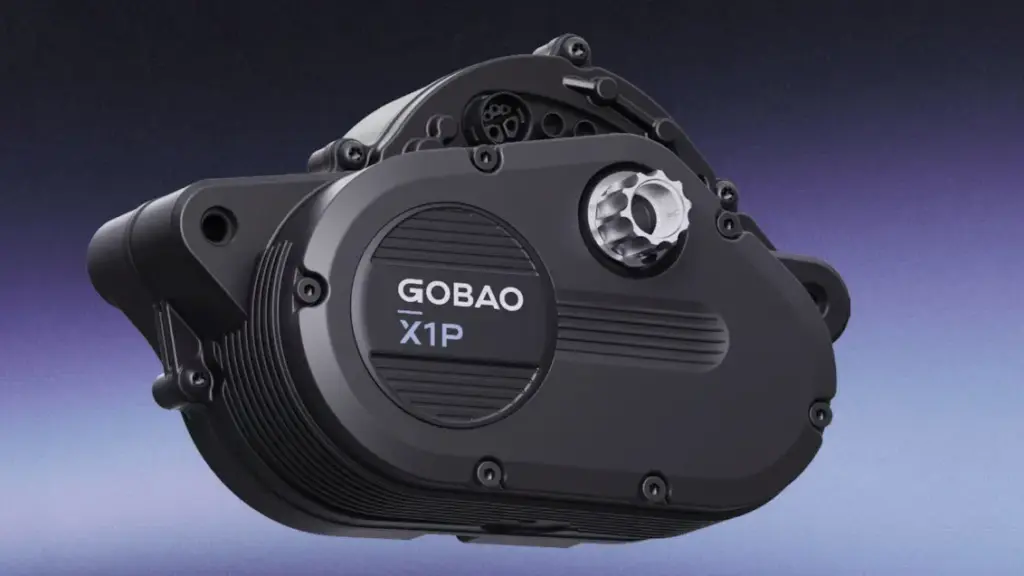
Gobao, a Chinese motor manufacturer still discreet in Europe but already a supplier to Aventon and Hepha, unveiled two electric mountain bike units at Eurobike, the X1 and X1P. What sets them apart is less their power than their architecture: the continuously variable transmission sits inside the motor, which does away with the derailleur — and even with the chain, replaced by a belt. The X1P claims 1,500 W and 150 Nm at peak, on a par with the DJI Avinox M2S; the X1 targets 1,200 W and 120 Nm. Series production is only announced for early 2027, and no bike fitted with them has been shown yet.
| Models | Gobao X1 and X1P |
| Nominal power | 250 W (European type approval) |
| Peak power | 1 200 W (X1) · 1 500 W (X1P) |
| Maximum torque | 120 Nm (X1) · 150 Nm (X1P) |
| Gear range | 400 % (X1) · 500 % (X1P) |
| Transmission | eCVT continuously variable, integrated into the motor |
| Drive | belt, no derailleur or cassette |
| Motor weight | 3.85 kg |
| Batteries | 500, 750 and 900 Wh |
| 0–80% charge | 24 / 28 / 32 min depending on capacity (1.5 kW charger) |
| Availability | series production announced for early 2027 |
On Gobao’s new motors, there are no gears left to shift. The rider chooses their cadence; an automatic transmission, housed inside the motor, takes care of the rest. With its X1 and X1P units, unveiled at Eurobike, the Chinese manufacturer skips the derailleur and hands rear-wheel drive over to a belt.
The name is still little known on this side of the globe. Gobao keeps a low profile in Europe, but it already supplies motors to brands such as Aventon and Hepha, and equips several major Asian manufacturers. With the X1 and X1P, it is not only looking to pile on the watts: it is offering another way of getting power to the wheel.
A transmission that does without a derailleur
It all comes down to an acronym: eCVT, for electronic continuously variable transmission. There are no ratios left to select. The rider sets the pedalling cadence that suits them, and the system continuously adjusts the gearing to hold it, whether the gradient steepens or levels out. Software reads cadence, torque, speed and incline in real time, then adapts the ratio accordingly.
The idea is not entirely new. It recalls Enviolo’s continuously variable hubs, or the mechanics of the Toyota Prius, which made this type of transmission commonplace in cars. Above all, it echoes the approach of Owuru, the automatic motor pushed by Decathlon, which claims a range equivalent to twelve speeds without a single gear change. Where Pinion (with its MGU) or Valeo (with Cyclee) slip a genuine stepped gearbox into the motor, Gobao and Owuru are betting on continuous variation.
On paper, two benefits. The motor runs constantly within its ideal efficiency range. And maximum torque stays available at every moment, including when setting off again on a severe ramp, where changing gear can sometimes be painful. Gobao designed its units for a Gates belt rather than a chain — enough to promise reduced maintenance, provided the frame is built for it.
1,500 watts at peak, on a par with the Avinox M2S
The figures put Gobao straight away among the beefiest motor units. The X1 announces up to 1,200 W and 120 Nm; the X1P climbs to 1,500 W and 150 Nm, exactly the figures of the DJI Avinox M2S in Boost mode. One caveat is needed: these are peaks. Like the Avinox, the Gobao units remain type-approved at 250 W nominal power, the legal ceiling for an electrically assisted bike in Europe.
To grasp the leap made, it is worth remembering that Bosch, Shimano and Brose long stalled at around 85 to 90 Nm — the Bosch Performance Line CX, a mainstay of the electric mountain bike, tops out at 85 Nm. In two years, the DJI Avinox and then the Avinox M2 and M2S pushed the bar to 150 Nm and dragged the whole sector along in their wake. Gobao is falling in with this new standard.
Weight, the trade-off for integration
Bringing everything together in a single casing comes at a price on the scales. The X1 and X1P weigh 3.85 kg, against 2.6 kg for an Avinox motor. The comparison is misleading, though: the Avinox does not carry the transmission. Once a cassette and a derailleur are added, an M2S set-up gets close to 3.5 kg, and the gap melts away.
Against a genuine integrated gearbox, Gobao does even better: the Pinion MGU 1.12 comes in at 4.14 kg. In exchange, the latter offers a 600% gear range, against 500% for the X1P (and 400% for the X1). More compact, then, but with a slightly shorter spread.
Batteries that recharge in under half an hour
The other part of the announcement concerns the batteries, and this is probably where Gobao is most surprising. Paired with its own 1.5 kW charger, they would go from 0 to 80% in 24 minutes for the 500 Wh version, 28 minutes for the 750 Wh and 32 minutes for the 900 Wh.
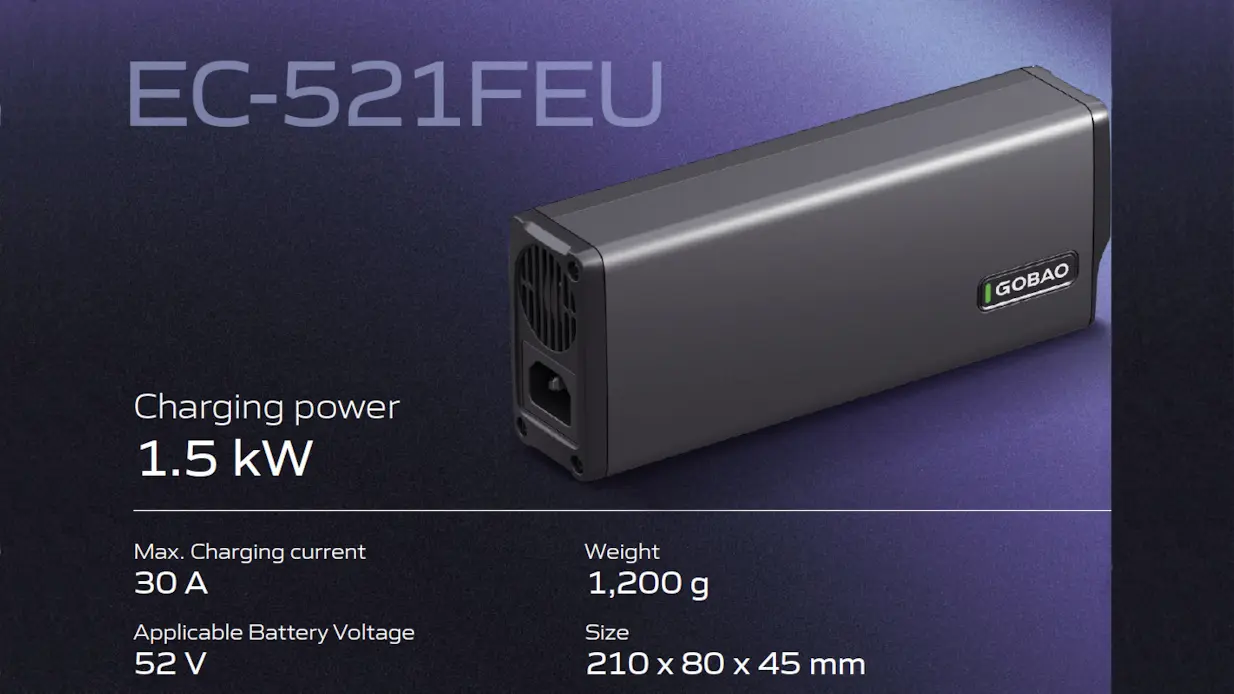
The order of magnitude stands out. A Bosch battery of comparable capacity needs between 2 hours 30 and 3 hours for the same level; the 800 Wh Avinox announces 1 hour 45. Gobao also highlights the density of its cells: its 900 Wh would weigh only 3.7 kg, a hair less than the 800 Wh Avinox (3.74 kg). Enough to bring bike charging closer to that of an electric car, where a short break is enough to win back range.
Still to go from the show floor to the trail
Technically, the object impresses. But Gobao starts with a handicap: for now it has neither a bike nor a partner to show with these motors, and series production is not expected until early 2027. Until then, heat management, long-term reliability and the finesse of the software — what separates a good idea from a good product — remain to be proven in the field.
The timetable above all places Gobao in Owuru’s wheel. Decathlon was targeting a first commercial launch by the end of 2026, in a Rockrider electric mountain bike, and intends to take its automatic motor beyond its own catalogue. Meanwhile, Avinox is stretching its lead through partnerships: dozens of brands, hundreds of bikes announced. Gobao arrives with an appealing architecture and a charging argument that is hard to brush aside. It is still missing the essential: a bike to ride.