IN BRIEF
Bosch, the benchmark in mid-drive motors for more than ten years, has sprung a surprise: with the Hub Line, the German supplier unveils its very first motor housed in the rear wheel. Compact (2.3 kg, around a hundred millimetres in diameter) and discreet, it delivers 45 Nm and up to 400 watts of peak power — with no torque sensor, a choice that goes against the grain. Bosch is not banking on raw figures, where Mahle does better, but on its Smart System ecosystem: the eBike Flow app, over-the-air updates, connected anti-theft protection and navigation. It comes with the PowerTube 360, the brand’s slimmest integrated battery (360 Wh, 2.1 kg). First rides: convincing in Auto mode and cut out for the city, more debatable in Turbo and when pulling away uphill.
| Type | Bosch’s first hub motor (rear wheel) |
| Torque / power | 45 Nm — up to 400 W peak (250 W continuous) |
| Motor weight | ~2.3 kg, ~100 mm diameter |
| Sensors | No torque sensor; speed, cadence, accelerometer, rotation |
| Freewheeling | Fully disengages above 25 km/h (free pedalling) |
| Modes | Eco, Tour, Turbo, Auto (no eMTB mode) |
| Battery | PowerTube 360: 360 Wh, ~2.1 kg, 68 mm — > 80 km claimed |
| Extended range | PowerMore 250 range extender (DualBattery) |
| Ecosystem | Smart System, eBike Flow app, eShift, anti-theft/alarm, navigation |
| Complete system | ~4.5 kg (motor + battery + controls) |
For more than ten years, Bosch and electric assistance have meant a unit sitting at the centre of the bike, at the bottom bracket — a benchmark few rivals have troubled. With the Hub Line, the German supplier is wrong-footing everyone: for the first time, it is fitting its motor directly into the rear wheel. An architecture it had always ignored, and one it approaches with an unexpected technical choice.
The king of mid-drives switches sides
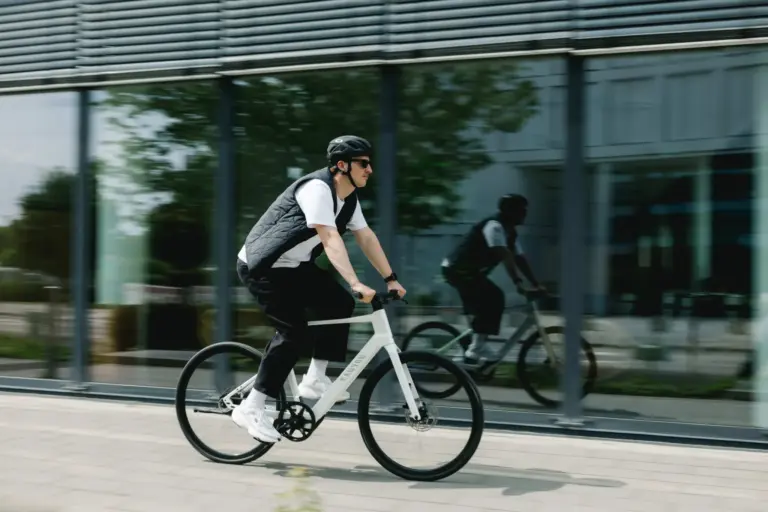
The Hub Line does not replace Bosch’s own mid-drive motors: it opens a new front. Bosch is targeting light, discreet and connected urban electric bikes — a segment so far occupied by Mahle, Bafang and Mivice, where the brand was absent.
The motor puts out 45 Nm of torque and peak power of up to 400 watts, with continuous power capped at 250 watts as pedelec regulations require. Those figures fall short of the Performance Line mid-drives, but make sense for everyday journeys — and they are hard to compare, since a hub motor sends its power straight to the wheel, whereas a mid-drive motor goes through the drivetrain.
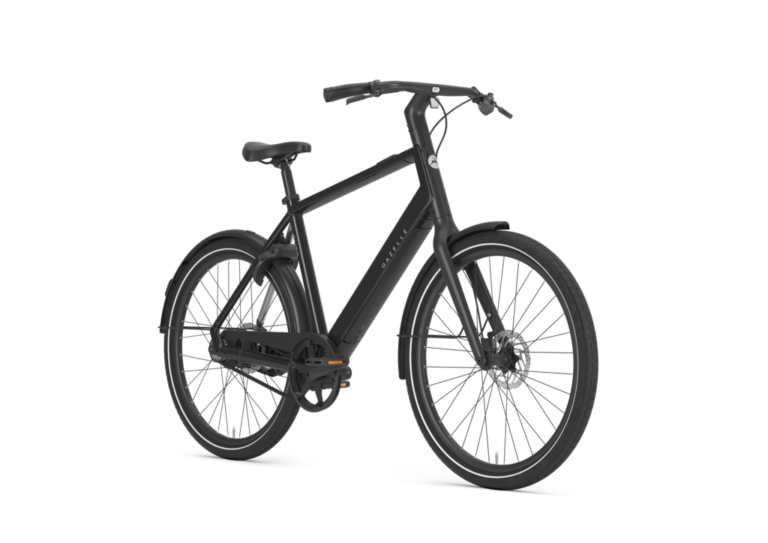
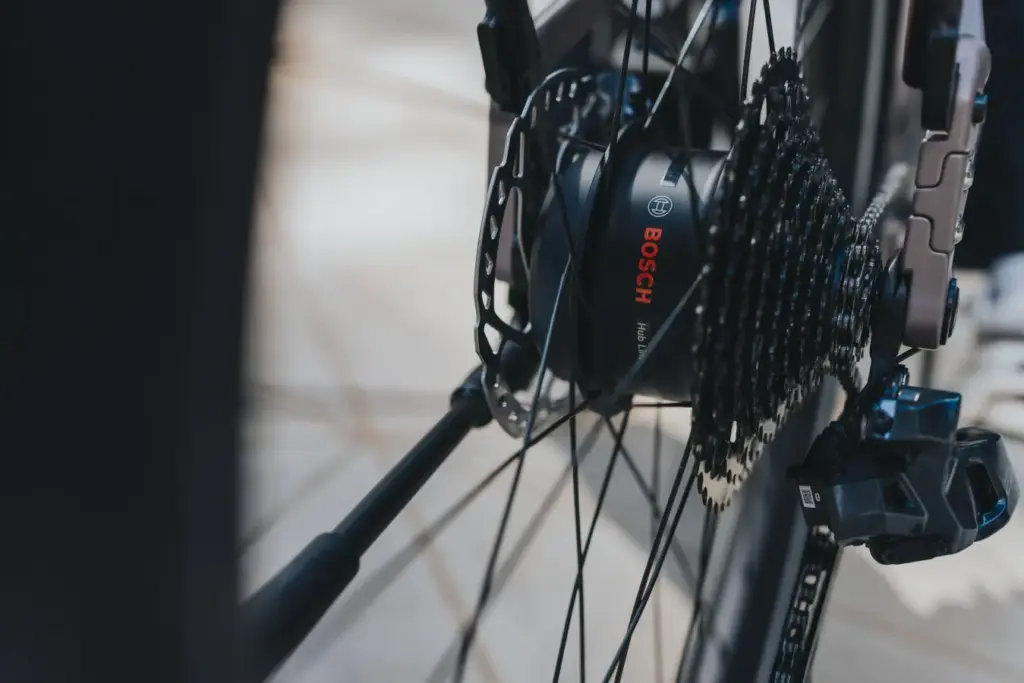
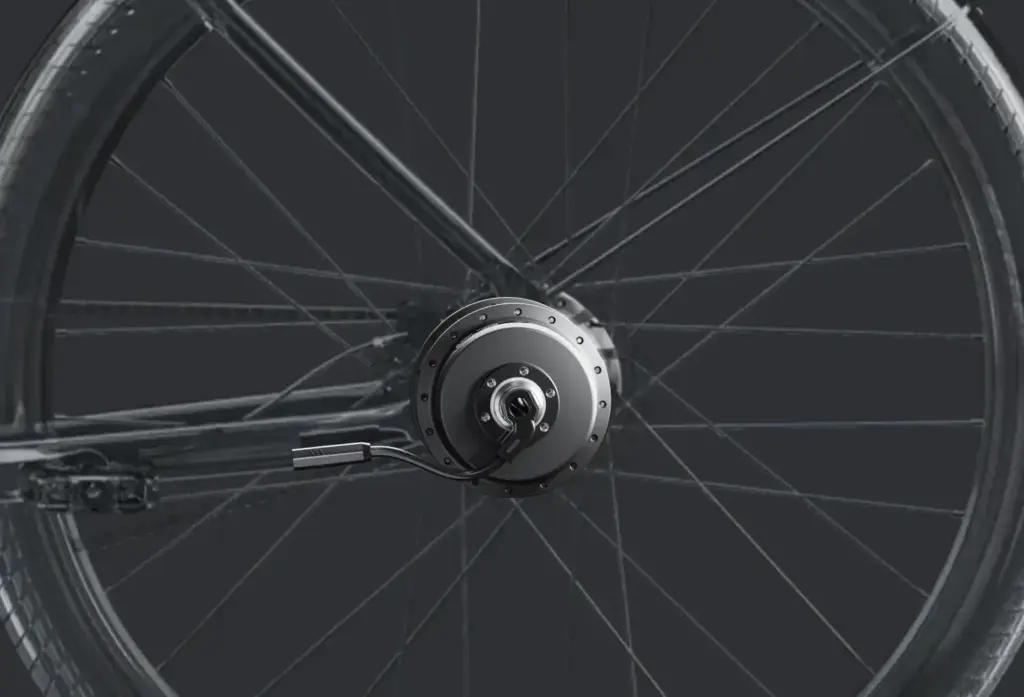
Above all, it makes itself forgotten: 2.3 kg on the scales, around a hundred millimetres in diameter, and integration so discreet that it all but disappears between the cassette and the brake rotor. Enough to design urban bikes with clean lines, without the telltale bulge at the bottom bracket.
A technical gamble: no torque sensor
This is the decision that caused surprise at launch. Where a torque sensor was expected — the one that measures the force applied to the pedals — Bosch does without. The Hub Line relies on a cluster of other sensors: speed, cadence, accelerometer and a high-precision rotation sensor. So the system knows how fast you are riding and how you are pedalling, but not how hard.
On the road, during the first test rides, you can feel it. Sometimes it is enough to let the cranks turn without pressing for the assistance to keep pushing. When pulling away uphill, the help only arrives after about a quarter of a pedal turn; walk assist then serves as a leg-up to get going.
A pleasant surprise, on the other hand, beyond the legal speed limit: past 25 km/h, the motor disengages completely. You keep pedalling without the slightest mechanical resistance — a valuable detail on a light bike built to be ridden, where some motors drag as soon as they stop assisting.
In the city, Auto mode makes the difference
For anyone who already knows Bosch, the reference points do not move: familiar controls, the same Eco, Tour and Turbo levels. Only a few specific modes, such as eMTB mode, are dropped — consistent for a motor that is not aimed at off-road riding. But it is Auto mode that emerged as the favourite of those first rides.
On the flat, it assists discreetly, without ever seeming to want to run away with itself. As soon as the road tilts upwards, it beefs up its help until it becomes almost indistinguishable from Turbo. Turbo, for its part, proves scrappier: it pushes hard at the slightest pedal stroke, sometimes in a slightly artificial way on the lightest bikes. Tour and Eco modes remain more linear and predictable. The sense of power also depends a great deal on the bike: its weight and its gearing make the feel vary from one model to another. As for noise, the motor keeps a low profile — a faint hum, quickly drowned out by traffic.
Bosch’s real trump card: its ecosystem
On paper, the Hub Line is not the best-endowed hub motor. The Mahle X20 claims up to 65 Nm for 1.4 kg, and the X30 the same torque as the Bosch for almost 400 grams less. But reducing these motors to their figures would be to miss the point.
Bosch’s asset is its Smart System. The Hub Line connects to the eBike Flow app, receives over-the-air updates and unlocks the brand’s own functions: connected anti-theft protection and alarm, navigation, and the eShift electronic drivetrain with automatic gear changes. On top of that comes a very extensive network of partner bike shops, a guarantee of ongoing servicing. On mid-drive motors, competitors can match Bosch on software; on hub motors, nobody comes close to that level of integration today.
A detail that will speak to workshops: an access plate makes it possible to work on the motor without having to rebuild the wheel. A real plus for after-sales service.
PowerTube 360: Bosch’s slimmest battery
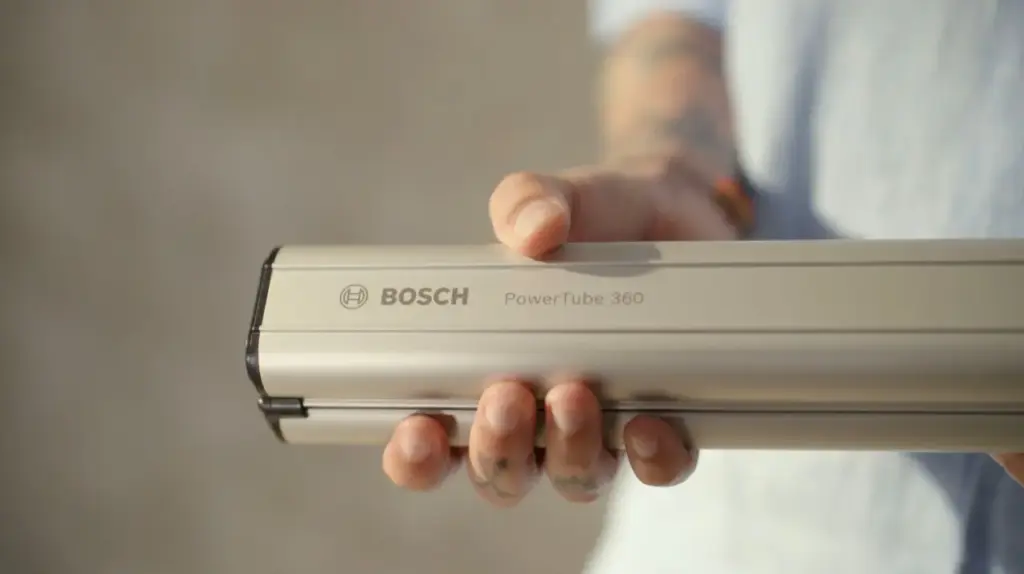
The Hub Line arrives with a battery tailored to it: the PowerTube 360. At 68 mm in diameter and around 2.1 kg, Bosch presents it as the slimmest integrated battery it has ever produced. Enough to fit 360 Wh into a slender down tube and to design frames close to those of a non-assisted bike. The brand claims more than 80 kilometres of range depending on conditions.
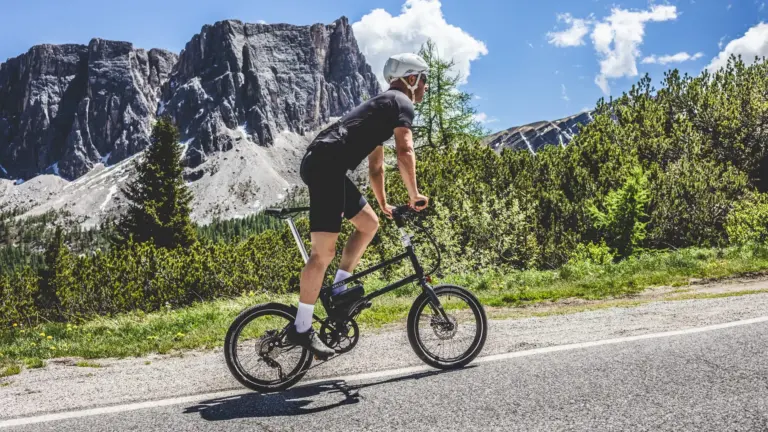
To go further, it can be paired with the PowerMore 250 range extender (around 1.5 kg) via the DualBattery system. The Hub Line can even run on that range extender alone: Bosch demonstrated as much on a 24-inch hardtail mountain bike from Early Rider, an interesting avenue for folding bikes and other tightly constrained frames. The main battery also remains removable for charging, provided the manufacturer opts for that solution — handy for anyone who cannot plug in their bike where they park it.
That leaves the question of price. As a supplier, Bosch is not announcing any figure: everything will depend on the bikes that adopt it. Manufacturers questioned at the launch point to fairly premium urban models, around €2,500 or even below — to be confirmed as announcements come through over the coming months.
For a first attempt in the wheel, Bosch strikes where it was not necessarily expected: less on the spec sheet than on everything around it. In the city, the Hub Line delivers on its promises; for steep climbing, its own mid-drive motor keeps the upper hand.