IN BRIEF
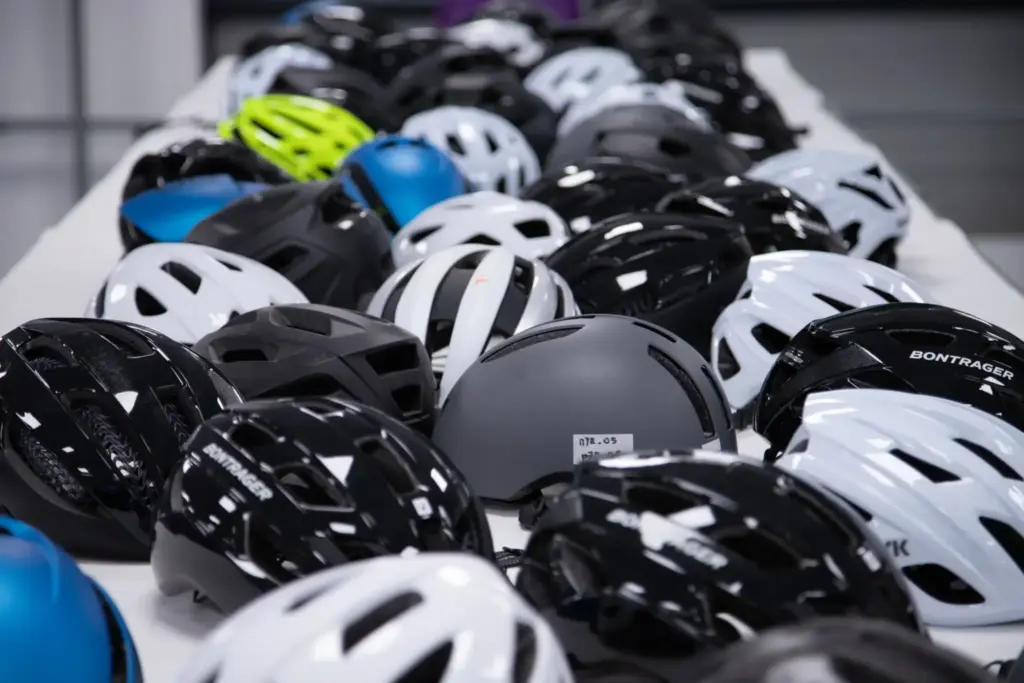
A study by Imperial College London, presented on 4 November, tested 30 bike helmets sold in the United Kingdom, including the six collapsible models available. On average, collapsible helmets offer less protection against serious head injuries: the predicted linear risk reaches 24%, compared with 20% for conventional helmets. Five of the six collapsible helmets finish in the bottom half of the ranking. But the collapsible model fitted with Mips ranks 2nd out of 30, while its version without Mips is 26th. The press release states that all the helmets tested meet minimum standards.
Funded by the Road Safety Trust, the study presents itself as the first to compare the protection of collapsible foam helmets with that of conventional helmets. It was carried out at Imperial College’s Dyson School of Design Engineering.
Tests more demanding than the standard
British (BSI) and European (CEN) regulatory tests rely on a vertical drop, which mainly measures direct impacts without accounting for oblique impacts or head rotation. The Imperial team tested the helmets at four impact locations, measuring both linear and rotational head motion. The press release states that each impact was repeated three times, with a new helmet for each test.
Collapsible helmets: what the study shows
The gap concerns linear impacts. For brain injuries caused by head rotation, the press release states that the study found “no difference” in protection. Anti-rotation technologies reduce both risks, linear and rotational, but only one of the six collapsible helmets has them, compared with 12 of the 24 conventional helmets.
Weight also plays a part. Collapsible helmets weigh 461 g on average, compared with 294 g for conventional ones, or 57% more. And linear risk rises on average by 0.2% for every 10 g added. They also cost more: the collapsible helmets bought for the study cost £101 on average, compared with £64 for conventional ones. The press release nevertheless states that, for the researchers, this gap is not inherent to collapsible design: lighter models with anti-rotation protection would significantly improve protection against head injuries.
Yet the study’s lead author backs the idea:
“Collapsible helmets are a great solution to overcome inconvenience; one of the most reported reasons people in urban areas don’t wear helmets when they want to ride a bicycle.”
William Dawber, of the Dyson School of Design Engineering, Imperial College London
“Any helmet is safer than no helmet and innovative designs that appeal to more people are to be applauded,” adds Mazdak Ghajari, professor of Brain Biomechanics and one of the founders of Imperial’s HEAD Lab.
Newlane disputes the framing
The Newlane Foldable MIPS helmet features in the lab’s HIPER ranking. For Dominic Cotton, co-founder of Newlane, the headline conclusion gives the wrong overall impression of the results:
“The claim that collapsible helmets provide less protection is misleading because it’s about which collapsible helmet you’re talking about. It’s about the design and technology.”
Dominic Cotton, co-founder of Newlane
“Five of the six foldable helmets came towards the bottom of the test pack, but one of them came second,” he points out. He notes that nine of the ten top-ranked helmets were fitted with Mips: “I don’t think it’s about whether it’s foldable or not. It’s about whether it has rotational capabilities.”
Newlane’s collapsible Mips helmet folds down to 81 mm, around half the height of a conventional helmet, and meets the EN 1078 standard.
Towards the HIPER rating
The results will feed into the HEAD Lab’s HIPER (Helmet Impact Protection Effectiveness Rating) system, created with funding from the Road Safety Trust, which awards diamond, platinum, gold, silver and bronze medals. A previous study by the lab, published in 2024 in Annals of Biomedical Engineering, concluded that a helmet’s price was not a reliable indicator of its protection.
The press release states that all the helmets in the study meet minimum safety standards. The press release also states that wearing any helmet offers better protection than wearing none.
Buying guide
Commuter bike helmets: six models compared
MET, Bern, Abus, Sweet Protection and Unit 1: lab-rated protection, lights, weight and price.