IN BRIEF
The Ontario government began removing Toronto’s protected bike lanes on 13 October 2026, starting with a stretch of about 1 km of Bloor Street West in Etobicoke. The plan targets up to 19 km of lanes on Bloor, Yonge and University. Cyclists are trying to block the work, and police had announced three arrests as of 15 October. In August, the Court of Appeal for Ontario sided with the province, and opponents have announced they are taking the case to the Supreme Court of Canada. Mayor Olivia Chow calls it “a gigantic waste of money”.
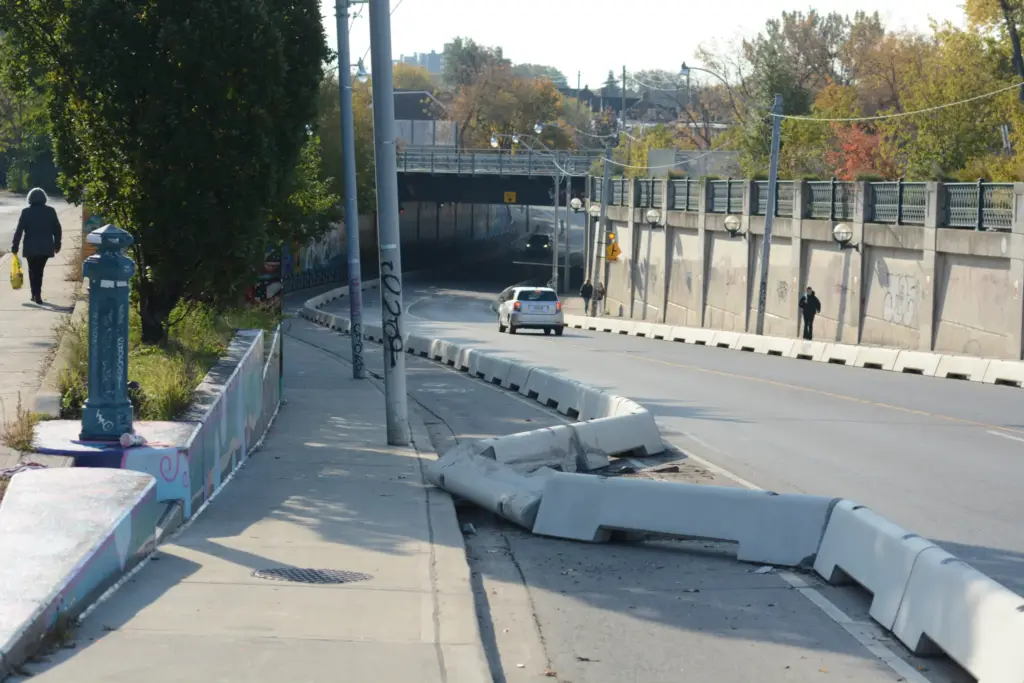
Trucks loaded with pylons arrived on Bloor Street West on Tuesday 13 October. That evening, the protest ended peacefully: police escorted the crews off the street, and demonstrators chanted “get home safe” to the workers. The next day, the confrontation hardened.
Toronto bike lanes: removal begins in Etobicoke
The work begins with a stretch of about one kilometre on Bloor Street West between Islington Avenue and Royal York Road, in Etobicoke, the home turf of Doug Ford, Ontario’s premier. A notice published on the City’s website scheduled the work until 17 November. The province intends to rework up to 19 km of the city’s protected bike lane network, on Bloor, Yonge Street and University Avenue.
Transportation Minister Prabmeet Sarkaria warned in a statement after Tuesday’s protest: “make no mistake: these bike lanes are coming out.”
Three arrests
On Wednesday 14 October, protesters trying for a second day to block the work clashed with police. A 25-year-old woman from Hamilton was arrested and charged with mischief and obstructing a peace officer. A few hours later, shortly before 20h, a 20-year-old man was arrested: police say he allegedly removed City signs before being detained, and charged him with mischief, obstructing the lawful use of property and theft under $5,000. On 15 October, police announced a third arrest, that of a woman detained near the intersection of Bloor Street West and Lothian Avenue, for mischief and obstructing police.
Michael Longfield, executive director of the advocacy group Cycle Toronto, said ahead of Wednesday’s demonstration that he expected protests to continue “until further notice.” He added:
“It’s not about addressing traffic congestion and very disappointingly, it seems like rather than, you know, try to find those win-win solutions, they’re just doubling down on spite.”
Michael Longfield, executive director of Cycle Toronto
A battle of numbers and courts
The City estimates the cost of removing all the targeted lanes on Bloor, Yonge and University at $48 million, a figure the province disputes without having provided its own as of 14 October. Doug Ford had called the estimate “a bunch of hogwash”, promising: “We’re going to show them how to do it for a lot less and get traffic moving.” “It’s a gigantic waste of money, and it’s trampling on local democracy,” Mayor Olivia Chow replies.
The legal framework is Bill 212, the Reducing Gridlock, Saving You Time Act, passed at third reading by 66 votes to 27 in November 2024. It targeted the removal of lanes on stretches of Bloor, Yonge and University; law firm Torys says the provision at issue has since been repealed and replaced, to direct the Minister of Transportation to “reconfigure” the bike lanes rather than “remove” them. A trial judge had declared the law unconstitutional, because it infringed the right to life and security of the person guaranteed by section 7 of the Charter, and blocked the plan; he had also found that the government had kept the plan even though its own advisers believed it would not reduce congestion, but the Court of Appeal for Ontario overturned that decision in August. Law firm Torys sums up the ruling: the Charter guarantees no right to bike lanes, and their existence is a matter of legislative choice. On 13 October, groups supporting cyclists announced that they would ask the Supreme Court of Canada to take up the case.
The issue has also become divisive in the run-up to the 26 October municipal election.