IN BRIEF
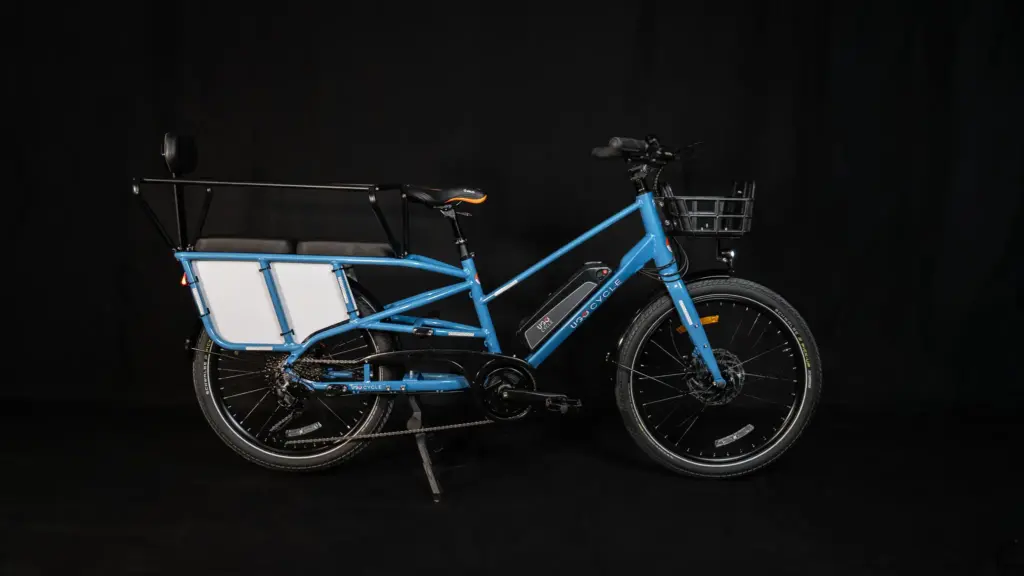
UGO Cycle, a Quebec manufacturer known for its electrification kits, is launching the Atlas, its first complete electric cargo bike. This aluminium longtail weighs around 34 kilos and carries a 120 Nm mid-drive motor, able to haul up to 200 kilos. Built around off-the-shelf components and a modular electrification system, it is designed to be repaired rather than replaced. Custom-assembled in two workshops in the Montreal area, it sells for CA$3,649, child seats included.
| Type | Electric longtail cargo bike |
| Price | CA$3,649 (custom assembly included) |
| Motor | TSDZ 8 mid-drive, 500 W, 120 Nm, torque sensor |
| Battery | 48 V, 672 Wh (LG cells), 6 h 30 min charge |
| Claimed range | 50 to 110 km depending on assistance level |
| Top assisted speed | 32 km/h |
| Weight | around 34 kg with the battery |
| Payload | 200 kg in total (80 kg at the rear) |
| Drivetrain | Shimano CUES, 10-speed |
| Brakes | Tektro hydraulic, 4-piston, 180 mm rotors |
| Wheels | 24-inch, puncture-resistant Schwalbe tyres |
| Assembly | Saint-Hubert and Mascouche (Quebec) |
Until now, UGO Cycle mainly sold kits to turn a conventional bike into an electric one. The Quebec company is moving up a level: it is presenting its first complete bike, a longtail cargo model named the Atlas, unveiled in mid-June 2026. On paper, it claims 120 Nm of torque for a contained weight of around 34 kilos — an uncommon combination on this type of machine, designed to carry children and shopping day in, day out.
From electrification kit to complete bike
The brand, established on both banks of the river in Montreal, made its name by electrifying existing bikes rather than selling new models. The Atlas follows the same logic: it pairs a longtail frame — a bike stretched at the rear, designed for carrying loads — with a modular electrification kit. The idea is to be able to repair a part or upgrade the bike over time, instead of replacing everything at the first breakdown.
We wanted to design a cargo bike that can evolve over time, without becoming obsolete after a few years, and that is repairable rather than disposable. This approach is exactly the same as the one applied to the traditional bikes we convert.
Hugo Deligny, president and founder of UGO Cycle
In practice, the Atlas relies on off-the-shelf components rather than in-house parts: a ten-speed Shimano CUES drivetrain, four-piston Tektro hydraulic brakes and puncture-resistant Schwalbe tyres. All of them parts a workshop can service without depending on a single supplier.
120 Nm of torque for 34 kilos
The heart of the bike is its motor. UGO Cycle went for a 500-watt TSDZ 8 mid-drive unit, fitted with a torque sensor and rated at 120 Nm. That is a lot for a cargo bike: enough to get a heavy load moving again on a climb without straining at the pedals. The motor sits at the bottom bracket rather than in the wheel, which spreads the weight better and takes the strain off the drivetrain.
On the battery side, the manufacturer claims 672 Wh (48 volts, LG cells) and a range of 50 kilometres under strong assistance, up to 110 kilometres in eco mode. Those figures should be taken as a rough guide: on a loaded cargo bike, the gradient and the weight carried count for a lot in the equation. A full charge takes about six and a half hours.
The other pleasant surprise is on the scales. With its battery, the Atlas stays at around 34 kilos, where many electric longtails go beyond 40 kilos. The aluminium frame still accepts 200 kilos of total load, including 80 kilos on the rear section.
A cargo bike delivered ready for the family
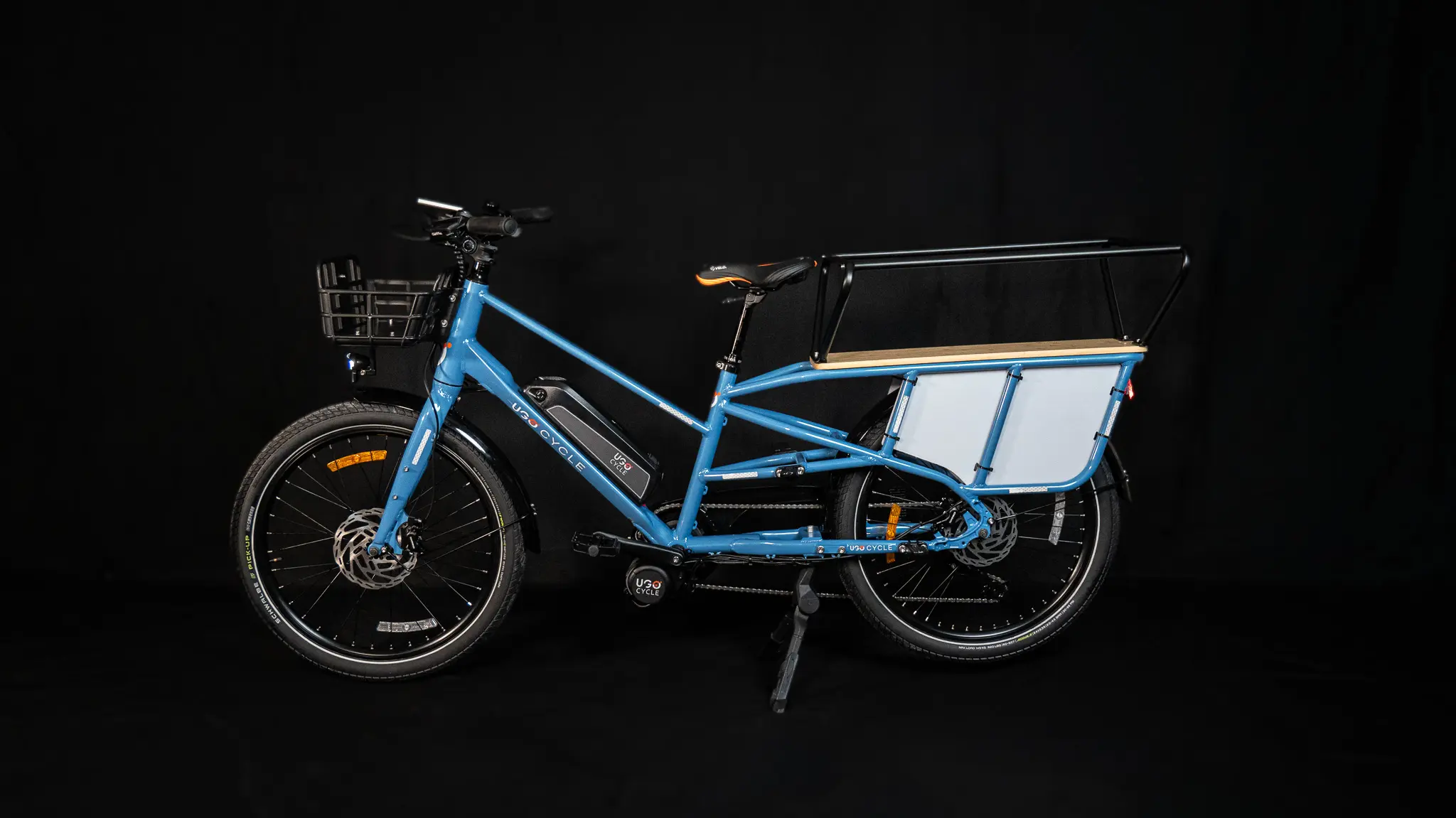
The Atlas is sold fully equipped: a double child seat with backrest, guard bars, front basket, bamboo deck, double centre stand and LED lighting. The dropper seatpost and the adjustable stem allow the bike to be passed from one rider to the next, for heights from 1.52 m to 1.83 m. All standard, then, with no options list to tick.
For a few years now, we have been seeing that the cargo bike is no longer a marginal model: it is increasingly part of the daily life of Quebec families looking for reliable solutions for their everyday journeys.
Hugo Deligny, president and founder of UGO Cycle
The whole package is priced at CA$3,649, or around €2,400, custom assembly included. Each bike is built by hand in UGO Cycle’s workshops in Saint-Hubert and Mascouche, with a set-up and a handover session when the bike is collected.
A bike cut out for Montreal, not for Europe
The timing is no accident. UGO Cycle says it had a record year in 2025, with 25% growth year on year, in a city where cycling is on the rise. According to the Autorité régionale de transport métropolitain, the regional metropolitan transport authority, the share of cycling doubled between 2018 and 2023 in Montreal’s central neighbourhoods, rising from around 7% to 15% of journeys in some areas. A study by Équiterre and the Mobility Chair at Polytechnique Montréal even estimates that a quarter of the journeys made by car in Greater Montreal could be made by electric bike.
One detail remains for European readers: with its 500 watts and assistance up to 32 km/h, the Atlas falls outside the regulatory framework for electrically assisted bikes in force on the Old Continent, capped at 250 watts and 25 km/h. The bike is not distributed outside Quebec in any case — for now, it is a strictly local affair.