Velodisco — The Long Ride #06
Cargo bikes: the state cut the funding, the city has already changed
A public subsidy born on 1st September 2025, repealed on 29 September 2025. In between, operators promised companies cargo bikes for zero euros — delivered late, non-compliant, or never delivered at all. This twenty-nine-day episode closes three years of public money poured into the French cargo bike. The market has turned. But in city centres, landscapers, plumbers and couriers keep riding, and their accounts say something the subsidies were masking.
In brief
- 01The national bike bonus disappeared on 14 February 2025. An electric cargo bike could qualify for 2 000 € in state aid, and up to 5 000 € by scrapping a car. It now qualifies for nothing.
- 02A replacement scheme lasted twenty-nine days. The energy-saving certificate scheme for professional cargo bikes was repealed after the administration found “circumvention strategies”: bikes promised at zero euros, never delivered.
- 03The bike market fell by 4,8 % in 2025, to 3.11 billion euros, and electric bike sales dropped by 16 %.
- 04Low-emission zones came close to disappearing in spring 2026. Parliament voted to abolish them; the Constitutional Council struck the vote down on a procedural flaw. Several cargo bike subsidies depend on those zones.
- 05The cyclologistics sector is no longer growing: it is holding on. 205 companies, 17 start-ups against 20 failures in a year, 2,200 to 2,400 jobs — and an ADEME comparison showing mobility costs eight times lower than those of an equivalent company running vans.
§ 1
Twenty-nine days
On 22 August 2025, the Journal officiel published a technical document whose title promises nothing romantic: TRA-EQ-131, “purchase or long-term lease of new electrically assisted cargo bikes”. It is an energy-saving certificate — a mechanism through which the state obliges energy suppliers to fund low-consumption equipment. Value of the scheme: 83 000 kWh cumac, that is, depending on the certificate price, between 500 and 650 € per bike. Applicable from 1st September.
On 29 September, an order repealed it. Published in the Journal officiel the next day. The text does not explain itself: it abolishes, and that is all.
The explanation came through the newsletter of the Ministry for Ecological Transition, which justified the about-turn by the “persistence of strategies to circumvent the scheme”. In plain terms, as Banque des Territoires summed it up in early October: “numerous offers to sell cargo bikes at ‘zero euros’ funded by energy-saving certificates have been identified”.
The Union des entreprises sport & cycle, which represents the industry and had fought to obtain the scheme, had been blunter — and much earlier. As soon as 26 August 2025, four days after the scheme was published and a month before it was repealed, it wrote that “certain operators were able to exploit the loopholes in the administrative procedure to promise companies cargo bikes at 0 €”, and said it had warned many companies, through the CPME, about the consequences of “this organised fraud”: “bikes never delivered, or not compliant with the standards in force, or incapable of meeting professional cargo use”.
Neither the ministry nor the trade body has published any figures: we do not know how many companies were approached, for what amounts, or whether any proceedings followed.
A subsidy built for tradespeople, hijacked by cold-callers, withdrawn before it could take effect. The episode is short, almost anecdotal. Above all, it comes at the worst possible moment.
§ 2
What was withdrawn, and how fast
Seven months earlier, on 14 February 2025, another line had closed — a far heavier one. The decree of 29 November 2024 abolishes the ecological bonus “for two- and three-wheeled and quadricycle motor vehicles as well as for cycles”. Bikes invoiced after that date no longer qualify.
It is worth measuring what disappears. The bonus alone reached 2 000 € on an electric cargo bike for households whose reference taxable income per share did not exceed 7 100 €. And it could be combined with the scrappage grant: up to 3 000 € more for anyone scrapping a petrol or diesel vehicle. In the best case, that is 5 000 € of state aid on a single bike — before any local subsidy — more than the list price of many family models.
All that remains nationally is the sustainable mobility allowance: 600 € a year at most, paid by the employer, and only if the employer decides to.
Local authorities, for their part, did what they could, in no particular order. Some held on. Others closed the counter, and not always out of ideology. Grand Annecy scrapped its subsidy following the community council of 19 December 2024, and said so plainly: “this decision stems from the budget restrictions the Grand Annecy conurbation faced for 2025”. Montpellier Méditerranée Métropole cut three schemes in a single resolution in April 2025, including a repair subsidy that had handled nearly 15 000 applications in two years. Grand Chambéry, which offered up to 1 500 € on an electric cargo bike — one of the most generous amounts in France for a private buyer with no strings attached —, stopped from 2026. Grand Besançon kept its amounts but halved its budget, from 70 000 to 35 000 € a year.
Grenoble-Alpes Métropole offers the most telling case. Its subsidy was suspended in May 2025, the envelope exhausted, after more than 5 400 recipients: a victim of its own success, literally. It returned on 31 October, funded with 900 000 € until the end of 2026 — and with a lowered scale.
A detail that says a great deal about how fast all this came undone: in August 2026, eighteen months after it was abolished, the subsidy page of the Métropole de Lyon still links, under the heading “Les aides de l’État”, to the official bike bonus fact sheet. A page on economie.gouv.fr written on 31 January 2025, never taken down, which still details the amounts and the paperwork — and which states that “the bike bonus can be combined with the scrappage grant as well as with other subsidies from local authorities”.
§ 3
The market took the hit
On 24 April 2026, the Union des entreprises sport & cycle presented the 27th edition of its Observatoire du Cycle. The verdict on 2025 is clear: the market down 4.8 %, at 3.11 billion euros. 1 836 000 bikes sold, 6 % fewer than in 2024. And above all, the collapse of the segment that had carried growth for ten years: sales of electrically assisted bikes fell by 16 %. The trade body’s headline is sober: “electrification stalled”.
What the cargo bike lost exactly is impossible to know: the Observatoire devotes no sales line to it. The only figure available concerns manufacturing — cargo bikes account for 2 % of the bikes assembled in France, a production that is itself back up 3.4 %, at 512 000 units.
Not everything is down, incidentally, and that is instructive. Repair is up 10.5 % and worth 128 million euros, with 53 % more jobs than in 2019. Second-hand gains 14 % at refurbishers and resellers.
At the round table presenting the figures, MP Guillaume Gouffier-Valente denounced “the incomprehensible disengagement of the public authorities”, all the more regrettable, in his view, given that “there are more people on the cycle lanes, heavier use of bike parking… and now all year round”.
Read next The second-hand bike market has exploded. It has become a headache.§ 4
What a landscaper’s accounts say
This is where the story turns. Because there is a measure of what a cargo bike is really worth once the subsidy question is removed — and it is more brutal than the sales pitch ever was.
In 2024, the association Les Boîtes à Vélo – France published the third edition of its Observatory of professional cycle mobility, carried out with CMA France and the Filière France Vélo, supported by ADEME. The consultancy BL Evolution compared two landscaping companies based in the same mid-sized town. The first, “conventional”: 16 full-time equivalent employees, twelve light commercial vehicles, two lorries, two cars, premises on the outskirts. The second, on bikes: 10 employees, thirteen electrically assisted bikes, six trailers, premises in the city centre.
Rectangles to scale — areas estimated by VeloDisco from the composition of the two fleets; the study does not quantify them. The × 11 ratio does come from the study and covers the land area used, premises included. One comparison, two companies, one town — BL Evolution study for ADEME, 2024.
For the cyclo-company, mobility costs are eight times lower. Greenhouse gas emissions per job held, fifteen times lower. The land area used, eleven times lower.
These figures should be taken for what they are: one comparison, in one sector, in one town. Not a national average. But the order of magnitude is not a margin of error, and it explains a more mundane figure from the same study: maintaining a professional cargo bike costs on average around 200 € a year. In very intensive use — daily commercial delivery — the bill can climb to 6 000 €.
One professional interviewed for the study puts the advantage another way: “on the same round, we can easily gain 30 % to 50 % more margin because the technicians lose much less time”. Another, in passenger transport: “whether the city is jammed at 8 a.m. or completely clear at 10 a.m., it will always take us 10 minutes to go from point A to point B”.
§ 5
An industry that no longer grows, but does not die
The same observatory paints the numbers of a sector that has reached a plateau. In October 2024, France counted 205 cyclologistics companies, spread over 266 establishments. Over a year, seventeen start-ups against twenty failures: three companies fewer, out of a base of 205. Employment is stabilising at around 2 200 to 2 400 full-time equivalents. The professional fleet reaches 2 900 cargo bikes and 450 trailers, roughly 1.2 bikes per employee.
Widened to every trade — retail, construction, services, passenger transport — the survey lists 650 cyclo-companies and 3 400 cargo bikes. Cyclologistics accounts for only 42 % of the companies, but 84 % of the fleet: it is the segment that buys the machines, and the study calls it the “locomotive”.
That fleet is very unevenly spread. Île-de-France concentrates 1 450 cargo bikes and trailers, 76 % of them inside Paris proper. Auvergne-Rhône-Alpes has 570 of them, with 73 % in the Rhône department alone. Elsewhere, the numbers fall to a few dozen. The professional cargo bike is a dense-metropolis phenomenon, and it remains one: 93 % of fleets are in large urban centres.
The study itself adds a caveat it would be dishonest to leave out: these data amount to “a body of knowledge probably underestimated relative to the state of development of professional cargo bike use in France”. A survey by an association is not a register.
§ 6
“But are you real professionals?”
What remains is what subsidies could never buy. The interviews conducted for the observatory — forty-seven, between January and June 2024 — bring up obstacles that have nothing to do with money.
The first is image. “A tradesman, in a van, is always taken ‘seriously’, that is, he is seen as a tradesman, a professional”, one company head recounts. “On bikes, we got the question: ‘But are you real professionals?’” Another points to the political label attached to the vehicle: “there is a bit of a positioning, a ‘green’ association, which is not always welcome, which not everyone wants attached to them”.
« It is hard to get people over the hurdle of the bike, especially when you have employees who have spent 10 or 15 years of their working life in a van.
Head of a cyclo-company — Observatory of professional cycle mobility, 47 interviews, January-June 2024.
The second is internal: the habit of the van, among employees who have spent ten or fifteen years behind the wheel. The study notes that the cargo bike is sometimes experienced as a step backwards, the car remaining, in the professional imagination, on the side of progress.
The third is safety, invoked by reluctant managers — even though 72 % of the cyclo-companies surveyed report never having had an accident since they were founded, material damage included.
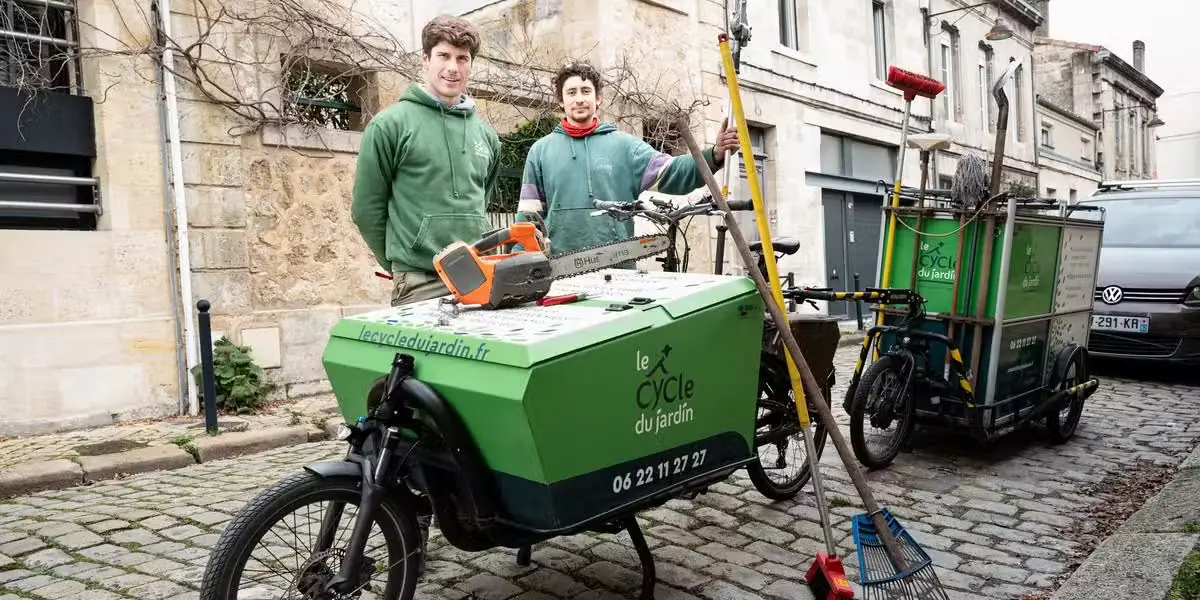
And then there are the problems that never appear in cycling plans. Premises, first: “I had nearly given up at one point, for lack of premises… it almost sank the model.” After-sales next: “there isn’t a single traditional bike shop that takes an interest in this type of bike, it isn’t worth their while […]. So we bring everything in-house.” Insurance last: “insurers aren’t proactive enough and don’t offer suitable products, because there aren’t enough of us.”
None of these difficulties is solved by a cheque at the point of purchase.
§ 7
The map of what is left
For a private buyer who wants to buy an electric cargo bike today, the amount of aid depends almost entirely on their postcode.
- Nantes 1 500 €
- Lyon 900 €
- Marseille 800 €
- Paris + Île-de-France Mobilités 1 200 €
- Toulouse 600 €
- Grenoble 500 €
- Strasbourg 500 €
- Bordeaux 350 €
- Rennes —
- Lille —
- Montpellier —
- Annecy —
- Chambéry —
Filled circles : purchase aid in force.
Hollow circles : no purchase aid for a private buyer. The amounts shown are maximums, rarely reached: most are reserved for households below a certain income, or for residents of a given area.
In Nantes, aid can reach 1 500 €, but it is reserved for household quotients of 900 or below: above that, nothing. In Lyon, up to 900 € subject to income, and on condition of buying from a retailer in the area — internet excluded. In Marseille, 800 €, with no income condition, but you have to live, study or work in the low-emission zone. In Paris, 600 €, capped at reference taxable incomes of 10 000 € per share or below. Île-de-France Mobilités adds 600 € with no income condition. Toulouse, 600 €. Grenoble and Strasbourg, 500 €. Bordeaux, 350 € at best.
In Rennes, no purchase aid: the metropolitan authority chose to fund a long-term rental offer instead. In the Lille metropolitan area, no metropolitan scheme either — only a few scattered municipal subsidies. In Montpellier, nothing left for a new cargo bike since April 2025.
The high amounts still exist, but they have moved. They go either to professionals — Grenoble grants up to 3 000 € to companies, Marseille 1 500 €, Paris 1 200 € — or to those who accept a heavy trade-off. Métropole Rouen Normandie can pay up to 2 500 € on a cargo bike, on condition that an old vehicle is scrapped.
In other words: the general subsidy to private buyers, the one that made the market take off between 2021 and 2024, has largely gone. What remains targets either the work tool or the replacement of a car.
And what remains sometimes hangs by a thread. Several of these subsidies — Marseille, Rouen, Strasbourg, Nancy — are tied to low-emission zones: you have to live or work inside the perimeter to qualify. Yet in spring 2026, Parliament voted the outright abolition of the ZFE, in article 37 of the law on simplifying economic life. On 21 May, the Constitutional Council struck that article down — not on the merits, but because it had no place in that text. A legislative rider. The low-emission zones therefore survived on a procedural flaw, and the subsidies that depend on them with them.
§ 8
What will not be given back
It would be easy to conclude that the parenthesis is closing. The sales figures invite it.
But a subsidised bubble that bursts leaves behind two very different things. On one side, opportunistic buyers who will not come back — the 2025 market lost them. On the other, two hundred companies that have built a business model around machines eight times cheaper to run than a fleet of vans, two thousand four hundred people who make a living from them, and thousands of tradespeople whose customers have got used to seeing them arrive by bike.
Those people did not buy a cargo bike because it was subsidised. They bought it because in a dense city centre it wins — on parking, on floor space, on journey time, on cost per kilometre. The subsidy merely sped up a discovery that urban congestion would have forced anyway.
That is the very definition of a Trojan horse: public money served to get the object through the gates. It is inside. You can take away its escort; it will not leave.
Sources
- Union des entreprises sport & cycle — Observatoire du Cycle 2025, the figures (27th edition, 24 April 2026)unionsportcycle.com/les-actualites/2026-04-24/observatoire-du-cycle-les-chiffres
- Union des entreprises sport & cycle — “Coup d’arrêt pour la fiche CEE cargo professionnels” (26 August 2025)unionsportcycle.com/les-actualites/2025-05-27/pas-de-fiche-cee-cargo
- Banque des Territoires — “Fiche CEE pour les vélos-cargos : un petit tour et puis s’en va” (3 October 2025)banquedesterritoires.fr/fiche-cee-pour-les-velos-cargos-un-petit-tour-et-puis-sen-va
- Légifrance — Decree no. 2024-1084 of 29 November 2024legifrance.gouv.fr/jorf/id/JORFTEXT000050690951
- Légifrance — Energy Code, article D251-1-3legifrance.gouv.fr/codes/article_lc/LEGIARTI000049133352/2024-12-01
- Légifrance — Order of 29 September 2025 repealing the TRA-EQ-131 certificatelegifrance.gouv.fr/jorf/id/JORFTEXT000052304412
- Service-public.gouv.fr — End of the bike bonus (fact sheet A17058)service-public.gouv.fr/particuliers/actualites/A17058
- DREAL Auvergne-Rhône-Alpes — “Les ZFE sont toujours en vigueur” (27 May 2026)auvergne-rhone-alpes.developpement-durable.gouv.fr/les-zfe-zones-a-faible-emission-sont-toujours-en-a28632.html
- Les Boîtes à Vélo – France, CMA France, Filière France Vélo, ADEME — Observatory of professional cycle mobility 2024lesboitesavelo.org/wp-content/uploads/2025/02/Observatoire-des-cyclomobilites-professionnelles-2024-Interactif.pdf
- Les Boîtes à Vélo – France / ADEME — Overview of cyclologistics in France (2023)librairie.ademe.fr/mobilite-et-transport/6499-panorama-de-la-cyclologistique-en-france.html
- City of Paris — Mobility subsidiesparis.fr/pages/lutte-contre-la-pollution-les-aides-a-la-mobilite-5373
- Île-de-France Mobilités — Bike purchase aidiledefrance-mobilites.fr/services-mobilite-alternative/aide-achat-velos
- Métropole de Lyon — Aid for buying a bikeavelo.grandlyon.com/choisir-son-velo/les-aides
- Nantes Métropole — Solidarity aid for buying a bikemetropole.nantes.fr/mes-services-mon-quotidien/aides-et-bons-plans/aides-a-l-achat-de-velo
- Grenoble-Alpes Métropole — Purchase aid returns on 31 October 2025grenoblealpesmetropole.fr/actualite/522/45-l-aide-a-l-achat-d-un-velo-revient-a-partir-du-31-octobre.htm
- Grand Annecy — Bike purchase aidaide-velo.grandannecy.fr
- Montpellier Méditerranée Métropole — Resolution no. M2025-107 of 8 April 2025montpellier.fr/sites/default/files/2025-04/Delib_M2025-107_ArretDispositifAideRepa.pdf
- Métropole Aix-Marseille-Provence — ZFE mobility aid rulesampmetropole.fr/wp-content/uploads/2024/11/96120_Annexe-1-2-particulier-1.pdf
- Métropole Rouen Normandie — ZFE-m aid “I replace my vehicle with a bike”zfe.metropole-rouen-normandie.fr/sites/default/files/2025-10/B2025_0429_annexe.pdf
- Les Boîtes à Vélo – France — Cyclo-cargologie programmelesboitesavelo.org/cyclocargologie
VELODISCO — THE LONG RIDE #06 Published 15 August 2026