IN BRIEF
A study by linexo, a bicycle insurer and rental company, published on 2 November 2026, estimates that adults in Germany cycle around 190 million kilometres every day: 130 million on a conventional bike and 60 million on an e-bike. Bikes and e-bikes account for 27% of the time spent travelling, behind cars and car sharing (55%) but ahead of public transport (19%). In terms of distance, the car remains far ahead: 73% of the 38 kilometres travelled daily, against 9% on two wheels. The study finds that the North and West pedal for longer than the South and East.
| Daily distance cycled (adults) | around 190 million km |
| of which conventional bikes | around 130 million km |
| of which e-bikes | around 60 million km |
| Share of travel time | 27 % |
| Average time cycling | 15 min 19 s per day |
| Sample | 1,094 participants aged 18 to 69 |
| Period | March to November 2025 |
To produce these figures on cycling in Germany, around 1,000 adults kept a diary of their journeys for 30 weeks, from March to November 2025. It is a longer exercise than a one-off survey, carried out by linexo, a bicycle insurer and rental company based in Hanover.
Cycling in Germany: a quarter of travel time
The study states that an adult spends on average 15 minutes and 19 seconds a day on a bike or e-bike. It puts this share at 27% of daily mobility time: second place, behind cars and car sharing (55%), ahead of buses, trams and trains (19%).
Usage differs depending on the machine. On weekdays, conventional bikes are used first for shopping (49%) and leisure (40%), with commuting coming next (37%). On e-bikes, leisure comes first (49%), ahead of shopping (43%) and work (27%).
“Our mobility diary shows how much, why and for how long people use bikes and e-bikes,” explains Sören Hirsch, head of department at linexo. “Active mobility is everyday life. And Germany is a cycling country,” he adds.
Over distance, the car keeps the upper hand
Time does not tell the whole story. The study finds that, of the 38 kilometres travelled on average each day, 73% are covered on four wheels and only 9% on two.
Sören Hirsch sees room for growth: “The data show both: how far we have come, and how much potential remains for more journeys by bike and e-bike.”
The North and West pedal for longer
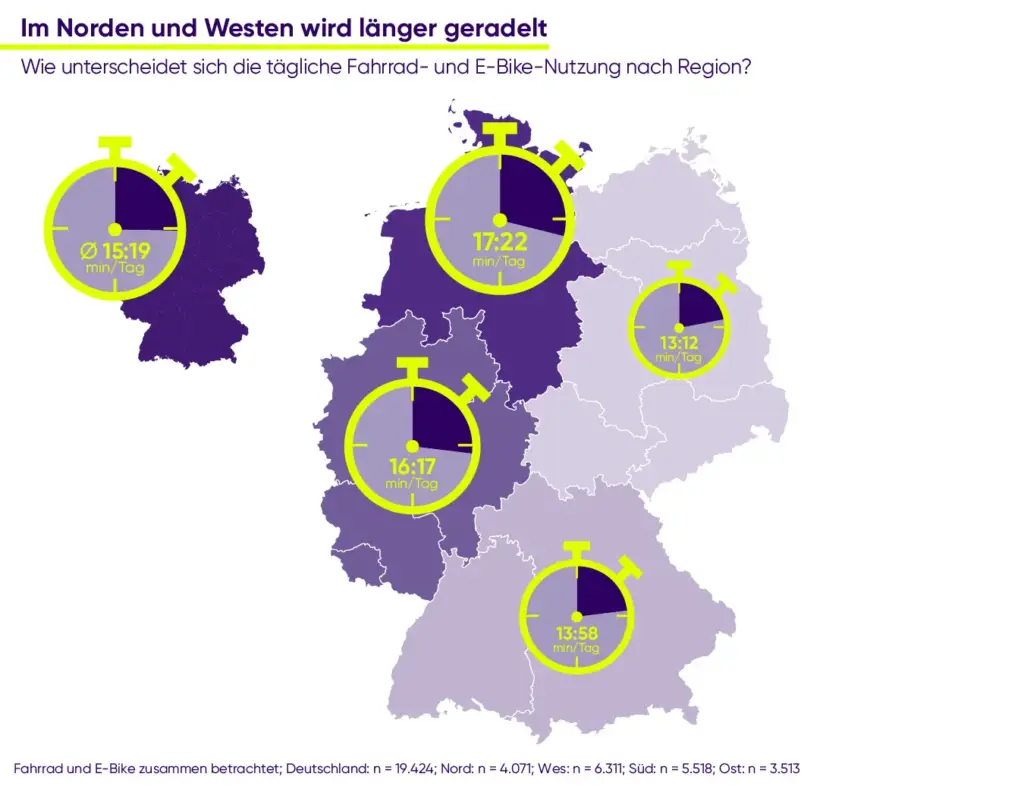
The regional differences are clear. In the North, people ride more than 17 minutes a day, and more than 16 minutes in the West, above the national average. In the South and East, time spent cycling falls below 14 minutes. The study also notes differences in bike use by age, gender and region.
An insurer’s study, based on an online panel
linexo is part of the Wertgarantie insurance group. For this study, 1,094 participants aged 18 to 69 were recruited from an online panel, representative by age, gender, educational attainment, employment status, and size and location of place of residence. After cleaning, 14,318 complete weekly reports were used. linexo specifies that the 190 million kilometres are an extrapolation of these diaries to the entire adult population.
The study can be requested free of charge on linexo’s mobility page. Four more detailed publications, each devoted to one theme, are due to follow.