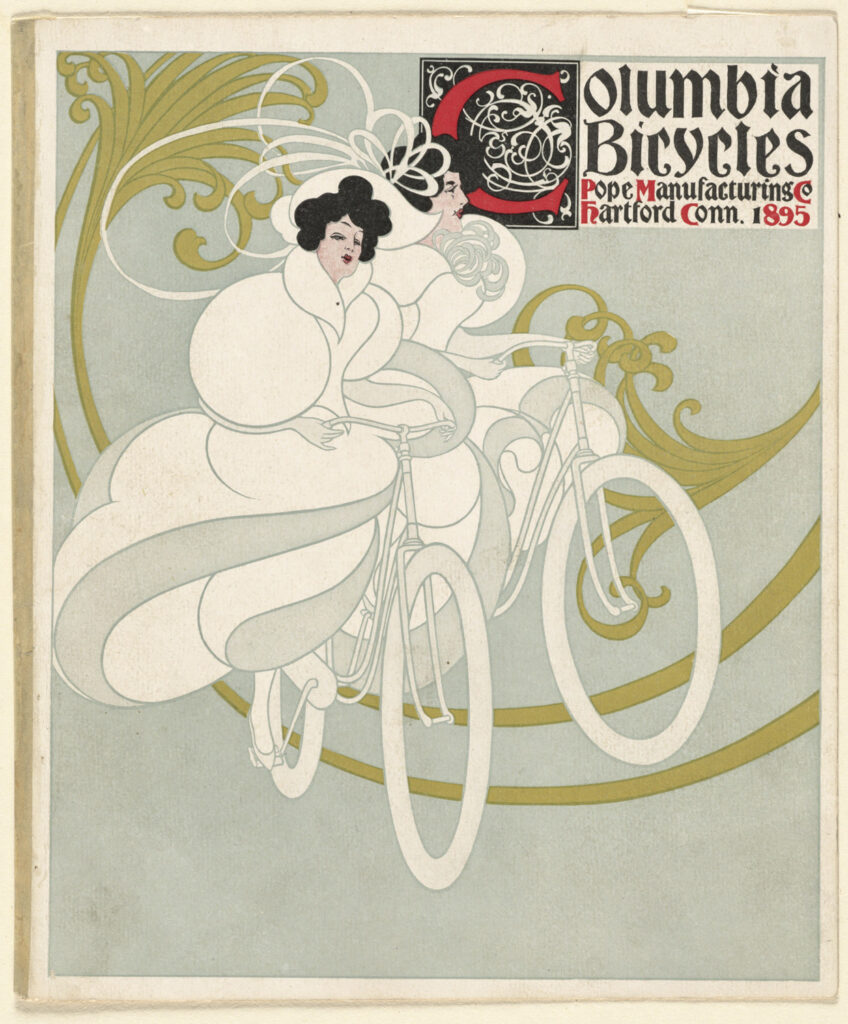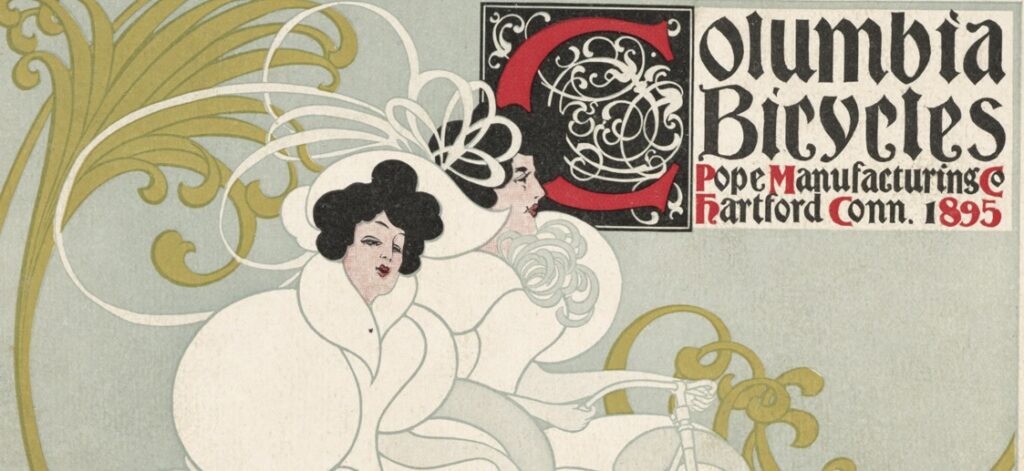
At the end of the nineteenth century, a two-wheeled machine did more for women’s emancipation than a great many political speeches. From New York to Paris by way of Brighton, it tore through skirts and corsets, opened up forbidden roads and rode alongside the first voices of suffrage. The story of a quiet revolution pedalled by women no one remembers — and by a few pioneers whose names history finally kept.
1885: the machine that changed everything
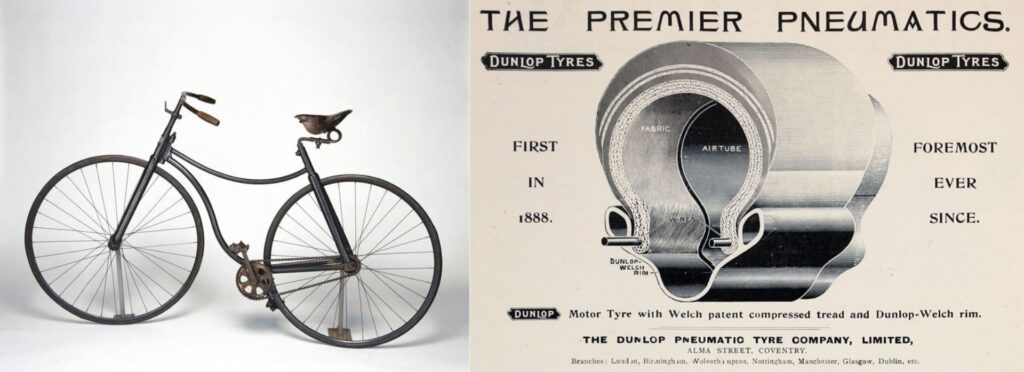
In 1885, Britain’s John Kemp Starley brought his Rover Safety Bicycle to market. Two wheels of equal size, a chain carrying power to the rear wheel, a saddle close to the ground. The bicycle was no longer the perilous penny-farthing of athletes — it was a machine anyone could climb onto. Three years later, in 1888, Scotland’s John Boyd Dunlop patented the pneumatic tyre. Comfort moved into another dimension.
The figures followed. In the United States, around 200,000 bicycles were built each year in 1889; ten years later, in 1899, annual output passed a million units. By the middle of the 1890s, estimates counted 2 to 4 million cyclists across the Atlantic. On the old continent, the spread was just as fast: between 1880 and 1890, the price of a bicycle collapsed, putting it within reach of the middle classes and then of working people. Pierre Giffard would title his 1899 essay La Fin du cheval (The End of the Horse), predicting a world in which the bicycle and then the motor car would have replaced the horse and carriage.
This democratisation matters more than it looks. For the first time in modern urban history, hundreds of thousands of city dwellers had an individual means of transport — silent, cheap, requiring neither coachman nor stable. It was into this technological, and cultural, breach that women poured.
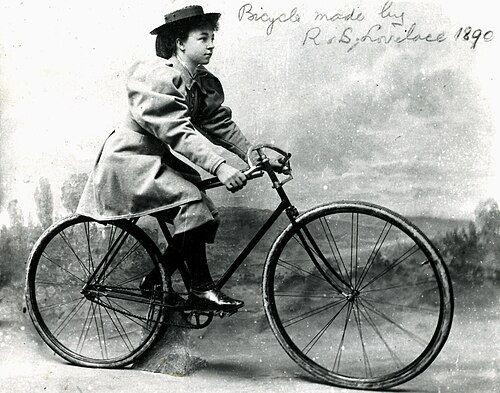
The pioneers nobody expected
The standard image of the 1890s woman cyclist — a young white woman in bloomers, with a half-smile — hides a range of stories that posterity has sometimes forgotten.
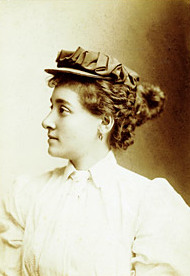
Annie Londonderry, the exile who circled the planet
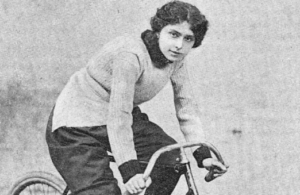
Annie Cohen Kopchovsky, a Latvian Jewish immigrant living in Boston and the mother of three small children, took on a probably fictitious (but cleverly publicised) wager in 1894: to ride around the world in fifteen months, setting out penniless and earning $5,000 along the way. She adopted a stage name — Annie Londonderry, after her sponsor, a New Hampshire mineral water brand — and left Boston on 25 June 1894. She was back in Chicago on 12 September 1895. The journey was a patchy one, mixing real riding with long stretches by boat or train (Marseille-Egypt-Ceylon-Singapore-Japan). Her great-grand-nephew, the journalist Peter Zheutlin, would sum it up like this: “Annie was a great achiever, but she had a rather casual relationship with the truth.” No matter: the icon was born. A woman could present herself to the world without a man’s permission.
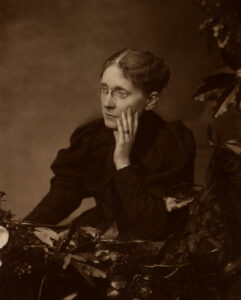
Frances Willard and her Gladys
Frances Willard, president of the Woman’s Christian Temperance Union — the largest American women’s organisation of the day, anti-alcohol and pro-suffrage — learned to ride at 53. She named her machine Gladys and told the story of her apprenticeship in a short book published in 1895, A Wheel within a Wheel. The book became a manifesto of bodily mastery. Sold in tens of thousands of copies, it did more for the cause of women’s cycling than a thousand pamphlets: it told mature women, weary of the home, that it is never too late to get back in the saddle.
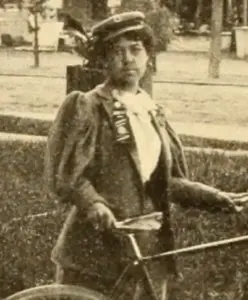
Kittie Knox, the forgotten colour
Kittie Knox, born in Cambridge (Massachusetts) in 1874 to a white mother and a Black father, co-founded in 1893 the Riverside Cycling Club, the first African-American cycling club in the United States. That same year she joined the League of American Wheelmen (LAW), the big national federation. In 1894, the LAW voted in a colour clause restricting membership to white riders. In 1895, at the national meet in Asbury Park, New Jersey, the federation ruled: since the clause was not retroactive, Knox kept her membership card. She raced the championship and finished 12th out of 50 — men and women together — in trousers she had made herself. Later, under pressure from segregationist members threatening to resign, she was pushed out of the federation. She died at 26 in 1900 of kidney disease, all but forgotten, until the archives returned her to the collective story a century later.
Hélène Dutrieu, the other flight
In France, Hélène Dutrieu was racing the board tracks at 17 — in Paris, but above all in Belgium. Unofficial world track sprint champion at Ostend in 1896 and 1897, she lost her title in 1898 to France’s Louise Roger. She would later become one of the first women aviators in history — another freedom won on wheels.
“Bicycle face” and other moral panics
Every liberation raises its guardians. As women got into the saddle, part of the medical profession — relayed by a mocking press — diagnosed a new female pathology: the “bicycle face”. The symptoms? A clenched jaw, a fixed stare, dark rings under the eyes, drawn features. The cause? Effort, fear, the strain of handling a machine. The prognosis? Nervous exhaustion, depression, tuberculosis, infertility. A few doctors went further and raised risks to morality, the rubbing of the saddle being suspected of awakening unwanted sensations.
The case was so crude that it prompted its own demolition. In 1897, the Phrenological Journal published a scalpel-sharp reply from Dr Sarah Hackett Stevenson, a well-known Chicago physician: the “cyclist’s face” is only a beginner’s expression, she wrote; it fades as confidence settles in. As for the supposed harm to health, the truth is simply the reverse: riding a bicycle improves fitness and mood.
The “bicycle face” turned out to be a medical hoax — but for a while it worked as a social brake. It is also a useful reminder that moral panics are often the exact negative of an emancipation under way.
From the handlebars to the ballot box
On 8 April 1896, in Paris, the International Congress of Women opened in the studious calm of a Left Bank salon for five days of proceedings. Maria Pognon, its president, delivered there the line that has stayed famous — she hailed “the egalitarian, levelling bicycle through which women’s emancipation will be achieved”. Barely two months earlier, the suffragist Susan B. Anthony had given the journalist Nellie Bly her own, just as striking. The coincidence is no coincidence: on both shores of the Atlantic, the leaders of the feminist movement had understood that the machine was riding with them.
The link between the bicycle and the vote is neither mechanical nor causal — it should not be overstated. New Zealand granted women the vote in 1893, before the peak of the “bicycle craze”. French women would not vote until 1944, half a century later, despite an early spread of cycling. The bicycle did not vote for women; it taught them to vote for themselves.
In the years 1900-1910, British and American suffragettes rode right out into the street, with banners reading “Votes for Women” tied to their handlebars. The bicycle became both a leafleting tool and a symbol of the cause. One phrase, credited sometimes to Anthony, sometimes to Elizabeth Cady Stanton, went round the English-language press: “Woman is riding to suffrage on the bicycle” — woman is riding towards the vote on a bicycle.
An unfinished liberation
One hundred and thirty years later, in Western cities, women still ride less than men. In Paris, Lyon and Bordeaux, recent counts show a majority of male users on the cycle lanes — less marked than in the Netherlands or Denmark, but persistent. The reasons are well known: a sense of danger in traffic, harassment, and the mental load of family life, which makes the chained trip (school-shopping-work) harder to complete by bike.
But the diagnosis made by Anthony and Pognon has not aged. Mobility is a material condition of autonomy. Giving a woman a saddle gives her back control over a portion of her time and her space. It is, in modest doses, an extension of the straight line they began to trace in 1895 on English roads, in Parisian velodromes, on the cobbles of Boston.
A quiet revolution is sometimes worth more than a noisy one. For fifteen years, at the end of the nineteenth century, hundreds of thousands of women changed their lives with a turn of the pedals, and without a manifesto. The bicycle opened for them the door that societies wanted to keep shut. It is, all in all, the finest advertisement ever written for a bicycle.
Sources and references
- Nellie Bly, “Champion of Her Sex: Miss Susan B. Anthony”, The New York World, 2 February 1896. Full text of the quotation reproduced by TeachIt CT.
- National Women’s History Museum, “Pedaling the Path to Freedom”.
- Smithsonian Institution, “How the 19th-century bicycle craze empowered women and changed fashion”.
- Library of Congress, “Women and Bicycles”.
- Frances E. Willard, A Wheel within a Wheel: How I Learned to Ride the Bicycle, 1895. Project Gutenberg.
- Peter Zheutlin, Around the World on Two Wheels: Annie Londonderry’s Extraordinary Ride, Citadel Press, 2007. Dedicated website: annielondonderry.com.
- Jewish Women’s Archive, “First woman to cycle the globe begins journey”.
- Brighton and Hove Museums, “Record breaking Brighton cyclist, Tessie Reynolds”.
- Sheila Hanlon, “Tessie Reynolds: The Stormy Petrel”.
- Cambridge Black History Project, “Katherine T. “Kittie” Knox”.
- League of American Bicyclists, “Women’s (Bike) History: Kittie Knox”.
- Sheila Hanlon, “Bicycle Face: A guide to Victorian cycling diseases”.
- Helen Rappaport, “Women in Trousers — From Bloomers to Rational Dress”.
- Pierre Giffard, La Fin du cheval (The End of the Horse), illustrated by Albert Robida, Armand Colin, 1899.