Electric bikes capped at 25 km/h: what the law actually says
Everyone quotes the figure; almost nobody has read the text. The 25 km/h are not a speed limit: they are a legal border.
On one side, a bicycle, and no formalities. On the other, a moped, with a plate, insurance, a type-approved helmet and cycle paths off limits. Same machine, same person, two worlds. Here is what the texts write, word for word — and what they do not say.
What to remember
- French law defines the pedal-assist bike by three conditions that go together: a motor rated at no more than 0.25 kilowatts, assistance that cuts out at 25 km/h, and that also cuts out as soon as you stop pedalling (Article R311-1, point 6.11 of the Highway Code).
- Those 25 km/h do not limit the bike, only the motor. Carrying on pedalling faster, downhill or on the flat, remains perfectly legal.
- The threshold does not come from Paris. It comes from a 2013 European regulation which, rather than authorising the electric bike, excludes it from motor-vehicle law.
- Once crossed, the border changes the machine’s category: it becomes a moped, with registration, insurance, a type-approved helmet, certified gloves and cycle paths closed by default.
- The €30,000 fines quoted everywhere do exist. But the two articles that carry them expressly target the professional and the operator in charge — not the private individual tinkering with their own bike.
Three machines, three statuses
The same object, three legal regimes| Criterion | Pedal-assist electric bikecycle | Derestricted bikenon-approved vehicle | Speed pedelec (45 km/h)L1e-B moped |
|---|---|---|---|
| Continuous rated power | 0.25 kW maximum | beyond that, outside the definition | up to 4 kW (category L1e) |
| Assistance cuts out at | 25 km/h | — that is the whole point of derestricting | 45 km/h |
| Legal status | cycle | vehicle that should be type-approved, and is not | moped (L1e-B) |
| Licence | none | required, and absent | AM licence (exempt if born before 1st January 1988) |
| Registration | no | required, and absent | yes, plate at the rear |
| Insurance | private third-party liability | motor-vehicle insurance required | motor-vehicle insurance |
| Helmet | optional, except under 12 | required, and absent | type-approved helmet and certified gloves |
| Cycle paths | yes | no | no, unless the police authority decides otherwise |
The middle column is not a category of the Highway Code: it is what a derestricted bike becomes, a vehicle that falls under moped rules without having moped type-approval.
1. What the law says, in one sentence
France’s Highway Code never mentions an “electric bike”. It talks about a pedal-assist cycle, and defines it in point 6.11 of Article R311-1, in a single sentence.
Three conditions, and they hold together. A motor rated at no more than 250 watts. Assistance that fades out at 25 km/h. Assistance that also fades out when the legs stop. Let a single one fall, and the machine is no longer a pedal-assist cycle within the meaning of the Code. That does not make it “illegal”: it makes it something else. That is the whole difference, and that is where the trouble starts.
Diagram 1
The border
What appears at the exact moment assistance goes past 25 km/h. Nothing changes on the machine; everything changes in its legal regime.
2. The line was not drawn in Paris
It is assumed to be French; it is European, and it is written the other way round from what one imagines. Regulation (EU) No 168/2013 sets the type-approval rules for powered two- and three-wheelers, then lists what it does not apply to.
So the electric bike is not authorised up to 25 km/h. It is taken out of the scope of motor-vehicle law below 25 km/h. The nuance sounds academic; it explains everything else. A pedal-assist cycle does not need to be type-approved, registered, insured like a vehicle or ridden with a licence — not because a text exempts it, but because none of those texts is looking at it.
The same regulation also shows what sits just above. Its L1e category covers vehicles whose maximum design speed does not exceed 45 km/h and whose continuous rated power does not exceed 4,000 watts. It splits in two: L1e-B, the “two-wheel mopeds”, and L1e-A, which the regulation calls the “powered cycle” — a pedal cycle whose assistance cuts out at 25 km/h but whose power may reach 1,000 watts. In other words, Europe did make room for a 1,000-watt assisted bike. It made it a moped.
Diagram 2
The European categories
Derestricting does not take you outside the law: it moves you to another box. And the box just above the bicycle is already called “moped”, even when the regulation names it “powered cycle”.
3. “Capped” does not mean “limited”
It is the most widespread misunderstanding, and it comes down to a badly chosen word. The law does not cap the speed of the bike: it caps the speed of the assistance. Past 25 km/h the motor steps aside and the bike carries on. Descending a mountain pass at 55 km/h on a pedal-assist bike breaks no rule at all — only the road’s speed limits apply, as for any cyclist. An electric bike is not a machine capped at 25 km/h. It is a bike whose motor stops at 25 km/h.
The second misunderstanding is about watts. The French and European texts alike refer to continuous rated power, meaning what the motor can sustain without flagging, not the peak it delivers for three seconds off the line. A motor sold as “250 W rated” can advertise 600 or 800 watts of peak power and stay within the definition. That is not a loophole: it is the exact wording of the text. Hence the gap, baffling for buyers, between two perfectly legal bikes, one of which visibly pushes harder than the other.
Diagram 3
Rated versus peak
A “250 W” motor that delivers 500 W at peak stays legal, because the text only looks at one of the two bars.
4. On the other side: the speed pedelec
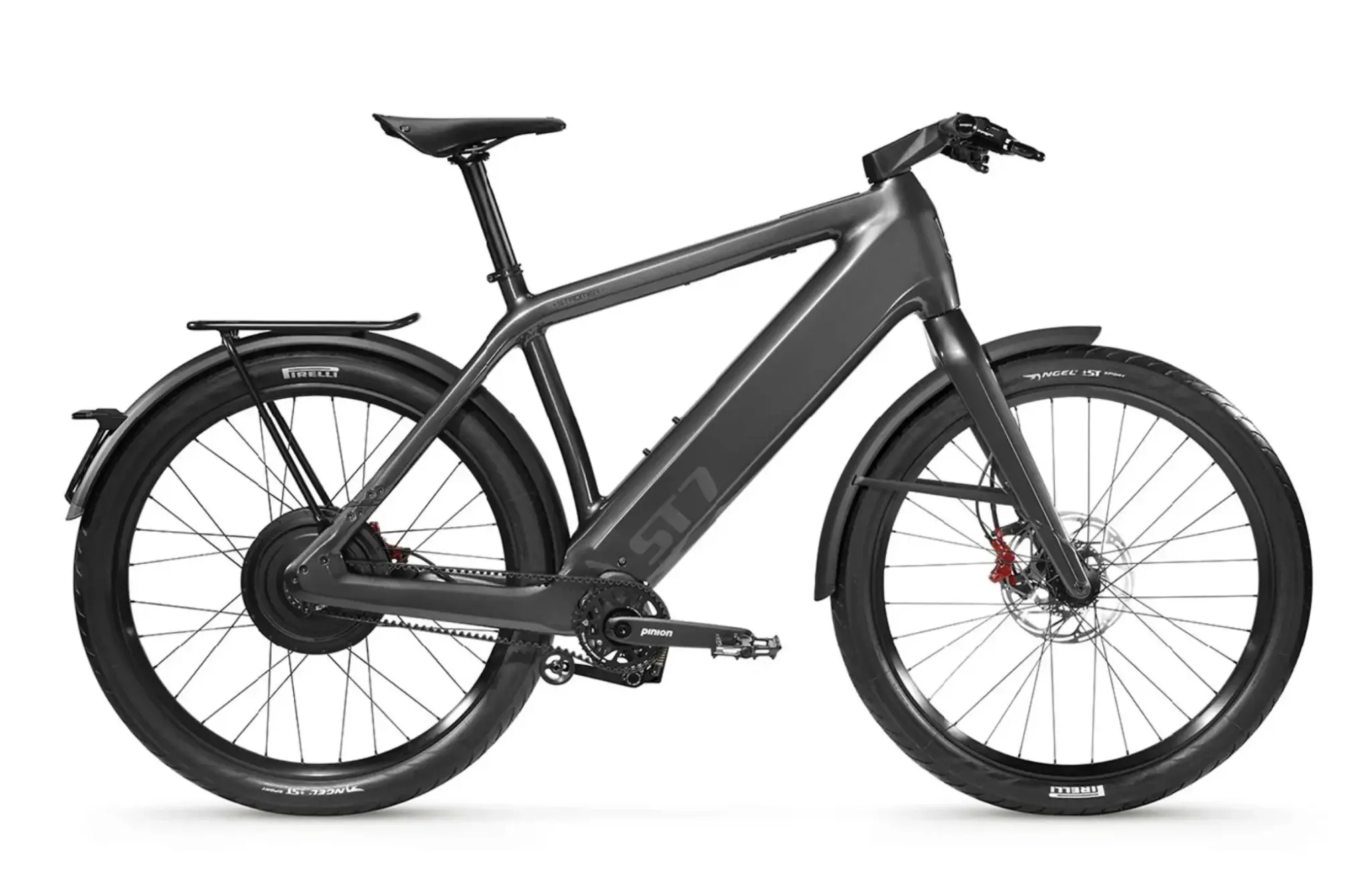
The bike that assists up to 45 km/h exists, it is sold in France, and it is not a bicycle. The Highway Code defines the moped, in point 4.8 of the same Article R311-1, as a “vehicle of category L1e or L2e” — so, for a fast two-wheeler with pedals, an L1e-B. The shift in vocabulary is complete: on the product sheet it is a bike, on the registration certificate it is a moped.
The instructions no buyer can find anywhere
 A registration certificate and a number plate. Putting a vehicle on the road without having obtained its registration certificate is punished with a fourth-class fine (Article R322-1).
 A licence. Riding a moped requires category AM of the driving licence: Article R211-2 of the Highway Code only imposes it on people born after 31 December 1987; those born before 1st January 1988 are exempt.
 Motor-vehicle insurance. It is compulsory, and riding without it is not a fine but a criminal offence: €3,750, reduced in practice to a fixed penalty of €500 (Article L324-2).
 A type-approved helmet, fastened. Article R431-1 requires it of every moped rider and passenger, on pain of a fourth-class fine and three points off the licence for those who hold one.
 Gloves. Article R431-1-2 requires gloves that meet personal-protective-equipment rules of every moped rider or passenger — a third-class fine, one point.
 No cycle paths. Article R431-9 provides that riders of two-wheel mopeds “may be authorised to use cycle lanes and cycle paths by decision of the authority holding police powers”. May be authorised: without a local decision, the answer is no.
That last point is the hardest to accept, and the most logical. People buy a fast bike to move quickly around town, and the town closes to it precisely the lanes where one can go fast without danger. The speed pedelec spends its life in motor traffic.
5. Derestricting: what the Code says, and to whom
A search on derestricting returns the same sentence everywhere: one year in prison, a €30,000 fine, three years’ licence suspension. Those penalties exist. They appear in two articles of the Highway Code, and it is worth reading whom they name.
Neither of those two articles names the private individual who derestricts their own bike for their own use. That does not mean they risk nothing: what catches them takes another route, that of the change of category. Their bike no longer meets the definition in point 6.11; it now falls under moped rules, without the type-approval, the registration, the insurance or the helmet. Each of those absences has its own article, and they have just been listed. Added to them is a text aimed at the machine itself once it has become a moped: Article R317-23-1 punishes with a fourth-class fine “the use of a moped […] fitted with a device whose effect is to allow it to exceed the regulatory limits set in Article R. 311-1 […] or which has been modified to that end”, and provides for immobilisation, impounding and confiscation as an additional penalty.
The costliest part remains, and it is the silence of the texts that puts it there. The Insurance Code requires every keeper of a motor land vehicle to hold third-party liability insurance (Article L211-1), and defines such a vehicle as “any self-propelled vehicle intended to travel on the ground and which can be driven by mechanical force without being bound to a railway track”. As long as the machine is a pedal-assist cycle, the liability cover of a home-insurance policy treats it as a bicycle. The moment it no longer is one, that cover no longer applies — and an accident is then settled out of the assets of whoever modified the machine. The criminal penalty is uncertain; the civil bill is not.
6. Conversion kits, the grey zone
Electrifying an ordinary bike changes nothing in the equation, and that is good news. A kit that stays under 0.25 kilowatts rated, cuts assistance at 25 km/h and fades out when you stop pedalling produces a pedal-assist cycle within the meaning of point 6.11. The bike remains a bike. No text requires it to have been electrified in a factory.
Above that, the reasoning flips and becomes unworkable. A more powerful kit builds a vehicle that falls into category L1e, and the application for a registration certificate requires, among other documents, proof that the vehicle conforms to an approved type or has been individually approved (Article R322-1, I, 4°). You do not end up with a bike that is a little too strong, but with a moped you will never be able to register.
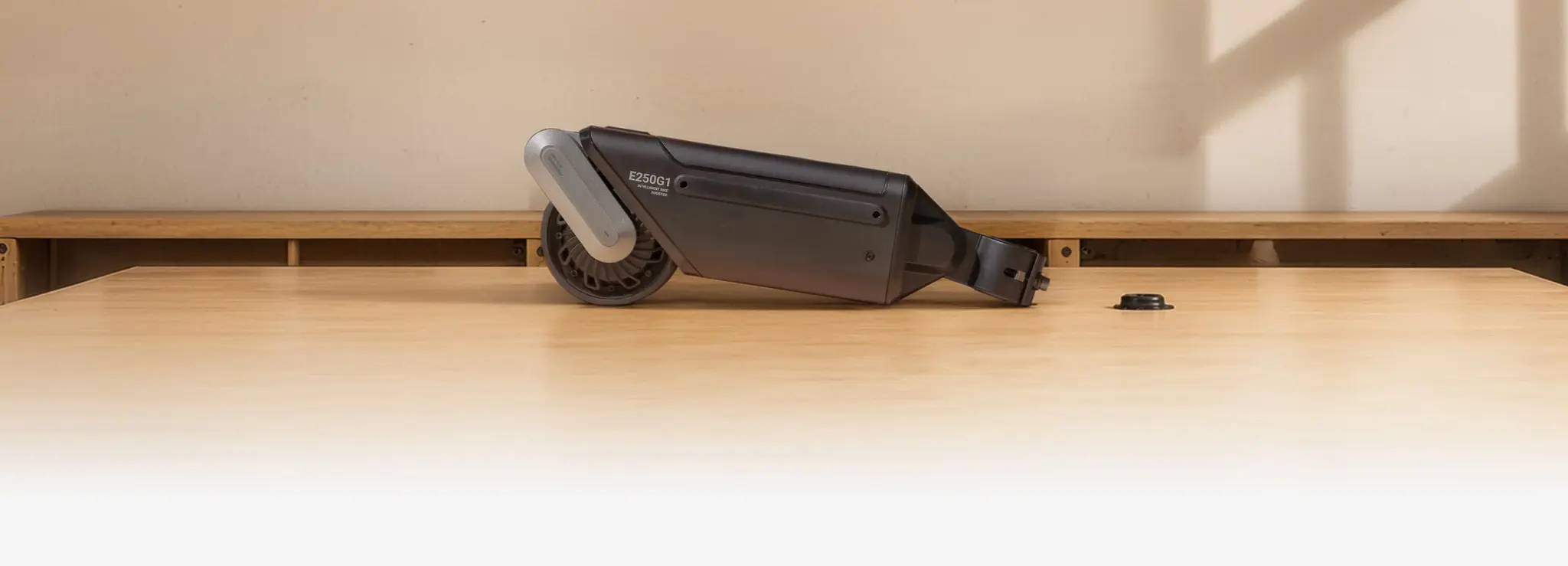
Product sheets tell this border better than any commentary. When ASUS unveiled its Oxiis E250G1 friction-drive kit, it announced 250 watts rated and 500 watts peak — within the lines, since only the rated figure counts — but assisting up to 32 km/h, seven too many. The manufacturer said a restriction was planned, without specifying for which countries. Seven kilometres per hour separate, on the same machine, a bicycle from a moped.
7. Why the line will not move
One may find 25 km/h too slow. The argument comes back with every rise in speed-pedelec sales. It runs into the nature of the threshold: this is not a road-safety setting that France could raise on its own, it is the exclusion limit of a European regulation. Moving it would not make bikes faster — it would tip, in one go, into bicycle law machines that the same regulation classes today as mopeds, with their plates and their insurance.
Until then, the only thing to remember fits on one line: what separates a bicycle from a moped is neither its speed, nor its weight, nor its price. It is one sentence, at point 6.11 of an article of the Highway Code.
Frequently asked questions
Can you ride faster than 25 km/h on a pedal-assist electric bike?
Yes. The law cuts the assistance at 25 km/h, not the bike. Beyond that, you move on leg power alone, within the speed limits of the road you are on.
Is a 500-watt electric bike legal in France?
Not as a bicycle, if those 500 watts are the continuous rated power: point 6.11 of Article R311-1 caps it at 0.25 kilowatts. On the other hand, a motor rated at 250 watts that shows higher peaks stays within the definition, because the text only looks at continuous rated power.
Do you need insurance for a pedal-assist electric bike?
No motor-vehicle insurance is required as long as the machine meets the definition of a pedal-assist cycle: it falls under private third-party liability. For a speed pedelec, motor land vehicle insurance is compulsory, and riding without it is punished with a €3,750 fine (Article L324-2).
Is a helmet compulsory on an electric bike?
Not for an adult. It is, however, for every cycle rider or passenger under twelve (Article R431-1-3), and for every moped rider, hence on a speed pedelec (Article R431-1).
What do you really risk by derestricting your electric bike?
The €30,000 penalties of Articles L317-1 and L317-5 name the operator in charge and the professional. The private individual, meanwhile, rides a machine that now falls under moped rules without the registration, the insurance or the helmet — and whose bicycle insurance no longer applies in the event of an accident.
Can a speed pedelec use a cycle path?
Not by default. Article R431-9 allows the authority holding police powers to admit two-wheel mopeds onto cycle lanes and cycle paths: without that local decision, access is closed.
Sources
- Highway Code, Article R311-1 (definitions, points 4.8 and 6.11) — Légifrance: legifrance.gouv.fr/codes/article_lc/LEGIARTI000051682572
- Regulation (EU) No 168/2013 of the European Parliament and of the Council of 15 January 2013, Article 2(2)(h) and Annex I — EUR-Lex: eur-lex.europa.eu · CELEX:32013R0168
- Highway Code, Article L317-1 — Légifrance: legifrance.gouv.fr/codes/article_lc/LEGIARTI000039784406
- Highway Code, Article L317-5 — Légifrance: legifrance.gouv.fr/codes/article_lc/LEGIARTI000039784399
- Highway Code, Article L324-2 (lack of insurance) — Légifrance: legifrance.gouv.fr/codes/article_lc/LEGIARTI000033460260
- Insurance Code, Article L211-1 — Légifrance: legifrance.gouv.fr/codes/article_lc/LEGIARTI000048523650
- Highway Code, Article R431-1 (helmet) — Légifrance: legifrance.gouv.fr/codes/article_lc/LEGIARTI000006842331
- Highway Code, Article R431-1-2 (gloves) — Légifrance: legifrance.gouv.fr/codes/article_lc/LEGIARTI000033132243
- Highway Code, Article R431-1-3 (helmets for under-12s) — Légifrance: legifrance.gouv.fr/codes/article_lc/LEGIARTI000033669070
- Highway Code, Article R431-9 (cycle lanes and paths) — Légifrance: legifrance.gouv.fr/codes/article_lc/LEGIARTI000030851697
- Highway Code, Article R317-23-1 (use of a modified machine) — Légifrance: legifrance.gouv.fr/codes/article_lc/LEGIARTI000042266055
- Highway Code, Article R211-2 (AM licence, cut-off date) — Légifrance: legifrance.gouv.fr/codes/article_lc/LEGIARTI000029685236
- Highway Code, Article R322-1 (registration certificate) — Légifrance: legifrance.gouv.fr/codes/article_lc/LEGIARTI000006841775
- “Which driving licence do you need for which category of vehicle?” — service-public.gouv.fr: service-public.gouv.fr/particuliers/vosdroits/F12096