IN BRIEF
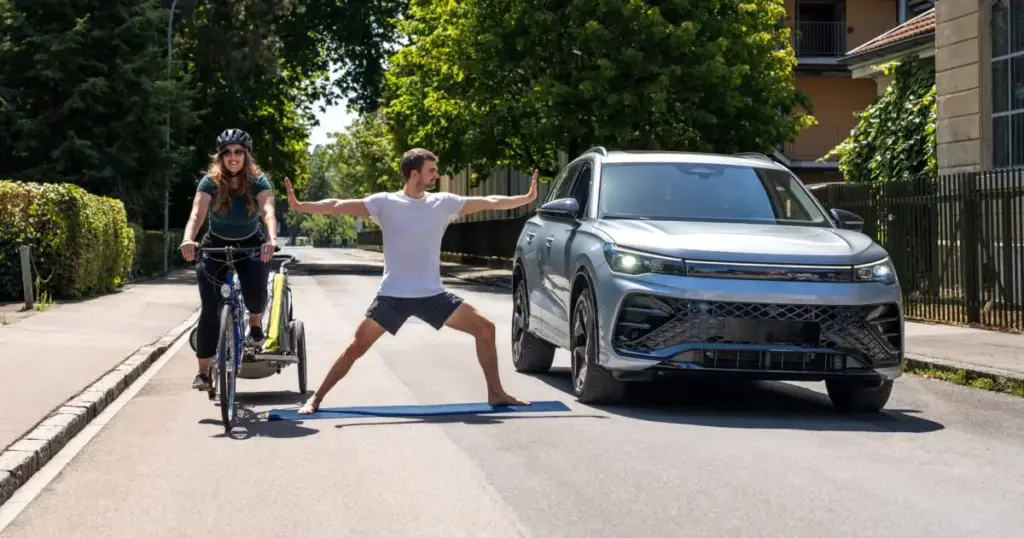
On 20 September, the Swiss transport and environment association (ATE) published a survey carried out by DemoSCOPE among 1,009 people in Switzerland: 52% of them consider the distance at which cars overtake bikes in town to be a problem, and 57% say they are in favour of writing a minimum distance of 1.5 metres into law. Support rises to 72% among people who ride regularly, and more than half of motorists are in favour too. The association also draws on its own measurements, taken with the Eastern Switzerland University of Applied Sciences: across more than 5,000 overtakes recorded with an ultrasonic sensor, the average distance comes to 1.2 metres and 79% of manoeuvres pass closer than 1.5 metres. Swiss law, for its part, currently asks for no more than “a sufficient distance”, without putting a figure on it.
| Survey | DemoSCOPE, commissioned by the ATE, August 2026 |
| Sample | 1,009 people in Switzerland, including 373 regular cyclists |
| Consider the distance a problem | 52 % |
| In favour of 1.5 m in law | 57% (72% among regular cyclists) |
| Often feel at risk (roads limited to 50 km/h) | 57% of regular cyclists |
| Often feel at risk (30 km/h zones) | 49 % |
| Field measurements (ATE / OST, seven cities) | more than 5,000 overtakes over about 1,500 km |
| Average measured distance | 1,2 m |
| Overtakes under 1.5 m / under 1 m | 79 % / 34 % |
| Car-bike overtaking crashes (2025) | 163, of which 146 with casualties (those 146 up 23% on 2016) |
In Switzerland, the law asks a driver overtaking a cyclist to leave “a sufficient distance”. It does not say what that means in centimetres. The Swiss transport and environment association (ATE) wants that vagueness gone, and on 20 September it published a survey meant to show that public opinion is ahead of the law: a majority of Swiss people, cyclists and motorists alike, want a figure written down in black and white.
An overtaking distance that 57% of respondents want written into law
The survey was entrusted to the DemoSCOPE institute, which questioned 1,009 people online across Switzerland during August. According to the press release, 52% of respondents consider the distance at which cars overtake bikes in Swiss towns and cities to be a problem. The second finding goes further, since 57% say they are in favour of introducing a minimum overtaking distance of 1.5 metres into law.
Unsurprisingly, the demand is backed most strongly by those who pedal: the ATE records 72% support among people who travel regularly by bike. More notably, the press release stresses that support does not stop at the handlebars: more than half of motorists also come out in favour of a minimum distance. The 20 September press release puts no further figure on that last group.
The survey also measures the sense of insecurity, and it points to a fairly clear culprit: the speed limit. Among the 373 regular cyclists questioned on this point, 57% say they often feel at risk when being overtaken on roads limited to 50 km/h. In 30 km/h zones the proportion falls back to 49% — a real improvement, but one that still leaves nearly one cyclist in two uncomfortable.
An ultrasonic sensor to put a figure on what the law does not
The survey follows up on fieldwork the association had made public a month earlier, on 17 August. Working with the Eastern Switzerland University of Applied Sciences (OST), the ATE measured overtaking distances in seven Swiss cities, using a bike fitted with an ultrasonic sensor to record the gap left by the vehicles passing it.
The protocol recorded more than 5,000 overtakes over about 1,500 kilometres. The average distance comes to 1.2 metres, below the recommended 1.5 metres. The distribution is more telling still: 79% of overtakes were made at less than 1.5 metres, and 34% at less than one metre. In other words, one manoeuvre in three leaves the cyclist less than an arm’s length of room.
These measurements frame a crash figure the ATE takes from the Federal Statistical Office. According to the Federal Statistical Office, quoted by the association, an overtaking crash involving a passenger car and a bike or an e-bike happened almost every other day in 2025, with the person behind the wheel identified as mainly responsible. In total, 163 crashes of this type were recorded. Of those, 146 caused casualties, up 23% on 2016.
“Much too vague”: what the ATE is asking of lawmakers
For the association, the problem lies first of all in the wording of the law as it stands. “Safety when overtaking is not a concern that affects cyclists alone,” says Edward Weber, a project manager at the ATE, in the press release. He adds, about the current rule: “The current rule, which simply requires a ‘sufficient distance’ and consideration, is much too vague.”
The argument put forward is as much about legibility as about safety: a distance expressed as a figure would also give motorists a clear instruction, where the notion of “sufficient distance” leaves everyone to judge their own margin. On its campaign page, the ATE calls for safe cycling infrastructure, more 30 km/h speed limits and a legal minimum distance of 1.5 metres when overtaking cyclists in built-up areas, as is already the case in many European countries according to the ATE.
In its press release of 21 August, the association was already writing that “it is urgent that the Federal Assembly corrects this gap”. At this stage, though, this remains a campaigning demand: neither of the ATE’s two press releases nor its campaign page mentions a parliamentary initiative or a formal petition. The 1.5-metre benchmark in built-up areas is the one the association puts forward on its campaign page as the distance to be written into the text.