IN BRIEF
Following the death of Finlay Tarling, a 19-year-old British rider killed on the eighth stage of the Volta a Portugal, the international riders’ union is calling for helmet standards to be reviewed. Its president Adam Hansen told BBC Sport that helmets “need a major upgrade”: the European CE EN 1078 standard, which he says is only tested up to 19.5 km/h, is not enough for road racing. Portugal’s national gendarmerie, which has opened an investigation, says the van driver came onto the course via a secondary access road.
According to public summaries of the EN 1078 standard, a helmet approved in Europe is tested for an impact equivalent to a low-speed fall: a level calibrated for the everyday cyclist, not for a peloton.
“Helmets need a major upgrade”
Adam Hansen, a former professional who is now president of the CPA — the peloton’s union —, spoke to BBC Sport.
His criticism targets one standard in particular: “They need a major upgrade. Bike helmets only have to meet standard tests like all helmets; the European CE EN 1078 standard is only tested for 19.5 km/h and I don’t believe that is enough for road racing.”
This reading is Hansen’s own: EN 1078 is a paid-for standards document, and VeloDisco reports it as his.
Speaking to the American magazine Velo, Hansen named his target: he is calling on the UCI to urgently review its helmet standards and wants to take the subject to SafeR, its safety working group. “Riders go much faster than people who commute to work by bike. The risk is so much higher,” he sums up there.
What the Portuguese investigation says
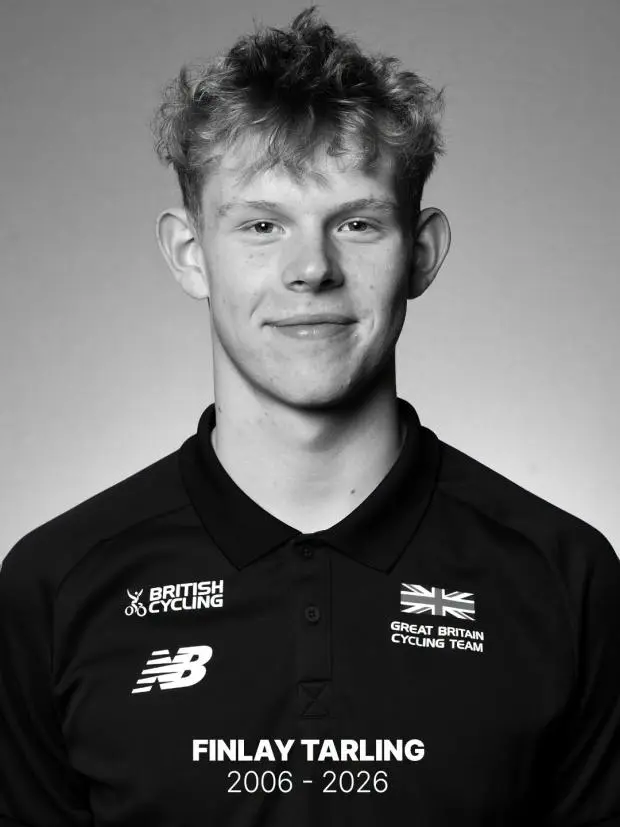
Finlay Tarling, 19, rode for the NSN development team. He was killed on Friday, on the eighth stage.
The Guarda Nacional Republicana (GNR), Portugal’s national gendarmerie, which has opened an investigation, has set out some details of how events unfolded. Like many races, the Volta a Portugal runs with what is known as a rolling road closure, held by officers and volunteer marshals: once the convoy has passed, the road can reopen.
It also described the shape of the race at that moment: the peloton had split into three groups, and Tarling was one of three riders who had been dropped, on a descent. The vehicles at the back — one car and two motorbikes — were adapting to that situation; the escort, according to Colonel Canatario, “was unable to follow Tarling”.
According to Colonel Carlos Canatario, the van driver came onto the route via an access road, after waiting at the closure. “We know that he stopped at the access road, that he saw the peloton go past, that he waited a while and that he asked passers-by whether the race was over. They are said to have told him that the last riders had gone through and that he could drive,” the officer reports.
The GNR also explains the limits of the arrangement: “It is impossible to post an officer at every access point along the route.” Priority, it says, “is given to the access points where the risk of vehicles and people entering the route is highest”. “This point was a secondary access, with no officers, but with signage.”
On the collision itself, Canatario describes a familiar trajectory: “The vehicle was travelling in the opposite direction to the race. The cyclist was cutting the corner on the left-hand lane — as riders naturally do — and that is what caused the collision.”
A hole in the system, according to the CPA
Hansen does not stop at helmets; he also points to the road closure system itself: “The organisation is [generally] very good, but what has happened is kind of a hole in the system.”
He concedes that locking everything down is out of reach: “Closing every road and every access is difficult, and it comes down to what risk the organisers want to take.”
According to road.cc, several riders in the Volta a Portugal said they had come across vehicles belonging to the public on the route that day.
The CPA responded with a statement, saying it was “speechless and filled with anger”: this is, it says, one more rider dead in professional racing. According to BBC Sport, six riders have died in road racing over the past three years. For the union, the question of helmets and that of securing race routes belong to the same file.