Bikepacking, or how the industry sold us adventure
- Brand gravel bike3 499 €
- Full bag set591 €
- Ultralight tent690 €
- Sleeping mat240 €
- Sleeping bag330 €
- GPS500 €
- Dynamo lighting472 €
- The word “bikepacking” was coined by an editor at National Geographic in 1973, but the practice — travelling by bike self-supported, off tarmac — predates it by a century; it only became a structured market in the 2010s.
- For three days self-supported, one and the same use costs between ≈ €250 (second-hand bike and generic dry bags) and ≈ €6,300 (new brand gravel bike and a full bag set): it is this gap, and not the gear itself, that is the subject.
- Modern gear really is better — more waterproof, lighter, more reliable on all surfaces; the criticism is aimed at the marketing story and at the entry ticket, not at the products.
- The cheapest way in still exists: second-hand, salvage, strapped bags. It has simply disappeared from the images.
Before the word BIKEPACKING, there was the gear
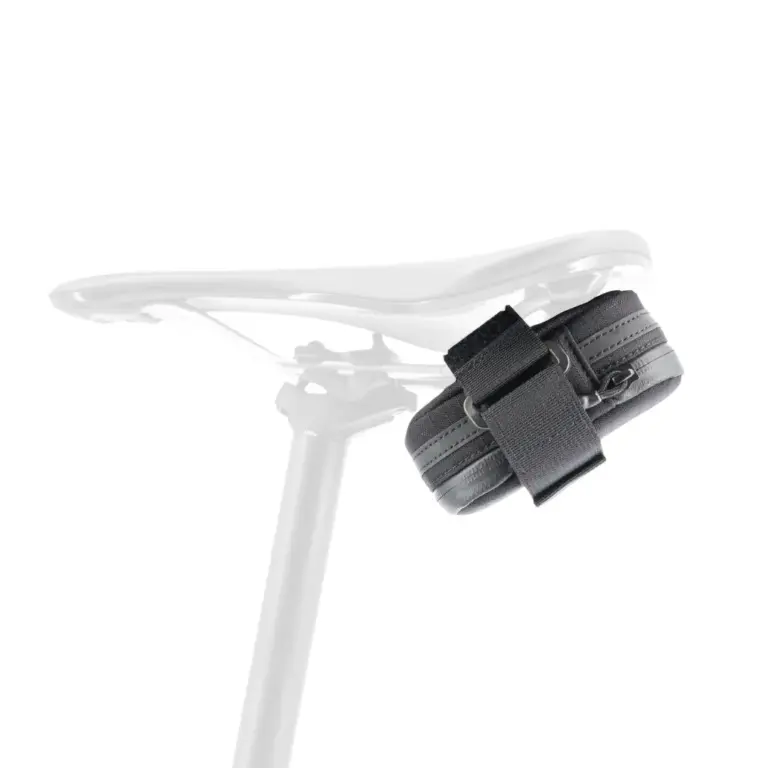
The handlebar pack on the shop wall is a beautiful object: three-layer technical fabric, radio-frequency welded seams, a compression valve, PFAS-free. Apidura sells it for €189. Next to it, a €195 saddle pack, a €145 frame pack, a €62 top-tube pack. The full set comes to more than €590 — before the sleeping bag, before the bike.
None of this existed under that name twenty years ago. The word “bikepacking” does have a precise birth certificate, though: an editor at National Geographic used it in a May 1973 article about a bike crossing of Alaska and Canada. The word then lay dormant for three decades. It resurfaced in the mid-2000s, in the United States, to describe a way of loading a bike without racks — and this time it stuck.
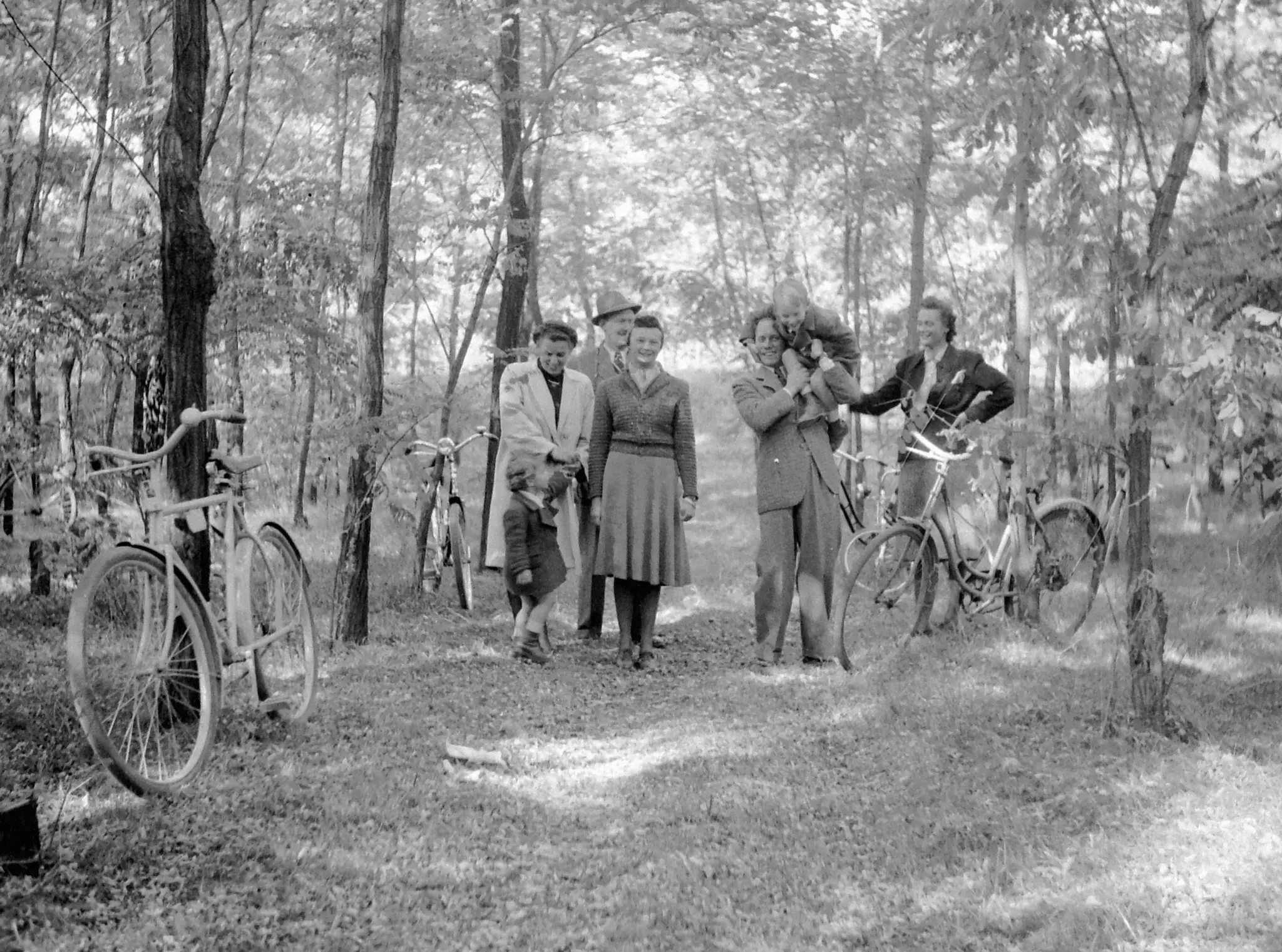
The practice itself is far older than its vocabulary. In the late nineteenth century, Paul de Vivie — a merchant from Saint-Étienne who signed his writing “Vélocio” — coined the French word for cycle touring, “cyclotourisme”, and founded the magazine Le Cycliste. He preached a discipline of frugality: ride far, eat before you are hungry, shed everything superfluous. His “commandments” have stayed in the collective memory of the scene as a moral code for travelling light. In Britain, the Rough-Stuff Fellowship met for the first time in May 1955, in a hotel in Leominster — which is what allows it to claim the title of oldest off-road cycling club in the world. Its members were riding tracks and trails long before anyone spoke of gravel, on ordinary bikes with a sleeping bag strapped on.
In other words, everything bikepacking presents as new — self-sufficiency, going off-road, travelling light — is a century old. What has changed is that you can now buy it.
From the rack to the frame triangle
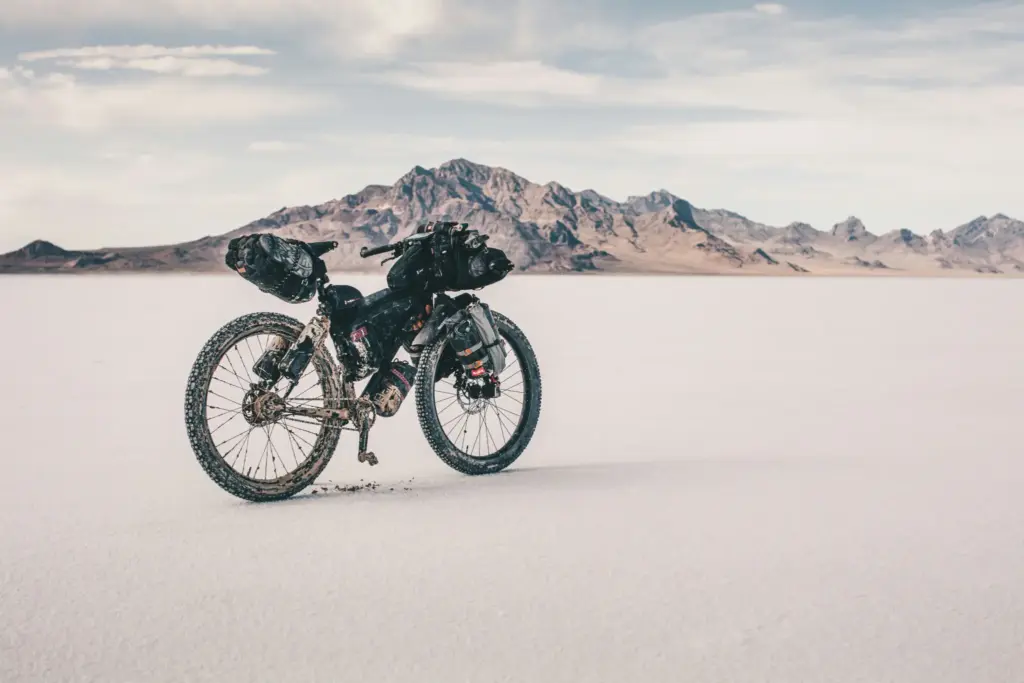
The gesture that separates bikepacking from classic cycle touring comes down to one detail: you no longer hang your luggage from a rack, you strap it straight onto the frame, the handlebar and the seatpost. That detail was born of a constraint, not a style. On a mountain bike pushed through snow or along a battered track, racks broke — welds cracked, bolts sheared. Soft bags held by straps took the punishment.
It was in Alaska that the solution took shape. Eric Parsons, founder of Revelate Designs (first named Epic Designs, set up in 2007 in Anchorage), says he had a frame bag made as early as 2002, after spotting one on a bike at the Iditarod, the state’s winter race. “When I started making frame bags, no one called what we did ‘bikepacking’,” he explains. “Putting bags on bikes was just a means for winter Alaska racers to carry what they needed.” In 2006 another maker, Jeff Boatman, brought a saddle pack to market under the name Carousel Design Works. As early as 2007, Jay Petervary won the Tour Divide — the race that follows the great North American crossing — and set its record, on a bike with no racks at all.
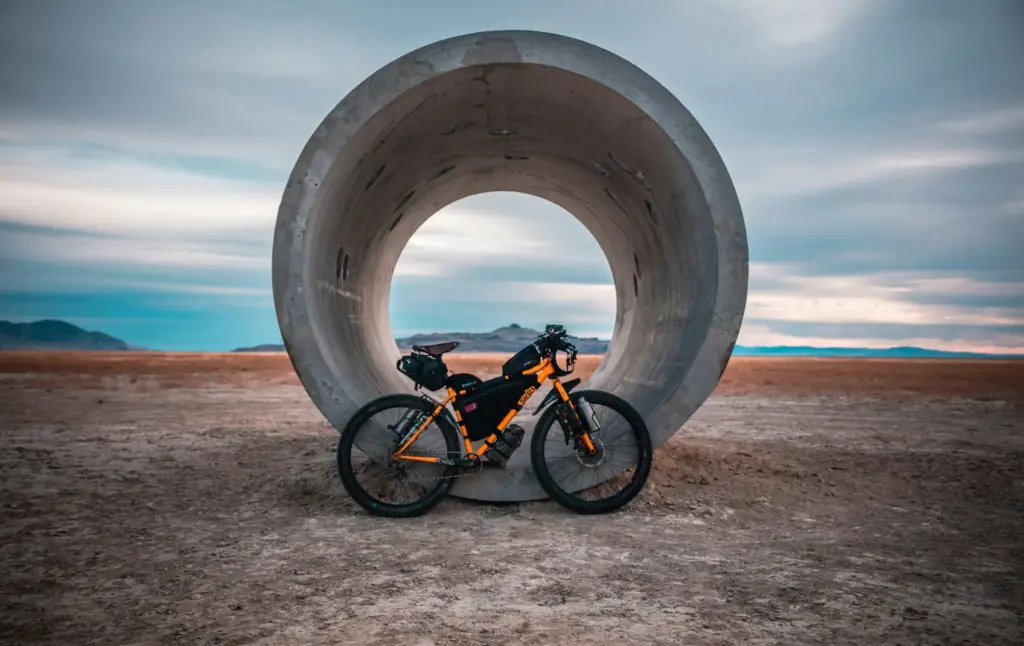
“When I started making frame bags, no one called what we did ‘bikepacking’.” Eric Parsons, founder of Revelate Designs
These races did the rest. The Great Divide Mountain Bike Route, surveyed and mapped in 1997 by the Adventure Cycling Association, links Canada to New Mexico, largely on tracks and unpaved roads; many see it as the cradle of the modern discipline. The race that follows it, which became the Tour Divide, covers 4,418 kilometres of it and supplied the founding images: one bike, three bags, a rider alone in the vastness.
There is an irony here of the kind cycling history enjoys. The frame bag, the handlebar roll, the saddle pack with no support: back in the 1890s that was already one of the very first ways of loading a bicycle. The rack and its side panniers only came to dominate afterwards, after the war. Bikepacking did not invent the soft bag. It rediscovered it — then patented, diversified and invoiced it.
Who sells what, and at what price
The waterproof pannier industry has an ancestor: Ortlieb, founded in 1982 in Nuremberg by Hartmut Ortlieb, who sewed his first bags out of truck tarpaulin. The rest of the galaxy is recent. Restrap was born in 2010 in Leeds, in a spare bedroom, where a man named Nathan first made pedal straps before moving on to bags. Apidura was launched in 2013 in London by Tori Fahey and Pierre Coeffe; after long-distance travels including the Tour Divide, Fahey had run up against the lack of technical gear. Tailfin emerged in Bristol around an engineer, Nick Broadbent, and a carbon rack funded on Kickstarter in 2016. In a few years, an accessory cobbled together in garages became a category with its own brands, ranges and codes.
France is not absent, but it is discreet. Gilles Berthoud, a framebuilder since 1977, based in Fleurville, carries on the randonneur tradition with his leather saddles and his bags — a workshop certified as an Entreprise du Patrimoine Vivant, France’s living-heritage label. A new generation of makers now sews bags to order, often one at a time: Bagera in the Ariège, the Atelier Velocidade in Mirepoix, Le Rouquin Qui Roule in Brittany, among others listed by the community. Tiny workshops, long lead times, artisan prices: the exact opposite of mass production, and a share of the market nobody puts forward.
This market is carried along by gravel, the road bike able to bite into a trail, which serves as the commercial vehicle for the practice. In France, around 3,700 gravel bikes were sold in 2019; the segment has since been one of the only ones growing, up to 75,000 units in 2025 — an 18% rise in a year, according to the Observatoire du Cycle published by the Union Sport et Cycle, France’s sports and cycling trade body.
In a bike market that is shrinking overall (€3.2 billion in 2024, down by nearly 6%), the average price of a new bike has gone from about €1,000 in 2019 to close to €2,000 in 2024. Fewer bikes are sold, but at higher prices. And they are bought in big-box stores: multisport chains, led by Decathlon and Intersport, shift 62% of the bikes sold in France — which is, incidentally, the easiest channel for kitting yourself out without going broke.
That leaves the question the imagery of the discipline never asks: what does “setting off on an adventure” actually cost? The figure of €5,000 circulates as if it were obvious. It is a figure of speech, not a measurement. To replace it with a real gap, we put together three baskets for one and the same use — three days self-supported, wild camping, all-road — from public prices recorded online on 19 July 2026.
| Item | Brand · model | Price inc. VAT |
|---|---|---|
| Gravel bike | BMC URS TWO, GRX 12-speed, carbon (2026) | 3 499 € |
| Handlebar pack | Apidura Expedition Handlebar Pack 14 L | 189 € |
| Saddle pack | Apidura Expedition Saddle Pack 16 L | 195 € |
| Frame pack | Apidura Expedition Frame Pack 4.3 L | 145 € |
| Top tube pack | Apidura Expedition Top Tube Pack 1 L | 62 € |
| Tent | MSR Hubba Hubba Bikepack 2 | 689,90 € |
| Sleeping mat | Therm-a-Rest NeoAir XLite NXT | 240 € |
| Sleeping bag | Sea to Summit Spark | 329,90 € |
| GPS | Garmin Edge 840 | 499,99 € |
| Hub lighting | Dynamo hub (DT Swiss/SP) + front light | ≈ 472 € |
| Total | list / street | ≈ 6 320 € / 5 370 € |
| Item | Brand · model | Price inc. VAT |
|---|---|---|
| Gravel bike | Cube Nuroad One FE, aluminium, Shimano Cues (2026) | 1 069 € |
| Handlebar pack | Ortlieb Handlebar-Pack 9 L | 99,99 € |
| Saddle pack | Ortlieb Seat-Pack 16.5 L | 149,99 € |
| Frame pack | Ortlieb Frame-Pack Toptube 4 L | 109,99 € |
| Tent | Decathlon MT900 2-person (Simond) | 249,99 € |
| Sleeping mat | Decathlon MT500 Air (size L) | 49,99 € |
| Sleeping bag | Decathlon MT500 10 °C | 59,99 € |
| Lighting | Decathlon Elops FL920 USB | 22,99 € |
| Navigation | Smartphone + handlebar mount | ≈ 15 € |
| Total | ≈ 1 830 € |
| Item | Brand · model | Price inc. VAT |
|---|---|---|
| Bike | Second-hand (rigid MTB/hybrid) — or borrowed | ≈ 150 € |
| Dry bags | 2 × Forclaz 25 L dry bag | 35,98 € |
| Fixing | 3 × Elops bungee strap | 19,47 € |
| Sleeping bag | Quechua Arpenaz 15 °C | 19,99 € |
| Sleeping mat | Quechua MT100 foam mat | 7,99 € |
| Lighting | Decathlon Elops FL920 USB | 22,99 € |
| Navigation | Smartphone already owned | 0 € |
| Total | including ≈ €150 for the bike | ≈ 256 € |
The whole of basket C (€256) fits inside the start of basket A’s “bike” line alone. It is not one item that makes the bill: it is the accumulation.
The gap speaks for itself. The same trip, the same weather, the same three nights outdoors cost twenty-five times more in the shop-window basket than in the make-do one. The “€5,000” was not wrong; it was simply incomplete. Kitted out new and in-brand, you go past it.
Weight as a religion
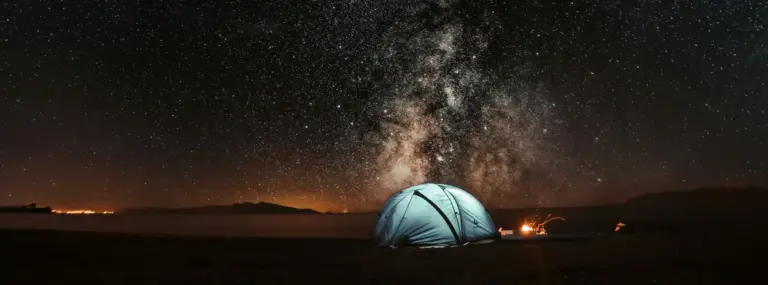
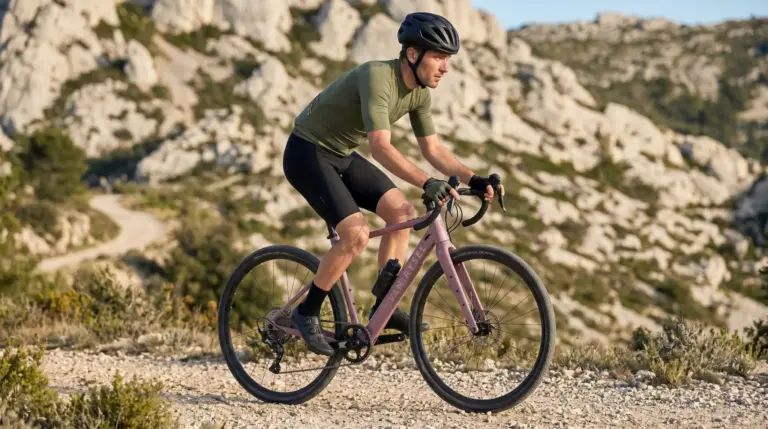
The whole art of adventure marketing lies in this paradox. It sells stripping back by means of products, and freedom by means of spec sheets. The imagery is well drilled: a tiny cyclist in an enormous landscape, low raking light, not a town on the horizon. Yet the implicit message is aimed, first of all, at city dwellers who dream at weekends of what the photograph promises.
The gear test has replaced the travel story as the dominant content. What gets told is less where you went than the gram you saved getting there. The loaded bike, photographed leaning against a rock at first light, has become a genre in itself — the “rig shot” — where the object counts as much as the journey. The race to ultralight — each season a slightly slimmer bag, a slightly dearer tent — quietly shifts the point: we have gone from “travelling” to “performing”. Voices inside the scene itself are uneasy about it: the reference publication Bikepacking.com published a piece with a blunt title, “Has Marketing Ruined Bikes?”, about this drive to over-specialisation.
This shift comes with an entry ticket, real or imagined. In forums and guides it often boils down to a formula: a thousand euros of gear, plus a three-thousand-euro bike. The three baskets show that this threshold is in no way compulsory. But it has settled in as a mental norm — the kind that makes people give up before they have even tried, and turns a three-day ride into a shopping project.
The caricature has to be refused, though, because it would be dishonest. Modern gear really is better. The roll-top closures and welded seams of an Ortlieb or Apidura bag keep water out far better than yesterday’s waxed canvas; TPU-coated fabrics have made it possible to do away with the most polluting perfluorinated treatments; and strapped bags, precisely because they depend on no rack, break less often than steel stays on a shaking track. These are not advertising claims: they are measurable improvements. The problem is not that these objects are good. It is that we ended up believing they were the condition for setting off.
Those who leave with almost nothing
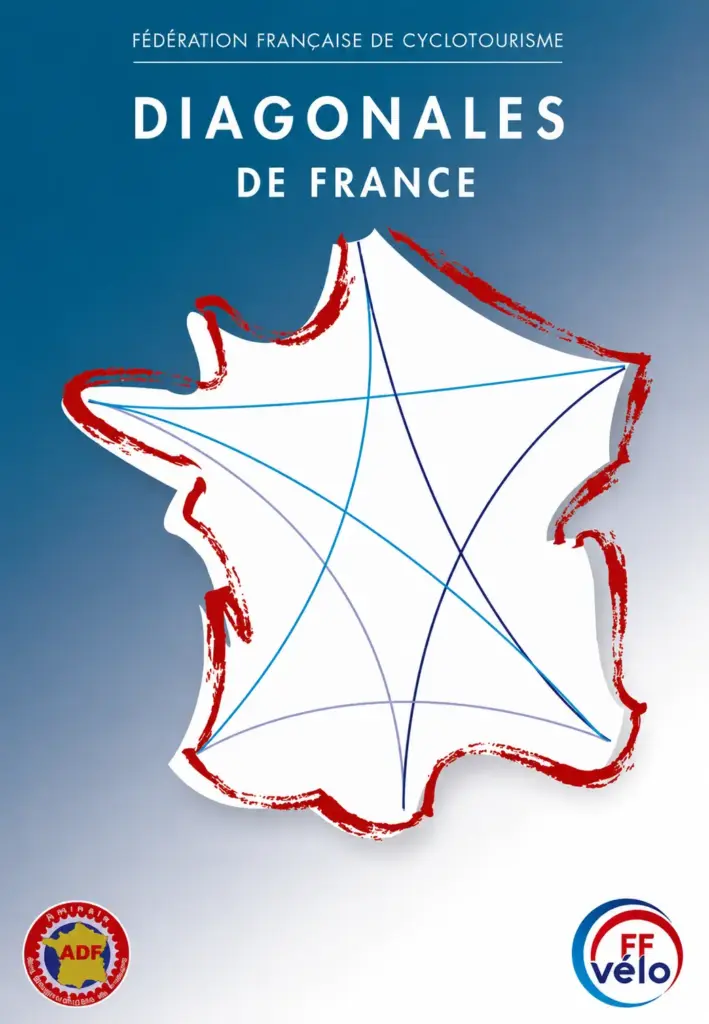
They have never stopped existing, and they are the breathing space in this story. In France, the randonneur tradition has rested for more than a century on a principle foreign to performance: Paris-Brest-Paris, born in 1891 and run in its randonneur form since 1931, still lines up 1,200 kilometres covered self-supported, with no classification, on bikes that are often perfectly ordinary. The Diagonales de France, created in 1930 on an idea of Vélocio’s, are not a single route but a network: nine lines between the six corners of mainland France — Dunkirk, Brest, Hendaye, Perpignan, Menton and Strasbourg. Each is ridden by bicycle and unsupported, within a set time limit that works out at close to 285 kilometres a day, and “with no competitive spirit”. You ride them with what you have.
The cheapest way in, too, is still open: a salvaged bike, a few generic dry bags, some straps. The second-hand market, which has boomed in recent years as we reported here, has made decent kit affordable for a few hundred euros. And the ultra-distance scene is a regular reminder that frugality has not deserted the top level: Lael Wilcox rode around the world in 108 days with radically frugal equipment. The lesson of these rides is not a moral one. It is factual: what is most lacking on a long bike journey is almost never gear.
Adventure has no price. Equipment does.
Bikepacking has done a real service: it brought back into fashion a practice that car dependency had pushed aside, and it genuinely improved the objects that serve it. What it sold at the same time is a belief — that self-sufficiency is bought, and that it costs a lot. The three baskets say otherwise. Between €250 and €6,300, the trip is the same; only the bill changes. The industry put a price on adventure. It never managed to make it compulsory.
- “A History of Bikepacking”, Bikepacking.com — bikepacking.com
- Revelate Designs, “Our Story” — revelatedesigns.com
- “The Rough-Stuff Fellowship”, Cyclist — cyclist.co.uk
- Paul de Vivie (Vélocio), Musée d’Art et d’Industrie, Saint-Étienne — mai.saint-etienne.fr
- Great Divide Mountain Bike Route, Adventure Cycling Association — adventurecycling.org
- “Tour Divide”, Wikipedia — en.wikipedia.org
- Apidura, “About Us” — apidura.com
- Restrap, “Our story” — restrap.com
- Tailfin (Cyclist) — cyclist.co.uk
- Gilles Berthoud / Berthoud Cycles — berthoudcycles.fr
- Register of bag makers, France Bikepacking — francebikepacking.com
- Observatoire du Cycle 2025, Union Sport et Cycle — unionsportcycle.com
- Paris-Brest-Paris randonneur, Audax Club Parisien — audax-club-parisien.com
- “Diagonales de France”, Wikipedia — fr.wikipedia.org
- “Has Marketing Ruined Bikes?”, Bikepacking.com — bikepacking.com
- Prices recorded on 19/07/2026: materiel-velo.com, alltricks.fr, decathlon.fr, snowleader.com