IN BRIEF
The UK Department for Transport has laid its third report on the national cycling and walking strategy (CWIS) before Parliament. On the table: £4.5 billion (a little over €5 billion) to help English local authorities develop active travel, with a target set for 2035 — 55% of short urban trips made on foot or by bike. The same report takes stock of the previous plan, and the verdict is harsh: the goal of doubling cycling by 2025 will not be met. Striking detail, cycling is growing mainly among the under-17s and the over-40s, but is clearly falling among 17-39 year-olds.
The document was a long time coming. Due in early 2025, it slipped by a year — the time needed to absorb the UK general election of summer 2024, then the spending review that followed. The third report on the Cycling and Walking Investment Strategy (CWIS) was finally laid before Parliament on 12 June, with one headline figure: £4.5 billion for walking, cycling and wheelchair travel in England.
Four and a half billion handed to local authorities
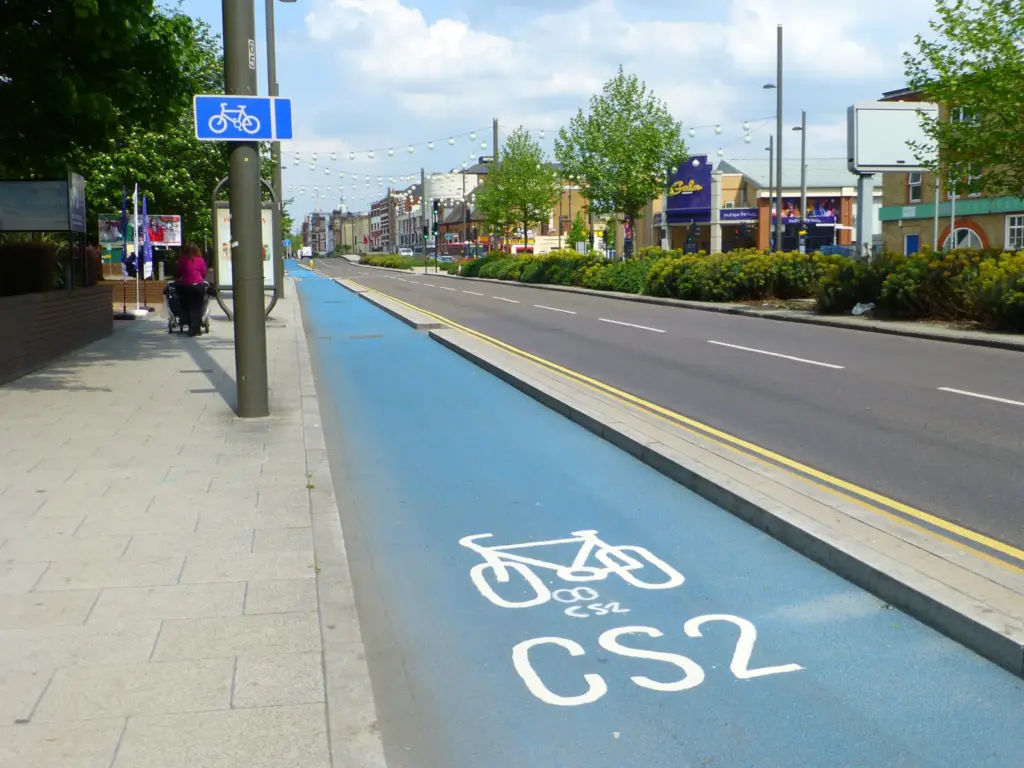
On paper, this envelope is meant to “enable local authorities across England to embed active travel in their local transport networks, so that everyone benefits”, the report sums up. In practical terms, the government is aiming for continuous, safe cycle networks around schools, and wants to strengthen local authorities’ resources: engineering, oversight, the capacity to turn an intention into a scheme actually built.
The plan also promises to map safe routes and display them in journey-planning apps, with consistent signage and road markings across England, by the end of the period covered (2025-2026 to 2029-2030).
Unusually, the report acknowledges that the Department for Transport “can sometimes be slow to support local authority innovation”. A dedicated £10 million fund, the Streets Innovation Fund, will therefore finance trials intended to encourage active travel and improve road safety. It is also a way of turning the page: the previous government had cut £200 million from the active travel budget.
Heidi Alexander, Secretary of State for Transport, and Lilian Greenwood, Minister for Local Transport, sign the report’s foreword:
Our aim is that by the end of this period we will have laid the foundations for a more strategic approach to investing in active travel: innovation supported and encouraged, real progress on walking, wheeling and cycling to school, a coherent national network to frame future decisions, and local authorities equipped to extend that network to meet our 2035 objectives.
Heidi Alexander and Lilian Greenwood, foreword to the CWIS3 report
Doubling cycling: the target will not be met
The same report settles the account of the previous plan along the way, and the glass is clearly half empty. In 2021, the CWIS2 strategy set out a clear target: to double cycling, going from 0.8 billion “trips” in 2013 to 1.6 billion in 2025. The report works in trip stages — a journey combining several modes counts as several stages.
The numbers do not add up. In 2024, English residents made around 1 billion cycling trips. The report notes a 15% rise since 2013: real, but a very long way from the doubling targeted. Another 0.6 billion trips were still missing to come close to the 1.6 billion target.
Older riders keep pedalling, young adults drop out
This is probably the most intriguing part. Behind the average — a 6% rise in the number of cycling trips per person between 2013 and 2024 — lie opposite trajectories depending on age.
Cycling is growing at both ends of the age pyramid: among the under-17s, and above all among 40-69 year-olds. The 60-69 age group even posts the sharpest rise, +61%. At the other end, 17-39 year-olds are cycling less, with the drop steepest among 17-20 year-olds, down 42%.
Another notable shift: cycling has risen sharply among ethnic minorities (+57% cycling trips on average between 2013 and 2024), against +8% for people identifying as White.
An appointment required by law
This stocktake is anything but optional. Since the Infrastructure Act of 2015, the Secretary of State for Transport has been required to report to Parliament at regular intervals on progress made on the cycling and walking strategy. This third report follows on from the second, published in July 2022, and closes the period covered by CWIS2 (April 2021 to March 2025).
What remains is the gap, now quantified, between stated ambition and the ground. The £4.5 billion is on the table; the 2035 target — 55% of short trips on foot or by bike — will be less easily secured. The previous plan, too, aimed high.