IN BRIEF
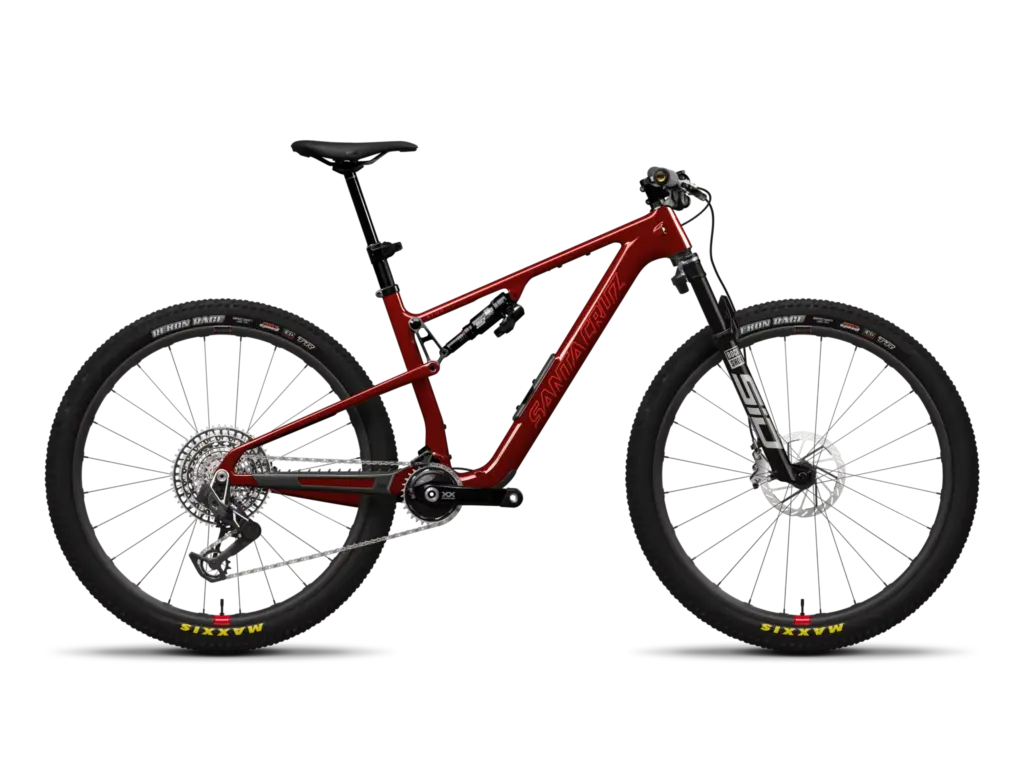
Santa Cruz has renewed its Blur, the Californian brand’s cross-country full-suspension bike. Travel rises to 120 mm at the front as well as the rear, on a frame offered in CC carbon only, according to BikeRadar. The geometry follows suit: the head angle slackens to 66 degrees against 67.1 previously, the bottom bracket drops to 334 mm and the reach of a size M gains 12 mm, to 450 mm. The frameset is listed at €3,899 on the brand’s website; the brand offers complete bikes there from €4,999 to €12,499.
| Travel | 120 mm front and rear |
| Rear suspension | Single pivot with flex stays |
| Frame | CC carbon |
| Head angle | 66° |
| Seat tube angle | 75.7° to 76.2° depending on size |
| Reach | 425 to 500 mm, in 25 mm steps |
| Sizes | S, M, L, XL |
| Colours | Matte Charcoal and Gloss Tart Cherry |
| Weight of the complete bikes | 11.43 kg (CC XTR RSV) to 13.21 kg (CC Deore) |
| Frameset price | €3,899 (FOX Float SL Factory shock) |
Cross-country has little left in common with what it was ten years ago. World Cup courses look more and more like shortened enduro tracks, and the bikes are following. The Blur, the Californian brand’s cross-country full-suspension bike, takes note: the generation unveiled in early August by Santa Cruz gains travel, slackens its head angle and stretches out.
The Santa Cruz Blur 2027 moves to 120 mm all round
The figure is the same at the front and the rear: 120 mm. Santa Cruz states it on the official frameset page, where the bike is designated “Blur 5”, and BikeRadar confirms it for every version. It is the foundation of a bike aimed at two audiences at once, the cross-country racer and the light trail rider.
The kinematics, for their part, remain faithful to the previous generation: a single pivot with flex stays, with no pivot point at rear axle height. According to BikeRadar, “the Blur Mk4’s flex-stay single pivot remains, but travel goes up to 120 mm”. Santa Cruz is therefore not changing architecture; the brand is stretching what it can do.
A geometry that slackens and stretches
The changes in the figures are measurable and consistent between the sources. The head angle slackens to 66 degrees against 67.1 on the outgoing model, and the bottom bracket drops by 6 mm, to 334 mm — two changes that pull in the same direction, that of stability at high speed and on descents. The actual seat tube angle rises from 75.7 degrees in S to 76.2 degrees in XL; Santa Cruz separately publishes an effective angle at saddle height, of 75 degrees.
The reach extends from 425 to 500 mm in 25 mm steps across four sizes, S to XL. In size M, it comes to 450 mm: BikeRadar mentions a reach that is “significantly” increased, without publishing the figure for the outgoing model. The frame, for its part, comes only in CC carbon: BikeRadar notes that the “Standard” and “Race” builds all share “the same CC carbon frame”.p>
Two families of builds, from Deore to XTR
Santa Cruz splits its range along two lines. The “Race” builds get a 60 mm stem, a flat bar and Maxxis Rekon Race tyres; the “Standard” ones, more trail-oriented, a 50 mm stem, a riser bar and Maxxis Aspen AT tyres. The same bike, two temperaments.
On the scales, the gap between the two ends of the range reaches almost two kilos: 11.43 kg for the Blur CC XTR RSV, 13.21 kg for the Blur CC Deore. The frameset, supplied with a FOX Float SL Factory shock, is listed at €3,899 on the brand’s website, in Matte Charcoal or Gloss Tart Cherry. Complete bikes run from €4,999 to €12,499 on the brand’s website, a range that BikeRadar reproduces identically.