The Long Ride
The second-hand bike market has exploded. Now it’s a headache.
While new bike sales are sliding, second-hand is climbing. Start-ups valued in the hundreds of millions are refurbishing e-bikes by the tens of thousands, Decathlon has turned it into a growth engine, and private sellers are trading bikes at a pace nobody can really measure. But behind the green bargain lies a minefield: stolen bikes, batteries on their last legs, prices with no benchmark left. Anatomy of a market that grew too fast to give itself any rules.
In brief
- The new bike market has been shrinking since 2023 (−14% by volume, 2.23 million units), weighed down by a giant overstock inherited from Covid — and that destocking has crushed prices, for new and second-hand bikes alike.
- Second-hand and refurbished bikes, on the other hand, are growing: a professional industry has taken shape around Upway, Buycycle and Alltricks, with funding rounds counted in tens of millions.
- For the buyer, it has become a minefield: nearly 300,000 bikes stolen every year in France, serial numbers erased, and above all e-bike batteries whose real wear is almost impossible to check.
- The environmental argument is solid — most of a bike’s carbon footprint comes from making it — but it has its grey areas too.

The great reversal
To understand it, you have to go back to the pandemic. In 2020 and 2021 the bicycle became the object of the moment: people fled public transport, rediscovered emptied streets, and the French government subsidised repairs. Demand exploded, industry could not keep up, delivery times stretched to several months. Manufacturers then ordered massively, convinced the party would last.
It did not. In late 2022, demand fell as sharply as it had risen. The French market went from nearly 2.8 million bikes sold in 2021 to 2.6 million in 2022, then 2.23 million in 2023 — a 14% drop in a single year. In 2023 the electrically assisted bike even recorded its first decline in thirteen years (−9%, 671,000 units), although it still accounts for a third of sales by volume and the dominant share by value.
Yet the sector’s value did not collapse: €3.435 billion in 2023, a limited fall of 5.5%. The reason? The average price of a bike climbed to €978 (+7% in a year), pulled up by non-electric models (+11%) while e-bike prices stayed flat, just under €2,000. In other words: fewer bikes sold, but at higher prices.
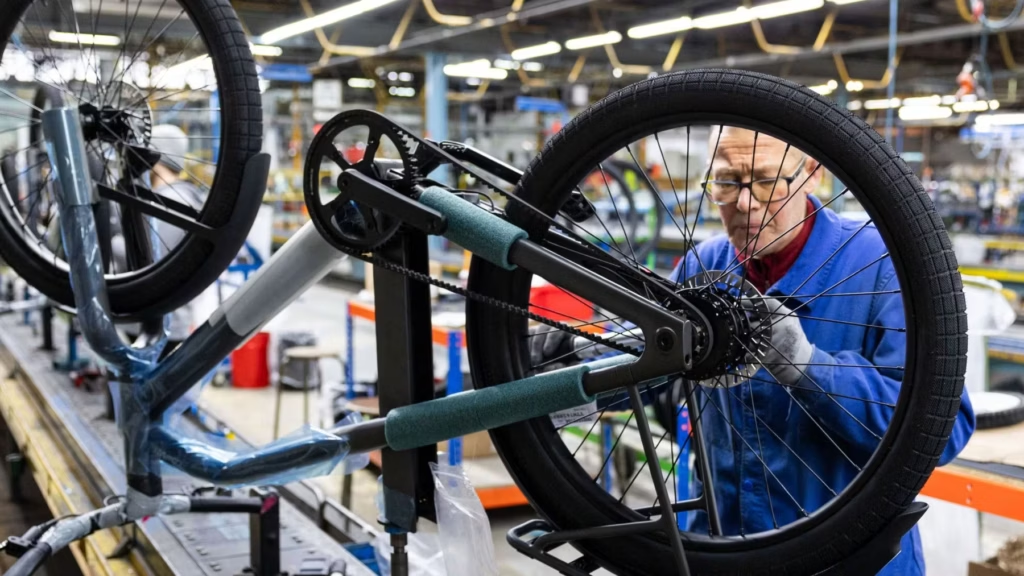
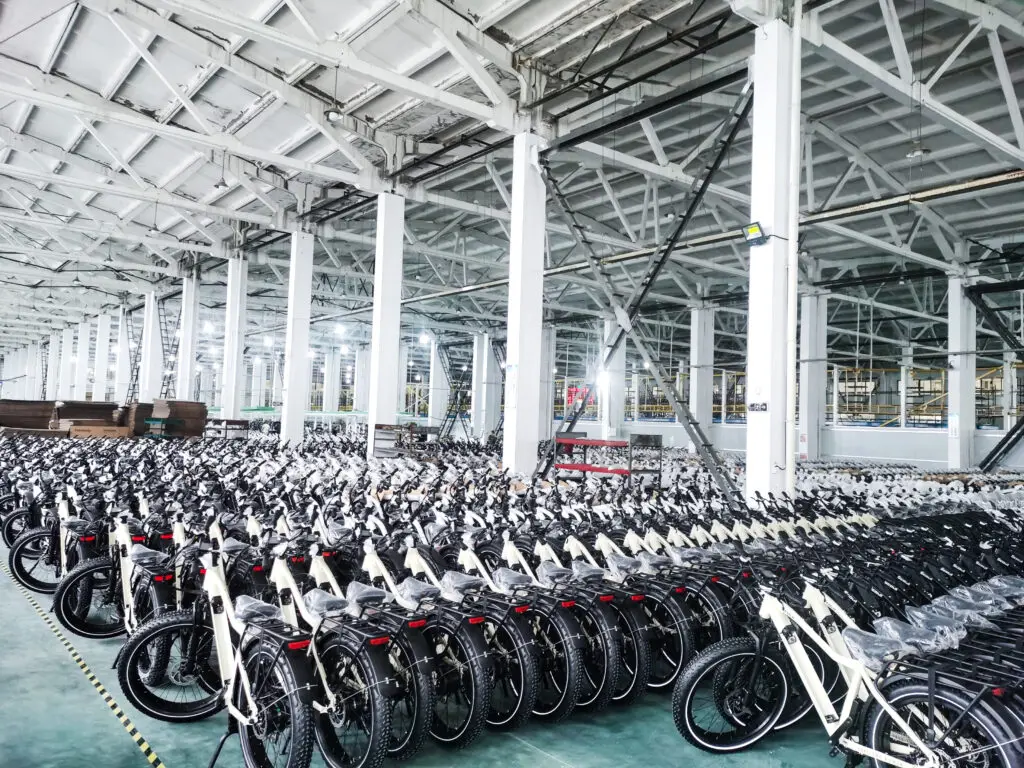
The real poison is what sits in the warehouses. By early 2024 the whole supply chain found itself carrying “overstock” estimated at four months of sales — a textbook case of the “bullwhip effect” that hits industries after a supply crisis. To shift those mountains of frames, manufacturers and retailers had only one option: slash prices. And when discounted new bikes flood the market, second-hand benefits in turn, its own prices dragged downwards.
It is against this depressed backdrop that another curve is rising. According to the Observatoire du Cycle, the French cycle industry’s monitoring body, nearly 178,000 second-hand and refurbished bikes were sold through professional channels, up around 13% — including some 34,000 electric ones. Repair work, for its part, has jumped by more than 100% since 2019: three times more bikes are now repaired than new ones are sold.
The great crossover
New is going down, second-hand is going up
Two opposing trends, on very different scales: new bike sales in millions of units, professional second-hand and refurbished sales in thousands.
The most striking thing is that these figures tell only a fraction of the story. The Observatoire counts only sales made through professionals. The entire private-to-private market — the bulk of transactions, on Leboncoin, France’s main classified-ads site, and elsewhere — escapes measurement. Nobody really knows how many bikes change hands in France each year. All we know is that it is a lot, and that it is growing.
The new second-life industry
Until recently, buying a second-hand bike was a small game of trust between strangers over a classified ad. A handful of companies decided to turn it into an industry.
The most emblematic is French: Upway. Founded in 2021 by Stéphane Ficaja and Toussaint Wattinne, the start-up buys used electric bikes, restores them in its own workshops following a 50-point inspection protocol, warranties them for a year and resells them at an average discount of around 45% against new. The model has convinced investors beyond all reason for such a down-to-earth sector: in November 2025, a $60 million Series C round led by A.P. Moller Holding — the Danish holding company behind shipping giant Maersk — lifted the company’s valuation to around $400 million. In total, Upway has raised more than $125 million since it was founded.
The new giants
Second-hand goes industrial
The bet is simple: refurbishment turned smartphones into a mass market, and it can do the same for the electric bike. A new e-bike easily costs €2,000 to €4,000; the same machine, refurbished and warrantied, can be listed at close to half that. For many households, that is the difference between buying and giving up. The company claims more than 100,000 bikes already refurbished, revenue that doubled between 2024 and 2025, and the ambition to handle a million of them by 2030. It relies on a network of six technical centres — Paris, Berlin, Antwerp, New York, Los Angeles, Düsseldorf — which it plans to extend to the United Kingdom, the Netherlands and Poland.
The price gap
New vs refurbished
A refurbished, warrantied electrically assisted bike can be listed at close to half the price.
In the sports segment — road, gravel and high-end mountain bikes — it is Germany’s Buycycle that has taken the lead. Born in Munich in 2021, it secures transactions between private individuals by handling payment and shipping, and expanded to the United States after a seed round in 2023. In March 2025 it bought the French platform Biked, which specialised in refurbished premium bikes and had some 120,000 users: the deal makes it one of Europe’s leading second-hand bike marketplaces, present in around thirty countries.
And then there is the giant advancing quietly: Decathlon. Through its subsidiary Alltricks and the Troc Vélo platform, the retailer has turned second-hand into a genuine growth engine. In 2024, Alltricks’ sales of refurbished products more than doubled, to the point of accounting for almost a tenth of its bike revenue. Add to that the famous Trocathlon events, the in-person swap markets where hundreds of thousands of items change hands every year. Where Upway and Buycycle bet on tech, Decathlon bets on its footprint: stores everywhere, a reassuring brand, logistics already in place.
The buyer’s headache
This professionalisation has one merit: it reassures. But it covers only part of the market. On private-sale platforms, the buyer is still alone in the face of very real risks — and the first of them has a name: theft.
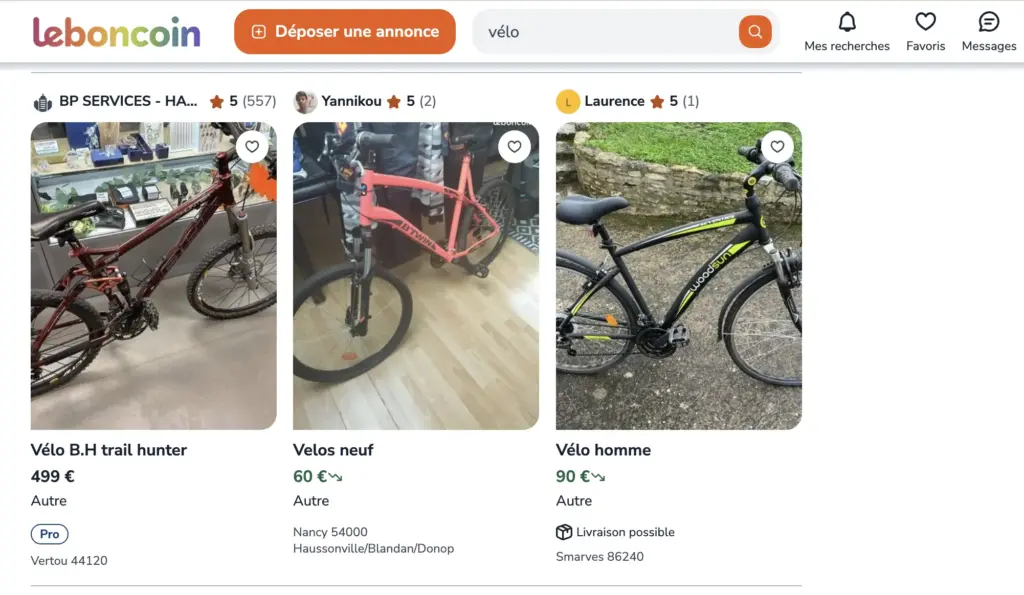
The stolen bike is the dark fuel of the second-hand market. In France, an estimated 300,000 bikes are stolen every year; police recover nearly 100,000 of them, but can almost never return them, having no way to identify the owner. A stolen bike turns up within hours on a classified ad, at an abnormally low price, sometimes with photos lifted from the manufacturer’s website. The warning signs are known to insiders: a serial number scratched or filed off the frame, glue marks where a sticker has been removed, a crudely repainted finish, a seller who refuses to send extra photos or to meet anywhere other than a car park.
Before you pay
The signals that should alert you
- Serial number scratched or filed off
- Abnormally low price
- Battery untested / condition unknown
- No FNUCI marking
France, though, has equipped itself with a tool unique in Europe. Since its mobility orientation law (LOM), frame marking has been compulsory: since 1 January 2021 for new bikes, and since 1 July 2021 for second-hand bikes sold by professionals. Every bike receives a unique identifier engraved on the frame and recorded in the national register of identified cycles, the Fichier National Unique des Cycles Identifiés (FNUCI). The register is run by APIC, an association created in 2020 by the industry body Union Sport & Cycle and the French cyclists’ federation (Fédération française des usagers de la bicyclette); it can be consulted by the police and is fed by approved operators. By the end of 2024, nearly 7 million bikes were registered, and marking generally costs between €10 and €30. In theory, then, a buyer can check that a bike has not been reported stolen before paying.
In theory. Because the system suffers from two gaping holes. First, the obligation applies only to sales by professionals: a private owner reselling to another private individual is bound by nothing. Second, the register’s effectiveness depends entirely on the owner having thought to report the theft to it. Many do not. Marking is a good idea that remains largely under-used, and in practice the careful buyer must always do their own detective work.
A price too good to be true almost always hides something: a theft, a defect, or both.
The battery time bomb
Theft may be the most publicised risk, but it is not the most insidious. On a second-hand electric bike, the real trap is invisible and expensive: the battery.
An e-bike lithium-ion battery takes on average between 500 and 1,000 full charge cycles before its capacity declines markedly, which is roughly three to six years of use. Yet nothing in a bike’s appearance betrays the state of its battery. An immaculate frame can hide a pack at the end of its life, its range collapsed, that will give up halfway up a climb. And a replacement battery often runs to several hundred euros — sometimes a third of the bike’s value.
Worse: wear does not depend on age alone. A little-used but badly stored battery — a winter in a damp garage, long months left flat — can have degraded far faster than an older pack that was looked after. The only way to get an idea is to ride the bike with the battery charged to 100%, over a distance long enough to see whether the gauge drops abnormally fast, and to ask the seller how many kilometres it has covered. This is precisely where professional refurbishers justify their premium: a player like Upway tests the battery, replaces it if needed and warranties it. Between private individuals, the buyer signs blind.
The green argument, and its grey areas
That leaves the promise the whole sector flies as its banner: buying a second-hand bike is said to be a strong environmental gesture. In substance, that is true — and for one specific reason.
Most of a bike’s carbon footprint comes not from riding it but from making it: metal extraction, frame production, assembly, shipping from Asia. For a non-electric bike, manufacturing accounts for more than half of emissions across the whole life cycle. For an electric bike it is even more pronounced: according to ADEME, France’s environment agency, riding one kilometre on an e-bike represents around 11 grams of CO₂ equivalent, of which nearly 80% is down to manufacturing alone — the battery counts for much of it. The logical consequence: extending the life of a bike that has already been made, rather than building a new one, is one of the most effective levers for reducing the sector’s impact. Every refurbished bike is a bike nobody had to build.
The nuance is that everything depends on what the second-hand bike replaces. A refurbished machine that takes the place of a new purchase: net benefit. But a cheap used e-bike that pushes someone to give up public transport, already very low-carbon, or a second bike bought for pure pleasure and quickly forgotten at the back of the garage: the sums are less obvious. Refurbishment does not erase the footprint, it spreads it over a longer period of use. It is real progress, provided the bike gets ridden — for a long time.
An adolescent market
The second-hand bike market has every symptom of growing too fast. It has giants before it has rules, hundreds of millions in valuation before it has standards, and a promise — cheaper, greener — that holds up but demands of the buyer a vigilance that few possess.
The direction, though, is hardly in doubt. As new bikes stay expensive and environmental awareness grows, second-hand will keep gaining ground. The real question is no longer whether this market will establish itself, but whether it can give itself the safeguards — universal frame marking, battery traceability, clear warranties — that would turn today’s headache into a simple good habit. For now, buying a second-hand bike is still something of a gamble. It is up to the buyer to load the dice in their favour.
Sources
- Union Sport & Cycle / Observatoire du Cycle (2023 and 2024)
- France Bleu / AFP
- LSA Conso
- Seconde Media / Guide Vélo / SPORTéco
- APIC (apic-asso.com) / BicyCode / Que Choisir
- LOEWI / Backpower
- ADEME / Natura Sciences