IN BRIEF
Lime has cut off hire of its shared bikes in the London borough of Bromley, in the south-east of the capital, after a blind resident described having to walk in the road to get around bikes parked across the pavement. Contacted by the couple, MP Liam Conlon took the matter up with the council and the operator. The council said Lime appeared to be operating in the borough without its authorisation, and the company blocked hire in its app; the council warned that it would remove the bikes and charge the costs if the problem continued. Lime has apologised and is now working with the council on parking solutions.
The debate around shared bikes is usually fought over principles: clutter, regulation, the sharing of public space. Between Lime and Bromley, it was fought over a pavement in Penge and a guide dog that refused to move forward.
A blocked pavement, a road to cross
Jason Beal, a blind Penge resident, told the British press what happens to him when a Lime bike blocks the pavement. « There, I have to stop, Kent House Road is quite a busy road », he explains. « He [Caine, his guide dog] will always refuse to step onto a road », Jason Beal says. « So I have to make the decision to try to take him onto the main road. It is a very frightening experience for me. »
The account describes a simple mechanism: an obstacle on the pavement forces you down onto the road, exactly where the guide dog is trained not to go. The constraint therefore bears on everyday travel, not on a one-off inconvenience.
Lime was operating in Bromley without formal authorisation
Jason Beal, an assistive technology manager, and his wife Jessica, who is also blind, took the case to their MP, Liam Conlon, who raised it with Bromley Council and with Lime. That is the point at which the matter changed in nature. According to road.cc, the borough’s executive councillor, Simon Fawthrop, found that Lime was operating in the area « without formal authorisation ». Still according to road.cc, it was after a threat of impound charges that the company blocked hire across the whole borough. Simon Fawthrop, quoted by the PA news agency, says for his part that he had « already raised his concerns » with Lime and welcomes a change that « seems » to have taken place; he warns that if the problem does not stop for good, the council will remove the bikes and charge the costs to the company. The company, for its part, explained in comments reported by LocalGov that a mapping error had allowed hire in certain parts of the borough, including Penge, without the council’s agreement.
In practice, it was the app that settled the matter: according to the PA news agency dispatch, Lime prevented its bikes from being « used beyond the Lewisham boundary, until we can agree an approach ». The service therefore disappeared overnight for the residents who were using it.
« We want people to keep cycling and walking »
Jessica Beal’s reaction, quoted by PA, sums up the ambiguity of the outcome rather well: « It feels like a victory, even though obviously we want people to keep cycling and walking. » The withdrawal of an operator solves one accessibility problem while creating another for the neighbourhood’s mobility.
The MP, for his part, welcomed the decision: « I am delighted that Lime has announced the removal of its bikes from Penge — and I would like to thank them for their cooperation and for their apology. » He adds, in comments reported by road.cc: « We cannot allow new barriers to be created for disabled residents who already face difficulties getting around. As a disabled person myself, who was unable to walk for four years as a teenager, I understand these issues first hand. »
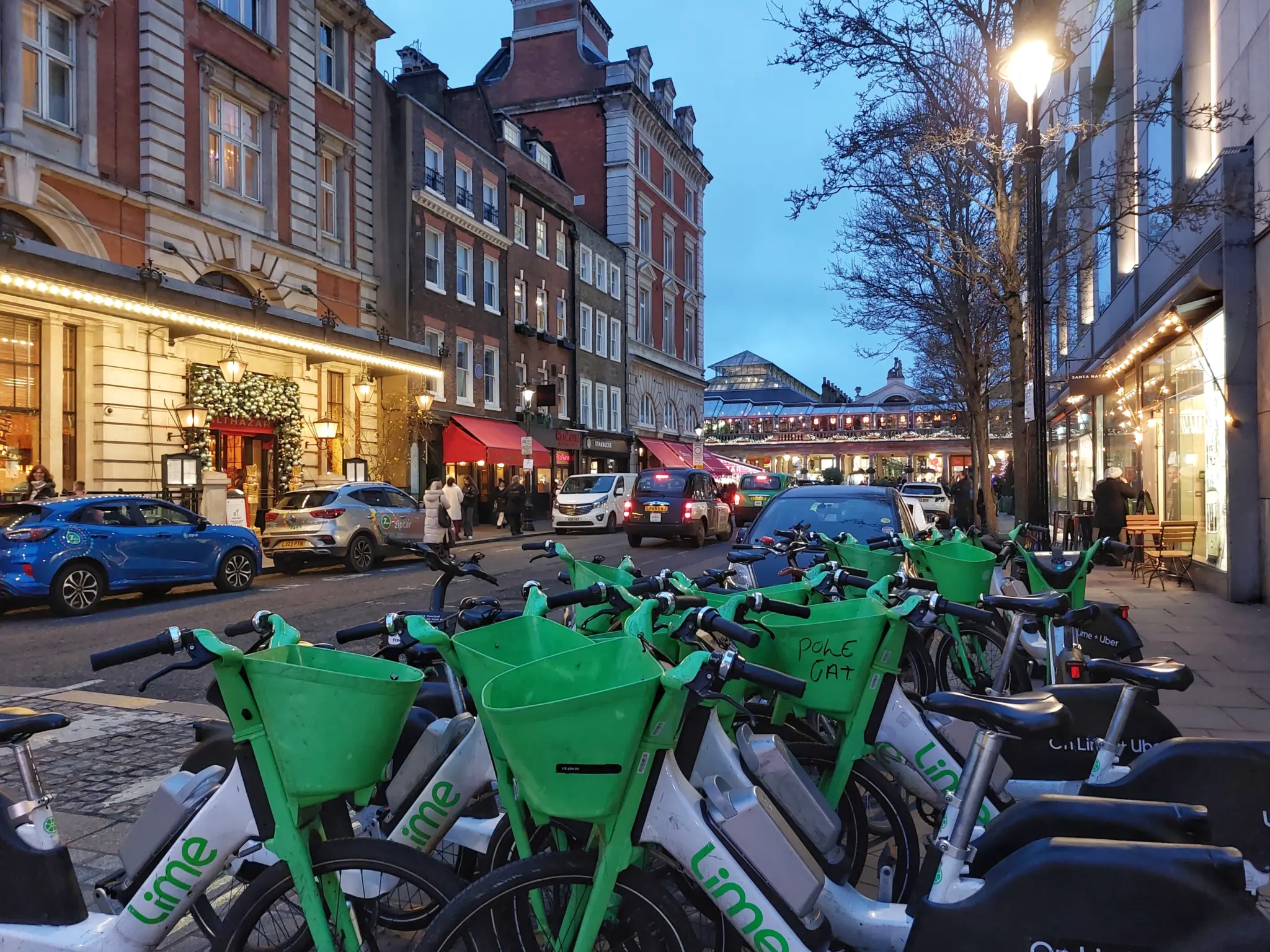
What happens next turns on parking. According to road.cc, Lime is now working with Bromley Council on rolling out a scheme encouraging « appropriate » parking solutions and preventing pavement clutter. This is the friction point specific to free-floating services: the freedom to drop the bike wherever you like is what makes the service convenient, and it is also what it gets criticised for.
Opening photo: illustration — Acabashi / Wikimedia Commons (CC BY-SA 4.0).